
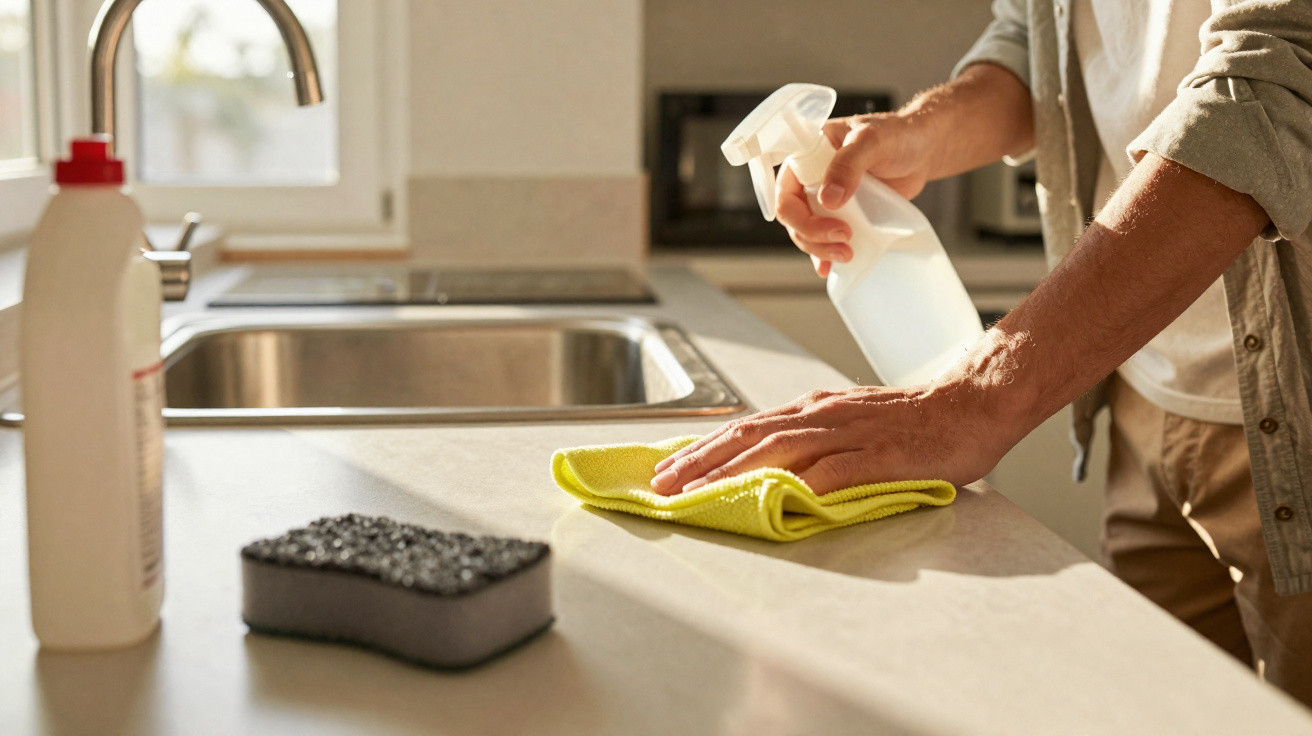
You wipe everything down, take a step back and feel strangely pleased with yourself. Ten minutes later, the kitchen could pass for a magazine photoshoot.
What remains unseen is the gradual harm developing beneath that gleam: minute scratches, fading colour and a tacky layer that never fully disappears. It is the sort of deterioration you spot only once it has gone too far, when the surface looks worn regardless of how much you scrub.
This is not about choosing the wrong cleaner. It is a minor everyday error that silently damages worktops, floors and screens: a move many of us make automatically because we watched our parents do it.
It begins with an overly generous spray and a cloth that is not quite clean.
The everyday cleaning habit that slowly damages your surfaces
Watch people clean at home and a familiar pattern emerges. They pick up a single all-purpose spray, soak the area, and spread the liquid using the cloth they used the day before. It appears efficient and feels satisfying. That lemon or pine fragrance delivers an immediate sense that the task is finished.
But the damp film concealed beneath the cloth is exactly where surfaces begin to deteriorate. Cleaner gathers repeatedly in the same places, while the cloth holds tiny crumbs and dust particles and pulls them across the surface like sandpaper. You get an instant shine, but lasting microdamage. The habit is so commonplace that it rarely gets questioned.
On a marble worktop, this approach gradually strips away the polish. On laminate, it takes the sheen off the finish. On wood, too much moisture enters joins and edges, causing slight swelling that distorts the way light falls along the surface. Every quick wipe adds another layer of wear. The issue is not the cleaner itself, but the amount used, the frequency of use and the careless way it is applied.
Picture a hectic family kitchen at 7.30 pm. Pasta sauce has splattered the hob, breadcrumbs cover the floor and a streak of jam sits on the white island. One parent grabs the multi-surface spray and gives the counter four or five heavy sprays. A paper towel makes one quick pass. The dinner-time chaos has been dealt with, and everyone moves on.
Six months on, that same island has developed an oddly uneven look near the sink. The once-smooth area around the toaster feels slightly rough, and beneath the fruit bowl sits a faint ring, rather like a watermark that will not dry away. It is nothing dramatic, simply a tired appearance that clashes with the rest of the kitchen.
Manufacturers of stone and timber surfaces quietly caution against this exact pattern. Marble and granite may etch when acidic cleaners remain on them. Wood can swell after repeated soaking, even when supposedly gentle products are used. Some research into household-cleaning residue indicates that many sprays leave behind a sticky film which catches dirt, making you scrub more vigorously next time. The loop then carries on: more cleaner, more friction and more damage built into daily cleaning.
There is a clear reason this happens. Most all-purpose cleaners are intended to be used sparingly before being wiped or rinsed away. They are not designed to remain on the surface, soak in and dry there every day. Spray directly on a counter and liquid works its way into joints, gaps and small scratches. In those spots, the chemical concentration can become much greater than the label suggests.
A cloth that is slightly dirty creates the second issue. Dust, minerals from tap water and even microplastics shed from synthetic cloths can all act as abrasive grit. Each wipe creates microscratches, particularly on glossy or lacquered finishes. In sunlight, those scratches scatter light, which is why surfaces start looking hazy instead of glossy.
Across months and years, the mix of residue and abrasion alters both texture and colour. Your worktop is not simply ageing naturally; it is ageing too soon. What seems like care is actually excessive care carried out in the wrong manner. The widespread mistake is not cleaning itself, but soaking, scrubbing and leaving cleaner where it should only make brief contact.
A small change that protects kitchen, bathroom and screen surfaces
The protective adjustment is almost unexciting: do not spray directly onto the surface. Spray the cloth first instead. Use two or three short sprays, rather than a full soaking, then wipe. Where dirt is heavy, lift crumbs and grit with a dry cloth or a vacuum before introducing any liquid.
That minor adjustment restricts the amount of cleaner reaching vulnerable joins, seams and edges. The cloth delivers the product instead of the surface receiving it directly. You have greater control over moisture and avoid pools that can seep into timber or beneath appliance bases. In most cases, half the usual quantity of product achieves the same visible result.
For more sensitive materials - stone, wood, stainless steel and touchscreens - this cloth-first approach can make a quiet but substantial difference. It gives you more precise control over pressure, direction and dampness. Rather than receiving a daily bath, the surface gets a quick, focused clean.
We have all noticed a lasting ring left by a candle or plant pot and thought, “When did that happen?” Many marks like these are not caused by one incident. They result from repetition: too much moisture, too frequently, in the same location. Alongside the wrong tool, this creates a worn-looking patch that never properly recovers.
A classic mistake is combining a powerful cleaner with an abrasive tool on a delicate material: a green scouring pad on a glossy worktop, bleach-based bathroom spray on chrome taps, or kitchen degreaser on a television screen “just this once”. It produces quick results, which is why we repeat it.
Let’s be honest: nobody really follows the perfect, by-the-book cleaning routine every day, with separate cloths and labelled bottles. Life is busy, children spill juice and you reach for whatever is nearest. The aim is to remove one or two of the most harmful habits, rather than pursue perfection. Begin with less product, softer cloths and shorter contact time. Your surfaces do not need heroic efforts; they need gentler routines repeated consistently.
One professional cleaner I spoke to put it bluntly:
“Your surfaces aren’t dying from dirt, they’re dying from over-cleaning done badly.”
The statement stays with you because it reverses the usual assumption. We tend to believe that “more product = more care”. In practice, extra product often brings more residue, more streaking and more scrubbing. Every additional wipe creates another opportunity to scratch, swell or dull a surface.
A few straightforward principles can help you break the pattern:
- Use one soft microfibre cloth to apply cleaner and another clean, dry cloth to buff away residue.
- Try unfamiliar products on a concealed corner before using them across the main surface.
- Keep a genuinely neutral cleaner for routine use, reserving stronger formulas for occasional stubborn dirt.
These are not rules intended to make you feel guilty. They are simply shortcuts to less work and rooms that look better for longer.
Rethinking “clean” so your home ages better
There is a subtle freedom in changing what “clean” means to you. Rather than chasing a chemical smell and a glass-like shine, pay attention to feel and texture. Does the worktop feel smooth after wiping, or a little sticky? Do the taps look reflective, or do fine swirls catch the light? Those small signs reveal more than any slogan printed on a bottle.
When you replace “soak and scrub” with “target and wipe”, you allow surfaces to last longer. You need fewer cleaning products and use them in ways that respect the materials you invested in: the marble chosen for its gentle reflection, the wood that makes the room feel warm and the stainless steel that ought to remain crisp-looking in ten years.
This is not about perfectionist housekeeping. It is about matching daily actions to the materials that make up your home. A few quieter, more considered habits practised over several months will always outperform a frantic weekend deep-clean. If you have already damaged part of a worktop or dulled a bathroom shelf, sharing the experience may prevent someone else making the same unseen mistake.
| Key point | Details | Why it matters to readers |
|---|---|---|
| Stop spraying directly on surfaces | Put cleaner on the cloth first, then wipe. Use 2–3 brief sprays rather than drenching the area, particularly on wood, stone and lacquered finishes. | This easy adjustment reduces chemical build-up and moisture around seams, helping counters avoid swelling, staining or losing their sheen after a few years. |
| Use separate cloths for “dirty” and “finishing” passes | Remove grime with one damp cloth, then use a clean, dry one to lift residue and buff the surface. Wash cloths regularly so grit does not build up. | It limits the fine scratches and haze created when leftover dirt is dragged around, keeping glossy finishes and screens clearer for longer. |
| Match the cleaner to the material | Use neutral pH cleaner for stone, mild soap for wood, alcohol-free spray for screens and non-abrasive cream for stainless steel. Save strong degreasers for infrequent, heavy dirt. | Choosing the appropriate formula prevents gradual etching, warping or discolouration, which cost a great deal to repair and are often blamed on “poor quality” rather than poor habits. |
FAQ
- What is the worst everyday mistake people make with cleaning sprays? Soaking the surface and allowing cleaner to sit, especially around joins and edges. The excess moisture and concentrated chemicals slowly weaken finishes, swell wood and leave a stubborn film that makes you scrub harder next time.
- Are “multi-surface” sprays genuinely safe for everything? They are made to be versatile, not magical. Most work well on sealed, hard surfaces when used occasionally and wiped away promptly. Repeated use on natural stone, real wood, piano-black appliances or televisions can dull or mark the finish over time, particularly if you do not rinse or buff it dry.
- How often should I really clean kitchen worktops? Wipe food-preparation areas every day with a mild or neutral cleaner, but use little product when no visible mess is present. Between proper cooking sessions, a quick wipe with a damp cloth followed by a dry buff will usually do the job.
- Can microfibre cloths cause damage as well? Fresh, clean microfibre is gentle. Trouble starts once the cloth is full of grit, dried cleaner and dust. At that stage, it behaves more like very fine sandpaper. Washing cloths correctly and replacing the most worn ones keeps the risk low.
- How can I tell whether a cleaner is too strong for my surface? Check for wording such as “heavy-duty”, “degreaser”, “limescale remover” or strong fragrances, and always test it in a hidden area. If that spot becomes dull, sticky or paler after it dries, the formula is too harsh for regular use.
- Is vinegar a safe alternative for every surface? Vinegar is acidic. It works effectively on glass and some tiles, but can etch natural stone, harm certain sealants and corrode some metals over time. Treat it as a targeted cleaner rather than an all-purpose everyday option.



Comments
No comments yet. Be the first to comment!
Leave a Comment