
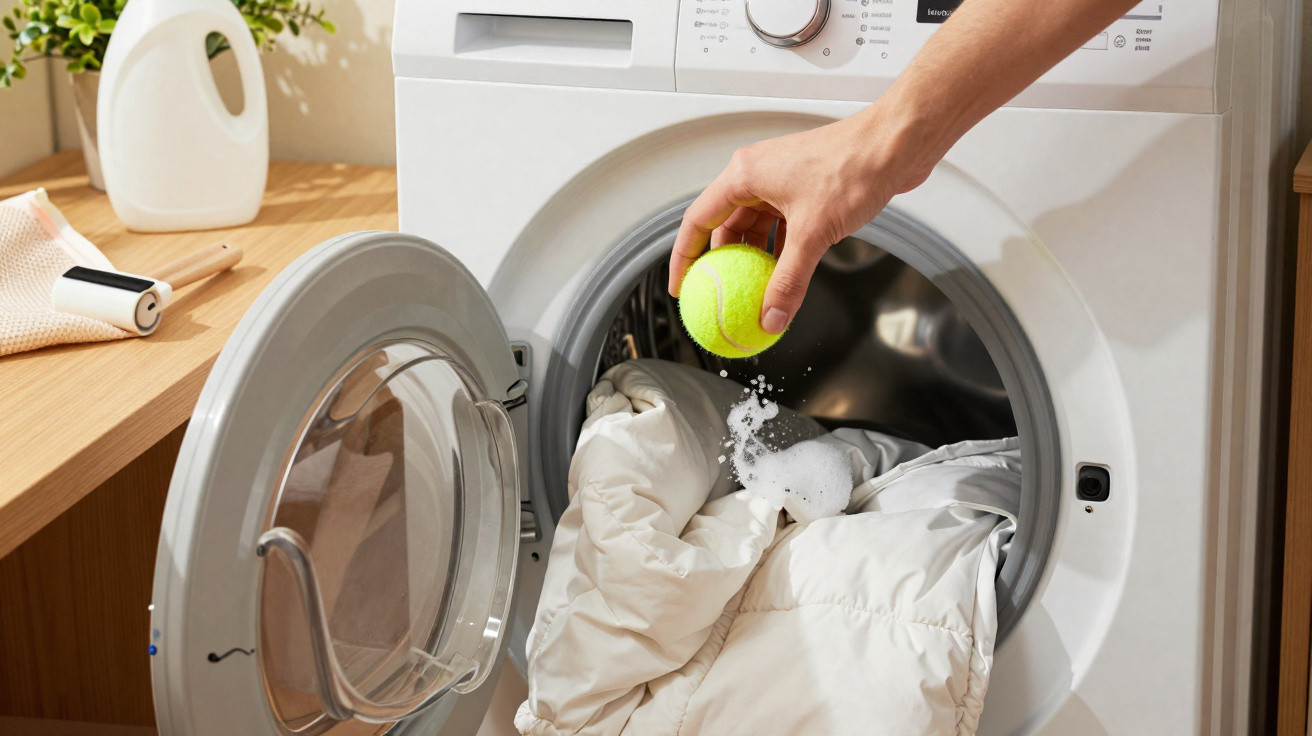
The laundry room was already warm when the cycle chimed: that muted little sound meaning, “Come deal with this.”
Inside the drum sat a twisted, weighty heap of towels and a favourite hoodie. They were clean, certainly. They smelled fresh, too. Yet they still felt flat, slightly wet in the creases, and covered in those persistent wrinkles that never quite disappear.
You probably know the peculiar annoyance: you have bought quality detergent, posh fabric conditioner and perhaps even scent beads, but the washing still emerges looking exhausted.
Then somebody suggests putting a tennis ball in the washing machine. Just one.
It sounds like an odd internet tip.
But it is strangely effective.
The surprising effect of a bouncing tennis ball
At first, a tennis ball seems entirely unrelated to washing. Its place is on a tennis court, not inside a washing machine drum.
However, when the machine begins to rotate, that small ball energises the whole load. It bounces, knocks and separates items, preventing fabrics from sticking together like a damp, bad-tempered crowd.
You quickly notice how little movement there often is in a normal wash cycle: clothes simply roll around together in a bundle, while water and detergent struggle to penetrate each thick layer.
The tennis ball alters that movement.
A single bouncing object can solve something even powerful detergent cannot: how the laundry moves in the drum.
Take a heavy winter duvet. When you remove it from the washing machine, it can feel like a dense, soaking-wet brick. Its filling has gathered in clumps, the corners are flattened, and no scented capsule in the world can make it seem appealing.
Picture that same wash with 2–3 tennis balls in the drum instead.
As it turns, the balls repeatedly strike the duvet, loosening clumped filling and creating routes for water and detergent, followed later by air and heat in the dryer.
Several people on online forums describe “revived duvets” and pillows that feel almost new after being washed with tennis balls, even though they had previously tried better products and hotter programmes.
The formula stayed the same; the movement changed.
Why is that more important than adding another capful of detergent?
Detergent relies on chemistry to tackle stains, dirt and odours. It cannot separate fibres or redistribute filling. It cannot physically knock your towels back into fluffiness.
A tennis ball brings mechanical action to the wash. It prevents bulky items from forming a ball, which can trap water and detergent in the middle while the outer surface spins and hits the drum.
Reduced clumping means less moisture held inside, fewer sour smells afterwards and less of that partly dry sensation when you put items on the line.
A straightforward rubber-and-felt sphere achieves what liquids and fragrances cannot: it changes the physical conditions inside the drum.
How to use a tennis ball in your washing machine
The technique is almost ridiculously easy.
For a large item, such as a duvet, mattress protector or bulky winter coat, place 2–3 clean tennis balls directly in the drum with the washing.
For a medium-sized load of towels or sportswear, 1–2 balls will generally do. They need room to move around rather than becoming stuck in one corner.
Use your normal detergent and programme; there is no reason to choose a hotter or more intensive cycle than usual.
After the cycle begins, the balls take care of the rest: bouncing, knocking and separating items, quietly preventing your fabrics from gathering into one miserable lump.
There are, however, a few pitfalls that can turn a useful trick into a poor idea.
Worn or cracked tennis balls may shed rubber or felt, so select balls that are clean and undamaged. Some people favour purpose-made dryer balls, although a standard tennis ball is suitable for most hard-wearing fabrics.
Do not use them with highly delicate items, including lace, silk or garments with fragile embellishments. That small bouncing action can be more like a hammer against fine details.
The knocking during the spin cycle can also sound rather alarming the first time. It sounds wrong, until you see the result hanging on the line.
Let’s be honest: nobody really does this every day, but for certain types of washing, it makes all the difference.
This tip also has a slight psychological appeal.
Tossing a tennis ball into the washing machine feels playful, turning a routine and mildly dull household job into something more like a personal experiment.
Rather than simply doing what the bottle instructs, you are trying your own trick and noticing texture, weight and softness.
“I thought it was one of those fake TikTok hacks,” says Laura, 34, who first tried it on her son’s duvet. “Then it came out fluffy for the first time in months. Now I keep two tennis balls next to my detergent.”
- Always choose clean balls in good condition – with no strong odour or peeling felt.
- Begin with 1–2 balls, increasing the number only for especially bulky items.
- Avoid using them with very delicate fabrics that could snag or lose their shape.
- Put them in the dryer too, to increase fluffiness and reduce drying time.
- Listen during the first cycle so that you know the unfamiliar noise is normal.
What a tennis ball in the washing machine says about us
On the face of it, this is simply a washing tip: add a tennis ball to the machine and get fluffier towels, better duvets and fewer gloomy, damp corners.
Yet the story behind it may be more compelling than the trick itself. We buy powerful detergents, fabric conditioners with poetic names and capsules promising “cloud softness”.
Still, we struggle with heavy bedding that never dries completely, jackets that lose their loft and pillows that gradually become pancakes.
Then along comes an inexpensive bright-green ball, quietly solving the element marketing never mentions: the physics of washing.
That little bounce inside the drum also reflects how we approach everyday problems.
We often add more product when what is actually needed is a different kind of movement, a fresh perspective or one small object that changes how things work together.
You may begin with duvets and towels, then test it with sports kit, your dog’s bed or that padded jacket you have been nervous about washing. Some loads will change dramatically, while others will be only “a bit better”.
The biggest change is mental: you begin to view the washing machine less as a sealed black box and more as something you can modify, fine-tune and almost hack.
| Key point | Detail | Benefit for the reader |
|---|---|---|
| Mechanical action | The tennis ball separates fabrics and prevents dense bundles from forming. | A more even wash, with less creasing and loftier laundry. |
| Ideal for bulky items | Particularly helpful for duvets, pillows, coats and thick towels. | Extends the life of these items and improves day-to-day comfort. |
| Low-cost tip | One simple reusable object, without chemicals or expensive gadgets. | Can reduce spending on fabric conditioner and repeated cycles. |
FAQ:
- Can I put tennis balls in any washing machine? Yes, both front-loading and top-loading machines can cope with tennis balls, provided the balls are in good condition and the drum is not overloaded.
- Will the tennis balls damage my washer or dryer? During a standard spin cycle, no. They make more noise than usual, but intact balls and a balanced load do not create extra risk for the drum.
- Do I need special “laundry” or “dryer” balls instead? They are a good option, particularly wool dryer balls, but ordinary clean tennis balls perform similarly for most sturdy items.
- Can I use this trick with every type of fabric? Avoid very delicate pieces, such as silk, lace or garments with fragile decoration. Stick to towels, bedding, sportswear and thick outerwear.
- Should I use tennis balls in the wash, the dryer, or both? You can use them in either, or in both. In the wash, they reduce clumping; in the dryer, they boost fluffiness and may shorten drying time.
Comments
No comments yet. Be the first to comment!
Leave a Comment