
The mug you genuinely want is somehow always buried at the very back of the cupboard.
The spatula you’re reaching for is still sitting in the dishwasher. There’s an extra bag of flour you don’t remember buying. Your kitchen isn’t a total wreck, but it doesn’t really support you either. Each meal leaves a thin layer of chaos behind, no matter how determined you are to “stay tidy this time”. You clear one worktop and another one seems to refill on its own. Oddly, the harder you scrub and straighten, the quicker the clutter returns. The issue may not be that your kitchen is messy. It may be that it’s organised the wrong way round.
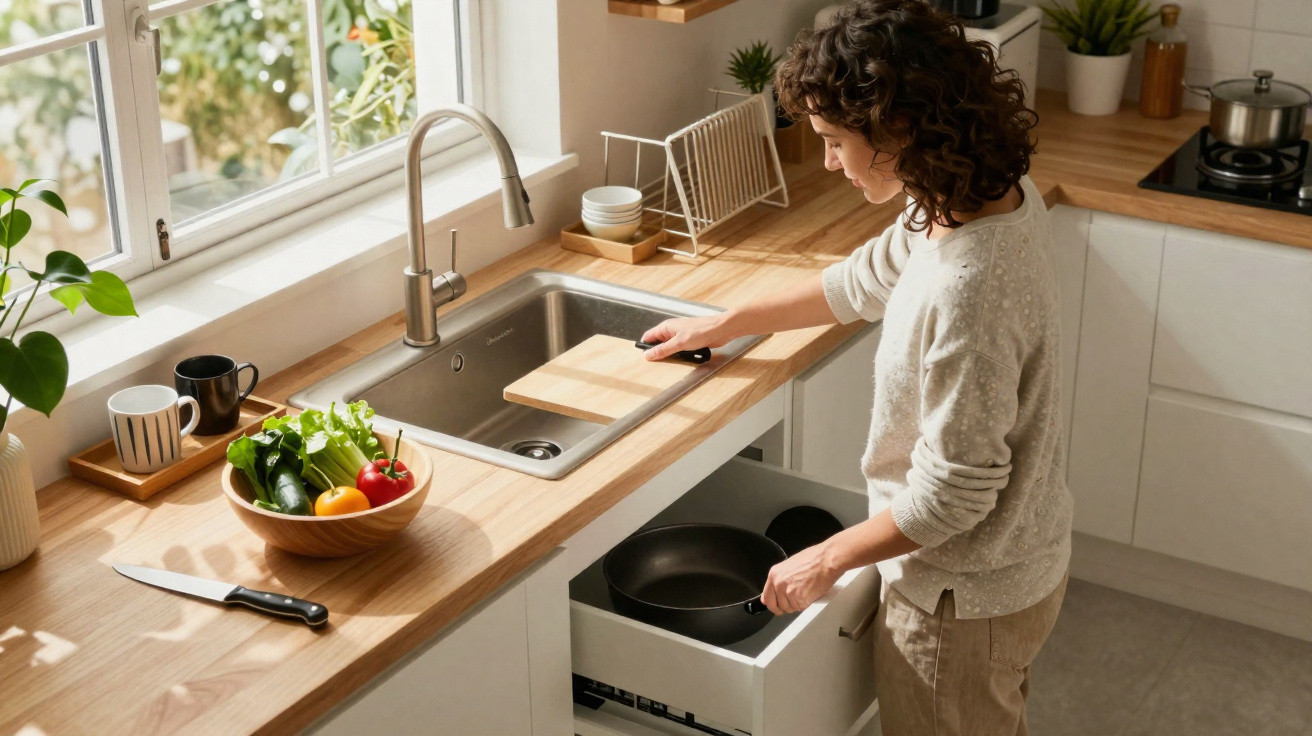
I first clocked this at a friend’s house on a Tuesday evening. She was cooking pasta, chatting on the phone, putting away the shopping and answering a child’s question about dinosaurs, all at once. Yet her very small kitchen stayed… calm. She moved as if everything had an obvious home, and nothing slowed her down. There were no cupboard doors being flung open and slammed shut. No panicked “Where’s the colander?” moment. At one point she let a dirty spoon drop, turned, and with one lazy sweep of her arm slid it straight into a drawer. That drawer was the clue.
The hidden reason your kitchen keeps fighting you
A lot of kitchens are arranged for appearance, not for real life. We line up the nice glasses, stack plates in perfect piles, and keep spices together “because that’s what you do”. Then we’re surprised when cooking feels like a minor skirmish. Every meal turns into a run of tiny irritations: a lid with nowhere sensible to live, a pan trapped under the wrong pan, a chopping board wedged behind the toaster. You might not register each annoyance deliberately, but your brain still has to deal with them. And it wears you down.
During a recent home visit, a professional organiser timed how many times a couple opened and shut cupboards while making an ordinary dinner. The total? Thirty-nine times in under 25 minutes. Every door, every drawer, every “where on earth is that?” cost them a few seconds and a little more mental effort. Over the course of a week, those micro-searches add up to hours. On a rough day, that’s what tips you from “We’ll cook something quick” to “Forget it, let’s get a takeaway.” On an easy day, it’s still energy you’d rather use elsewhere.
Here’s the quiet reality: your kitchen is only as organised as it is easy to put things away. Not how easy it is to locate them-how easy it is to return them. If taking a bowl out is effortless but putting it back means lifting three other bowls or walking to the other side of the room, that bowl will end up living on the worktop. That isn’t laziness. It’s a system that’s built around the wrong moment. Most setups obsess over access, not the reset. But the reset is where the mess starts. Flip the logic and something changes: the kitchen begins to “tidy itself”, not by magic, but because returning items becomes the easiest option.
The “drop zone” rule: a simple way to keep order with less effort
The shift that makes the biggest difference is this: organise your kitchen for putting things back, not for taking them out. Set up what I call “drop zones” - places where items can be dropped quickly (even a bit roughly) and still count as being in the right place. One drawer for “things that touch food while you cook”. One shelf for “things that belong near the hob and can handle heat”. One basket for “snacks people grab without thinking”. These don’t need to be perfect categories-just instinctive ones. The kind your half-tired brain can follow at 10 p.m.
In real terms, it might look like this. A deep drawer beside the dishwasher becomes the everything-dish drawer: plates, bowls and glasses together, including the kids’ cups. A stylist might shudder, but unloading goes from 7 minutes to 90 seconds. A low basket near the hob holds oils, salt, pepper, garlic and your two most-used spices. No more trekking across the kitchen halfway through a recipe. A tray by the sink becomes a landing spot for “floaters”: keys, post, and the odd utensil you’re not ready to sort yet. On a normal weekday, that tray stops your worktops from slowly disappearing. At the weekend, you clear it. Or you don’t. Life happens.
What you’re doing, in effect, is cutting down the number of decisions your brain has to make. “Where does this go?” turns into “Does this fit one of my 5 drop zones?” That’s a simple yes/no, not a full mental rummage. The fewer decisions required, the more likely the habit will stick. Your kitchen stops relying on motivation and starts running on gravity. The best-organised rooms aren’t necessarily the prettiest in photos. They’re the ones where, even on a bad day, you can do the bare minimum and it still feels “good enough”. Think of drop zones as soft nets: they catch the chaos before it hits the floor.
How to set up your own low-effort kitchen in one afternoon
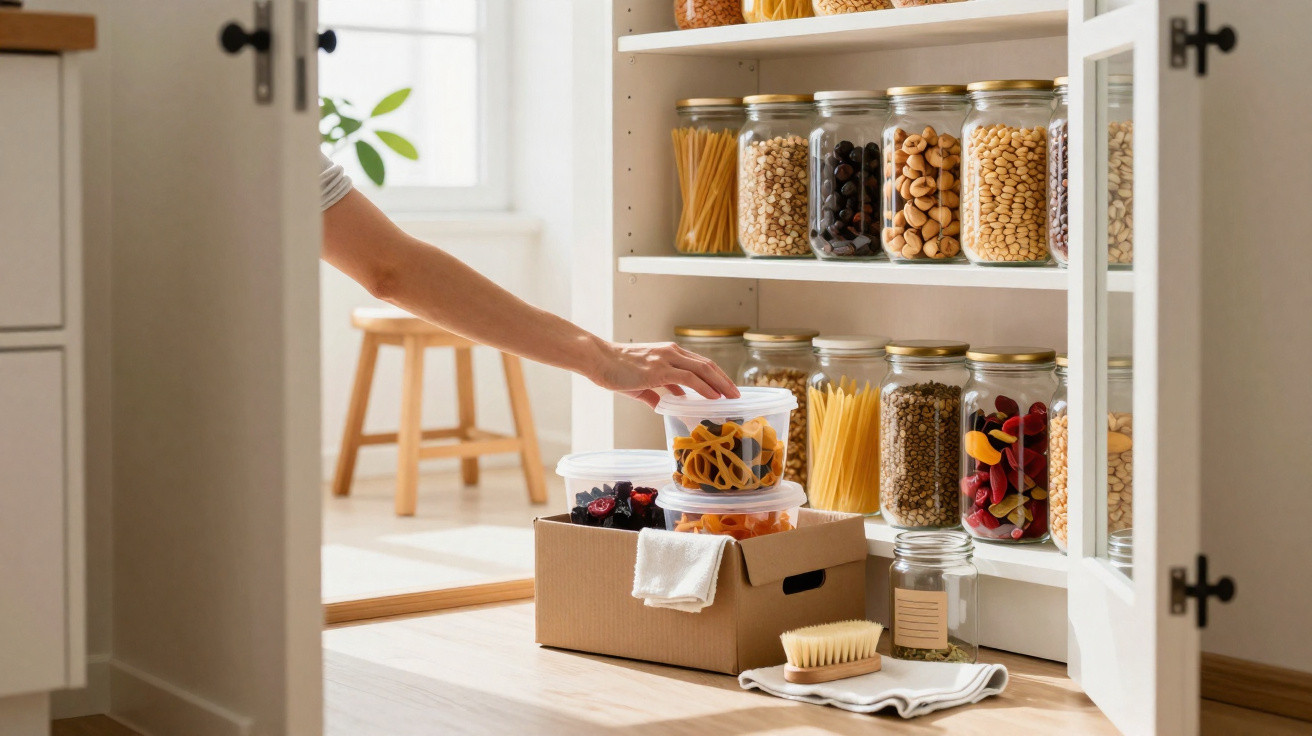
Choose one area that annoys you every day. Don’t tackle the entire kitchen. Pick the spot you complain about most: the cupboard of plastic containers, the spice muddle, the drawer that sticks. Empty it completely and make loose piles by “moment”: cooking, eating, prep, snacking, cleaning. Keep it rough. If you pause and overthink, put the item in a “not sure” pile. This isn’t a showroom; it’s built for your Tuesday evening. Your main aim is simple: move the things you use all the time to within one or two lazy arm movements of where you’re standing when you use them.
Next, create or rename your drop zones. Make one drawer the home for “anything you grab mid-cooking”. Make one shelf “breakfast only”. Make one tub “kids and snacks”. If it helps the rest of the household, add labels so people can follow along without asking. And yes-start with whatever containers you already have, even if they’re ugly or mismatched. Let’s be honest: nobody does this every day using perfectly coordinated, Instagram-ready boxes. Your system needs to cope with the weekly shop, sick days and late-night pasta. Make it work first; make it pretty later.
There’s a point where it starts to feel noticeably different. About a week in, you open a drawer and the contents are still roughly where they belong-even though you never did a “big tidy”. That’s the goal. As one organiser told me:
“A good kitchen system lets you be messy and still land in the right place most of the time.”
If you want something quick to screenshot, here’s a cheat-sheet:
- Start with one hotspot, not the whole kitchen.
- Organise for putting away, not for display.
- Create 4–6 broad drop zones people can follow half-asleep.
- Keep your most-used items within arm’s reach of where you actually use them.
- Aim for “good enough”, not perfect. Perfect doesn’t survive Wednesday.
The quiet payoff of a kitchen that resets itself
When your kitchen is built around drop zones and easy resets, your day changes in small but real ways. You cook more often because “making a mess” feels less risky. You tidy less, yet the space looks better. The worktops stay clearer, which somehow makes mornings feel less frantic. The calm doesn’t come from spotless surfaces; it comes from knowing everything has a home that fits how you actually live. On a rushed evening, you can toss things roughly into place and it still works.
At a deeper level, an easier kitchen is a discreet kind of self-respect. You stop demanding a version of yourself who always has time, energy and iron discipline. You design for the real you: sometimes tired, sometimes distracted, sometimes with three mental tabs open at once. In a bad week, the system flexes instead of failing. In a good week, you notice how much background noise has vanished. Cooking stops feeling like another draining chore and becomes a small, manageable part of the day-maybe even enjoyable again.
We like to believe meaningful change requires huge effort, strict routines and constant willpower. Often it starts with tiny frictions removed. A spoon that genuinely has a home. A drawer that shuts without a fight. You move a few things around on a Sunday afternoon, almost casually. Then on Wednesday night, when you throw together dinner after a long day, the benefit shows up quietly. No dramatic makeover, no headline-worthy before-and-after-just a kitchen that, for once, feels like it’s working with you.
| Key point | Detail | Why it helps you |
|---|---|---|
| Organise for putting away, not for display | Create zones where it’s effortless to return items to their place | Less mess boomeranging back, even when you’re tired |
| Reduce the number of decisions | Use 4 to 6 broad, simple categories across the kitchen | Lower mental load, quicker and more natural habits |
| Keep items close to real use | Store items where you use them, within one or two movements | Smoother cooking, fewer trips back and forth, fewer forgotten tools |
FAQ:
- What is a “drop zone” in a kitchen? A drop zone is a dedicated spot where you can put items back fast and without fuss, while still landing in the correct general area. Think “soft home for a type of thing or moment”, not a perfectly sorted container.
- Do I need to buy organisers or special containers? No. Begin with what you already own: old boxes, baskets, trays, even shoe boxes. The method matters far more than the products. If it’s still working after a month, upgrade the bits that irritate you.
- How long does it take to reorganise my kitchen this way? Set aside one to two hours to fix a single problem area. Many people feel a genuine improvement after updating just one drawer, cupboard or zone, then fine-tune the rest over the next few weeks.
- What if my family doesn’t follow the new system? Make it obvious and easy. Use wide categories and, if useful, labels. Show them once, then let the setup prove itself. When it saves them time, they’re more likely to stick with it.
- Can this method work in a very small kitchen? Yes-small kitchens often benefit most. Drop zones keep clutter off limited worktops and help each cupboard do double duty based on real habits, not “ideal” magazine layouts.
Comments
No comments yet. Be the first to comment!
Leave a Comment