
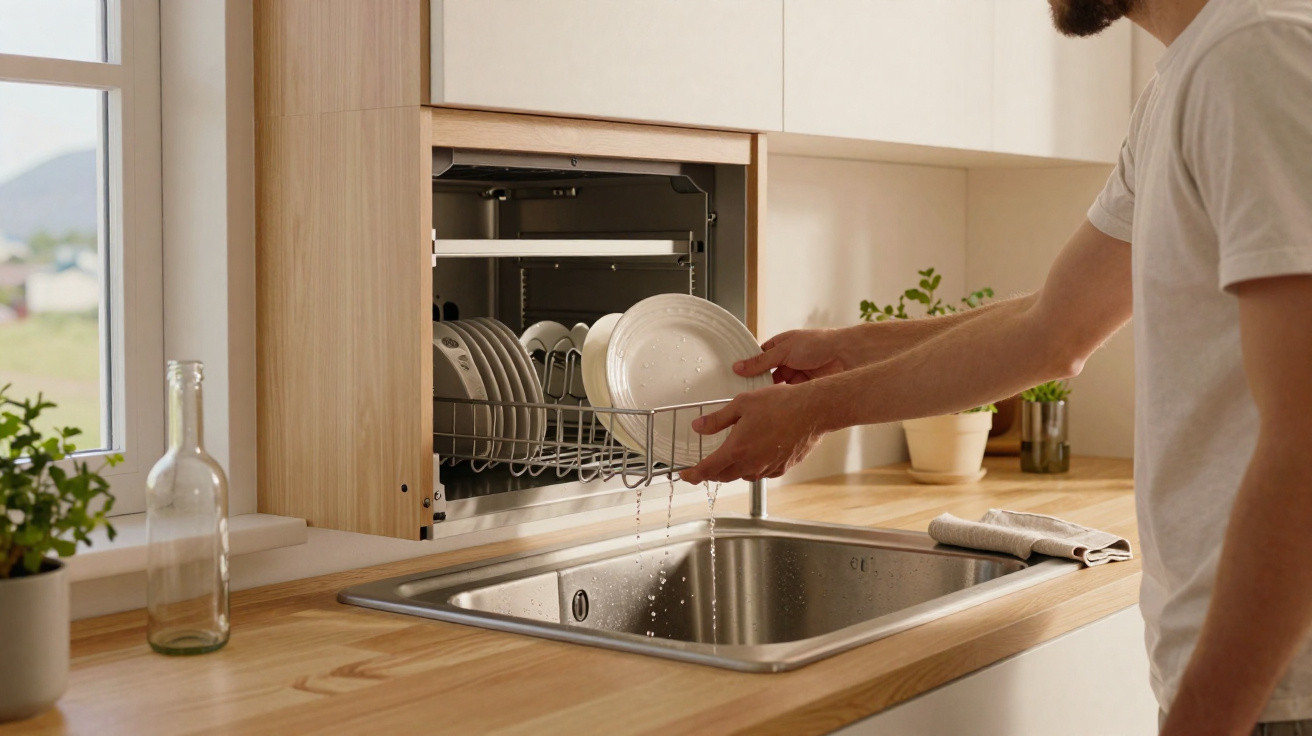
The dish-drying cabinet, known in Finland as the astiankuivauskaappi, makes it possible to put away plates, glasses and cutlery while they are still wet straight after washing. Fitted above the sink, it uses open racks so the water can drain away as the items air-dry, without taking up worktop space.
How does the Finnish dish-drying cabinet work?
Instead of the solid shelves found in a standard cupboard, this unit uses metal grids or slatted, open supports. Because the bottom is left open, droplets fall directly into the sink, while airflow gradually removes moisture from the utensils.
In day-to-day use, an astiankuivauskaappi above the sink combines two steps in one place: drying and storage. You wash the items, place each piece onto the rack, and shut the doors-so there is no need to move everything into another cupboard afterwards.
Why does this system completely free up the worktop?
With the drainer suspended overhead, the surface next to the sink stays clear for food preparation or for placing small appliances. Making use of vertical space also makes the system appealing for compact kitchens:
- Plates stand upright in the dividers;
- Glasses and bowls sit on the upper shelves;
- Cutlery can dry in a ventilated compartment;
- Water drains into the basin without forming puddles on the worktop;
- Utensils remain protected inside the cupboard.
Who created this solution for Finnish kitchens?
The researcher and inventor Maiju Gebhard developed the modern design between 1944 and 1945 while working at the Finnish Institute of Efficiency of Work. The aim was to cut down the time spent manually drying and putting away household utensils.
The earliest cabinets were made from wood, and manufacturing began in 1945. Industrial production expanded towards the end of the 1940s, while coated wire racks appeared later on. Over time, the astiankuivauskaappi became a familiar feature in kitchens across Finland.
What care prevents standing water and bad smells?
Even though the cabinet relies on ventilation to dry items, it still needs to be kept clean and correctly installed. Food residue, grease and trapped water can cause unpleasant odours, so a few habits should be part of the routine:
- Remove leftover food before placing items on the racks;
- Leave space between plates and glasses so air can circulate;
- Clean the open shelves regularly;
- Check that droplets really fall into the sink;
- Keep the doors open for a few minutes when there is a lot of humidity;
- Do not store soaking-wet wooden utensils in the compartment.
Can the dish-drying cabinet be adapted to other kitchens?
To recreate the idea, the unit needs to sit directly above the sink basin and have an open base or a tray that drains properly. The structure must also carry the weight of wet plates and pans, without sharp edges or areas where water can collect.
This Finnish trick follows the same logic as other habits that make home organisation simpler: removing a repeated step through the way the space is designed. In the astiankuivauskaappi, gravity, ventilation and the area above the sink dry the washing-up without a tea towel and keep the worktop clear.

Comments
No comments yet. Be the first to comment!
Leave a Comment