
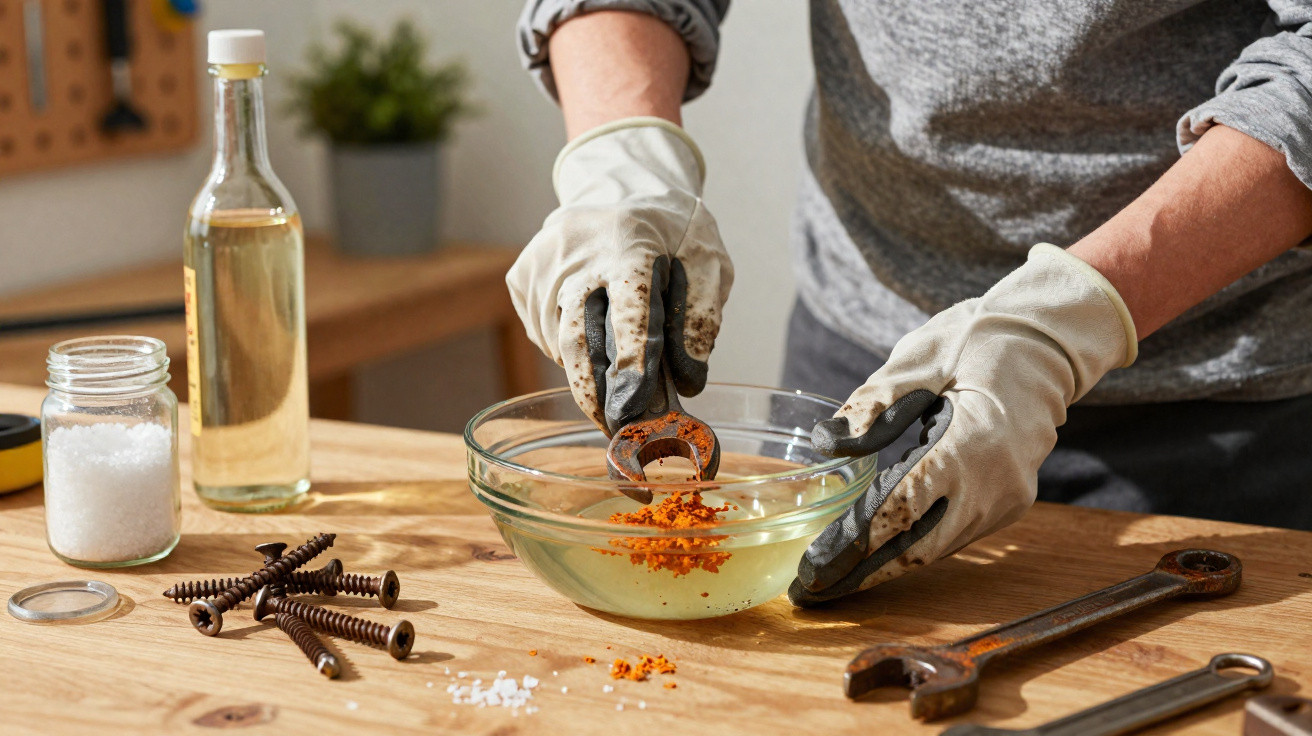
Rust removal on everyday items often raises questions in many households. Those orange-brown marks can show up on railings, tools, clothing and metal kitchenware, spoiling the look and sometimes affecting usability. Among the options people commonly reach for, vinegar with salt is frequently mentioned as a straightforward, affordable and surprisingly effective way to deal with rust in a range of situations.
How does the vinegar and salt mixture work on rust?
Vinegar contains acetic acid, a mild acid that can gradually soften the iron oxide that makes up rust. Table salt, which is rich in sodium chloride, helps as a gentle abrasive and can boost the cleaning reaction on the metal surface.
On small items such as screws, pliers or scissors, the mixture is usually applied straight onto the affected area, ensuring it is fully covered. On fabrics, you apply vinegar to the stain, sprinkle salt over the top and leave it to work for a controlled period, always rinsing thoroughly afterwards.
How to use vinegar with salt to remove rust step by step
To use vinegar with salt to lift rust stains, you can follow a simple method adjusted to the type of material. In most cases, no special equipment is needed, but you do need to take care not to harm the surface you are treating-particularly with more delicate pieces.
A basic step-by-step for metal objects can be set out like this as a practical at-home guide:
- Initial cleaning: wipe away dust, grease or loose dirt with a dry cloth or one that is slightly damp.
- Preparing the solution: combine white vinegar with salt until it becomes thicker, similar to a strong, concentrated brine.
- Application: spread the mixture directly over the rusty area using a brush, an old toothbrush or a cloth.
- Contact time: leave it for a few minutes, watching the reaction; for heavier marks, you may need to leave it longer.
- Scrub: use a sponge or a soft-bristled brush to help lift the softened rust.
- Rinse and dry: rinse under running water, dry extremely well and, if possible, add a protective layer such as lubricating oil.
Does vinegar with salt really remove rust in just a few minutes?
Vinegar with salt can give quick results on light surface rust, particularly when the corrosion is recent and the layer is thin. With older or deeper rust, the process typically takes longer and, in some cases, it will not fully reverse damage that has already been done to the metal.
Several factors directly affect how well it works and help explain why results vary so much:
- Severity of the rust: thin, recent layers respond better than old, thick rust.
- Type of metal: more sensitive metals can corrode more easily if the mixture is left in contact for too long.
- Mixture strength: more concentrated solutions act faster, but can also be harsher.
- Room temperature: warmer conditions tend to speed up chemical reactions slightly.
Care, limitations and alternatives to using vinegar with salt
Although vinegar with salt is popular and helpful in many homes, using it without care can worsen corrosion rather than reduce it. Leaving metal items soaking for too long, failing to rinse properly or not drying thoroughly can encourage rust to return.
Other options and complements include purpose-made rust removers, fine sandpaper, wire brushes and chemical conversion techniques that turn the oxide into a more stable layer. The best choice depends on how important the item is, what it is worth and how severe the rust is; it is common to try vinegar with salt first on simple, low-risk household items.


Comments
No comments yet. Be the first to comment!
Leave a Comment