
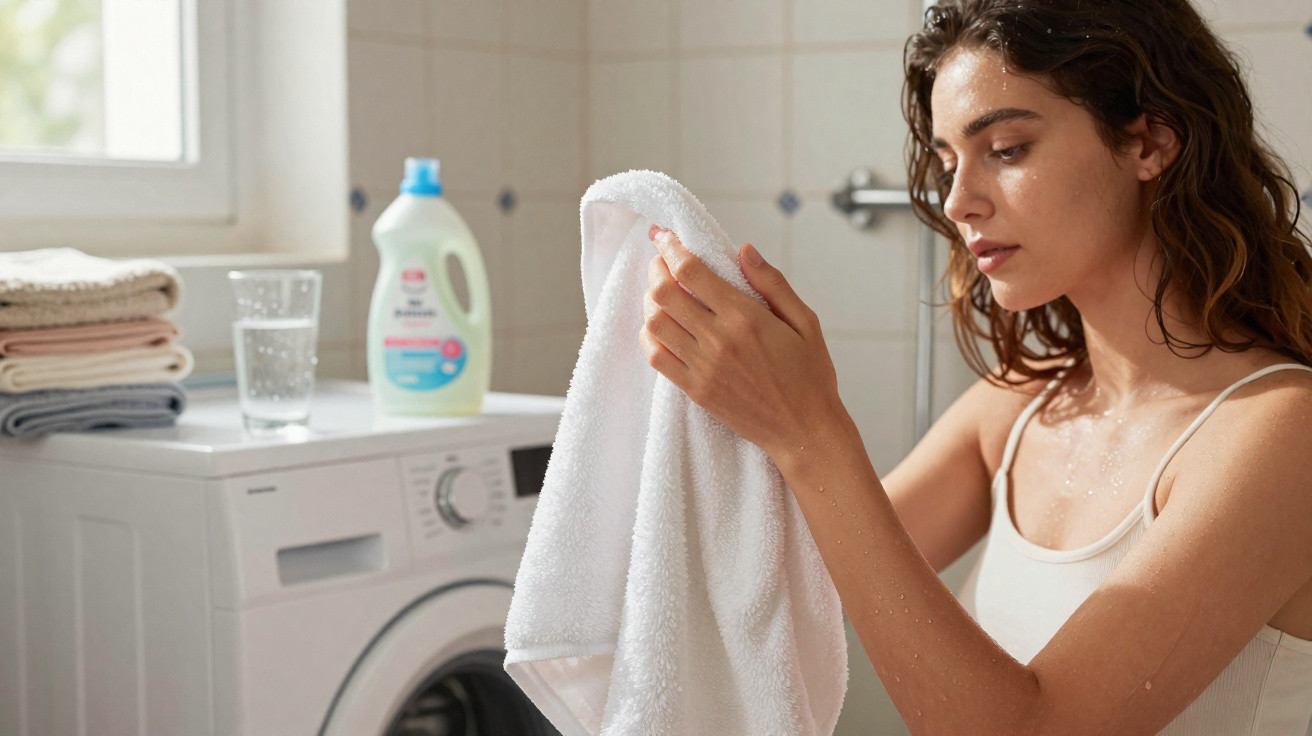
Fluffy, warm and carrying the scent of a fresh-laundry television advert. Then you leave the shower, press the towel against your skin… and the water simply stays put. The material slides rather than catches, as though the towel is politely declining to do its job.
That brief flash of irritation lasts only seconds, but it reveals something about the way we wash our laundry. We pile on “comfort” products, follow advertising more closely than care labels, then wonder why our towels wear out so quickly.
There is a concealed compromise behind all that silky softness. Once you notice it, it is impossible to ignore.
Why your softest towels suddenly stop doing their job
When you first realise your towels are not properly drying you, you may blame your skin, your shower gel or even the weather. The laundry routine is rarely the first suspect. Yet the cause is often beside the washing machine: that attractive bottle of fabric softener you pour “just a bit extra” from.
Fabric softener works by coating fibres, making them smoother to the touch and cutting static. That can be pleasant on clothing. With towels, though, it becomes gradual sabotage. Every wash leaves an unseen layer that presses down the cotton loops designed to hold water. The towel appears luxurious… while quietly stepping away from its most important task.
On a wet Monday morning in a compact London flat, the contrast is obvious. One towel, treated with softener for months, slips across your arm while leaving beads of water behind. Another, washed using ordinary detergent and a cup of white vinegar, takes up the water with a single press. They are the same make and the same age, but the experience is entirely different.
Some hotel chains have already recognised this. An American housekeeping manager once explained that their “harder” towels are not a cost-cutting error, but an intentional decision. Guests may complain when towels feel rough on the first day, but staff understand that ultra-fluffy softness often means they work only half as well. They therefore reduce the softener, accept a slightly coarser feel and gain better performance.
Research from textile laboratories supports what your skin may already have noticed. Testing on cotton terry towels reveals a steady pattern: repeated wash cycles using cationic softeners can cut absorbency by up to 40–50% after a few dozen washes. The greater the quantity of product, the poorer the outcome. It’s like putting a raincoat on every single fiber and then asking it to drink water.
When residue weighs down the loops, water tends to remain on the surface rather than soaking in. That is why you can sometimes feel damper after drying yourself than before. It is not an overnight problem; it accumulates with every well-intentioned “extra capful”.
How to wash towels so they stay soft enough and actually absorb
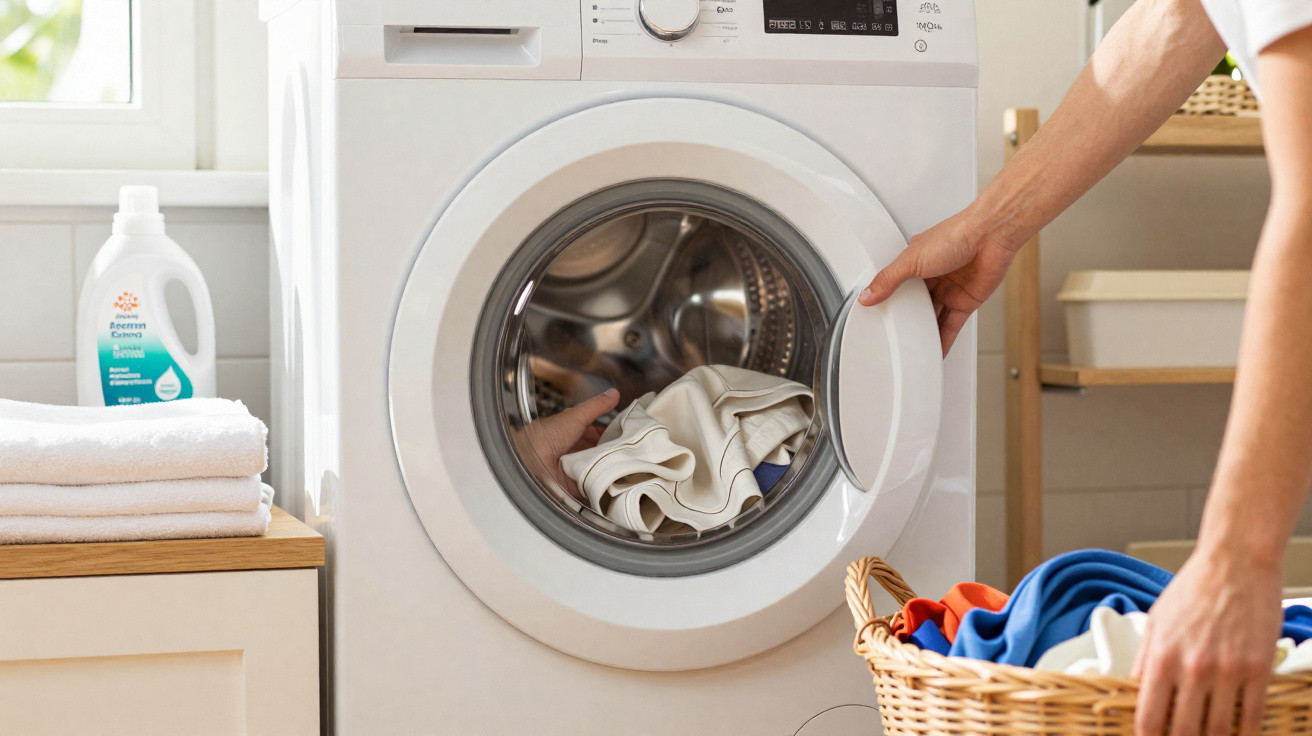
The most useful adjustment is almost brutally straightforward: remove fabric softener from towel loads. Do not merely use less. Stop using it. For your next few washes, use only detergent and hot water, plus a long rinse where your machine offers one. This begins to lift the old residue from the fibres.
Once or twice each month, put a cup of white vinegar into the fabric softener compartment. Vinegar functions as a gentle reset, helping to dissolve leftover product and limescale. Your bathroom will not smell like a pickle jar, as the odour vanishes while the towels dry. Leave the machine to handle the wash, then let warmth and air complete the process.
After removing softener from the equation, pay attention to drying your towels as well as washing them. An overloaded tumble dryer leaves everything tumbling in a damp bundle, keeping fibres flattened and preventing air from circulating properly. Allow towels enough space. Tumble-dry them on medium heat, then use an air-only finish if possible. Brief, uncomplicated cycles are more effective than harsh, overlong drying.
Here is the reality: hardly anyone has the time or patience for “perfect” laundry rituals. We want practical shortcuts that genuinely suit a busy day.
Begin by washing towels separately from synthetic fabrics and heavily soiled clothing. Mixed loads cause lint, residue and inconsistent rinsing. Towels in a load of their own have more freedom to move, rinse more thoroughly and are less likely to pick up grease or body oils from other items. It is one small habit with a major effect on how they feel.
Keep an eye on the detergent as well. Using too much detergent is nearly as problematic as using too much softener, since the fibres never rinse completely clean. Stick to the lower end of the recommended amount, particularly in a soft-water area. If your towels feel “waxy” or slippery, let the machine run an additional rinse. Let us be honest: nobody really does this every day, but doing it once a month can transform the texture.
“People think soft towels come from bottles,” says one veteran laundromat owner, “but they mostly come from hot water, enough space in the drum, and not drowning them in products.”
For a quick, practical checklist that is easy to recall on a busy Sunday evening, remember the following:
- Leave out fabric softener from every towel wash, every time.
- Add a cup of white vinegar once or twice a month to boost the rinse.
- Wash towels at 40–60°C, following the label, and avoid low-temperature “eco” programmes when they are very heavily soiled.
- Give them room to move while drying: use medium heat in the tumble dryer, or line-dry them before finishing with 10 minutes in the dryer.
A new way to think about “nice” towels at home
We often assess towels as we assess hotel beds: through the immediate sensory impression. Softness, fluffiness and fragrance. Yet in a small bathroom, with the mirror steamed up and wet hair running down your neck, what matters is whether the towel can keep pace with your life. Absorbency may not be glamorous, but it is precisely what makes you feel cared for after a long day.
From a practical perspective, using less softener may even extend the life of your towels. Fibres that are not burdened by residue recover their bounce more effectively after every wash. Colours remain more faithful because fewer deposits hold onto dirt and body oils. Over time, the towel that initially felt “less luxurious” will outlast the silky one you kept treating with scented products.
There is a subtle pleasure in taking back these small household details. On a cold morning, when a towel genuinely drinks the water from your skin in one go, the entire routine feels changed. On a warm summer evening, you notice when your beach towel does not merely spread sand and sun cream around. On a hectic Wednesday, when the children’s swimming towels dry quickly enough for another use, you quietly thank your earlier self for giving up fabric softener.
Emotionally, modest changes such as this can often mean something more: you are paying attention. You have permission to question habits learned from adverts and glossy bottles. Your home can be comfortable on your own terms, rather than according to Instagram’s version of “fresh laundry”. On a shelf, a towel is an ornament. In your hands, as you step dripping from the shower, it is a tool.
We have all encountered the moment when we realise that the best-smelling object in a room is failing at its actual purpose. Perhaps it is a candle that will not light. Perhaps it is a beautiful jacket that is impossible to wear. Towels covered in fabric softener sit in the same category. Attractive, certainly. But not truly working for you.
After a few weeks without softener, the difference is difficult to unfeel. The towel grips. Your skin cools more quickly. The fabric feels light rather than waxy. You begin to spot that “fake soft” finish from a distance, passing it in the supermarket aisle with a quiet, private sense of achievement.
That is the understated power of this small change: it requires neither a new appliance nor an elaborate routine. It only asks for a different decision when your hand reaches towards the bottle. A pause. A “not this time”. A few days later, you have a towel that performs as it did in the week you bought it.
| Key point | Details | Why it matters to readers |
|---|---|---|
| Stop using fabric softener on towels | Eliminate softener completely from towel loads and move to a simple detergent routine. Reserve softener for clothes where absorbency is unimportant, and keep it away from bath linens. | This one change can often bring back absorbency within a few washes, without the need to buy replacement towels or specialist products. |
| Use white vinegar as a “reset” rinse | Put about 150–250 ml of white vinegar into the softener compartment once or twice a month. It helps remove old softener coating and mineral build-up from the fibres. | Readers have an inexpensive, cupboard-friendly method for reviving heavy, slick towels that feel “dead” after years of product accumulation. |
| Wash hot enough and dry with space | Wash towels at 40–60°C in line with the label, avoid overfilling the machine, and tumble-dry on medium heat with enough room to move. Where possible, finish with a brief air cycle or line-dry them. | Improved washing and drying habits help towels remain absorbent and reasonably soft, while limiting that stiff, cardboard-like feel. |
FAQ
Can I ever use fabric softener on towels? Ideally, avoid it completely on bath and hand towels. If you truly want a softer feel, use only a tiny amount occasionally, then use a vinegar rinse in a later wash to clear the build-up.
Why do my new towels feel soft but don’t absorb well? Many new towels have factory finishes that make them feel smooth in the shop while repelling water. Washing them two or three times before using them, without softener and on a hot cycle, will usually solve the issue.
Is vinegar safe for my washing machine? In moderate quantities, white vinegar is generally safe for most modern machines and may even help limit limescale. Add it to the softener tray rather than directly onto rubber seals, and do not use it daily.
My towels are already ruined. Do I have to replace them? Not necessarily. Try three or four washes without softener, use a cup of vinegar in the rinse once, and select a hot cycle if the label permits. Many “dead” towels recover a surprising level of absorbency.
Are dryer sheets as bad as liquid softener for towels? Dryer sheets may leave similar waxy deposits on fibres, especially at high temperatures. For towel loads, it is preferable to leave them out and rely on sufficient drying time and a thorough shake at the end.

Comments
No comments yet. Be the first to comment!
Leave a Comment