
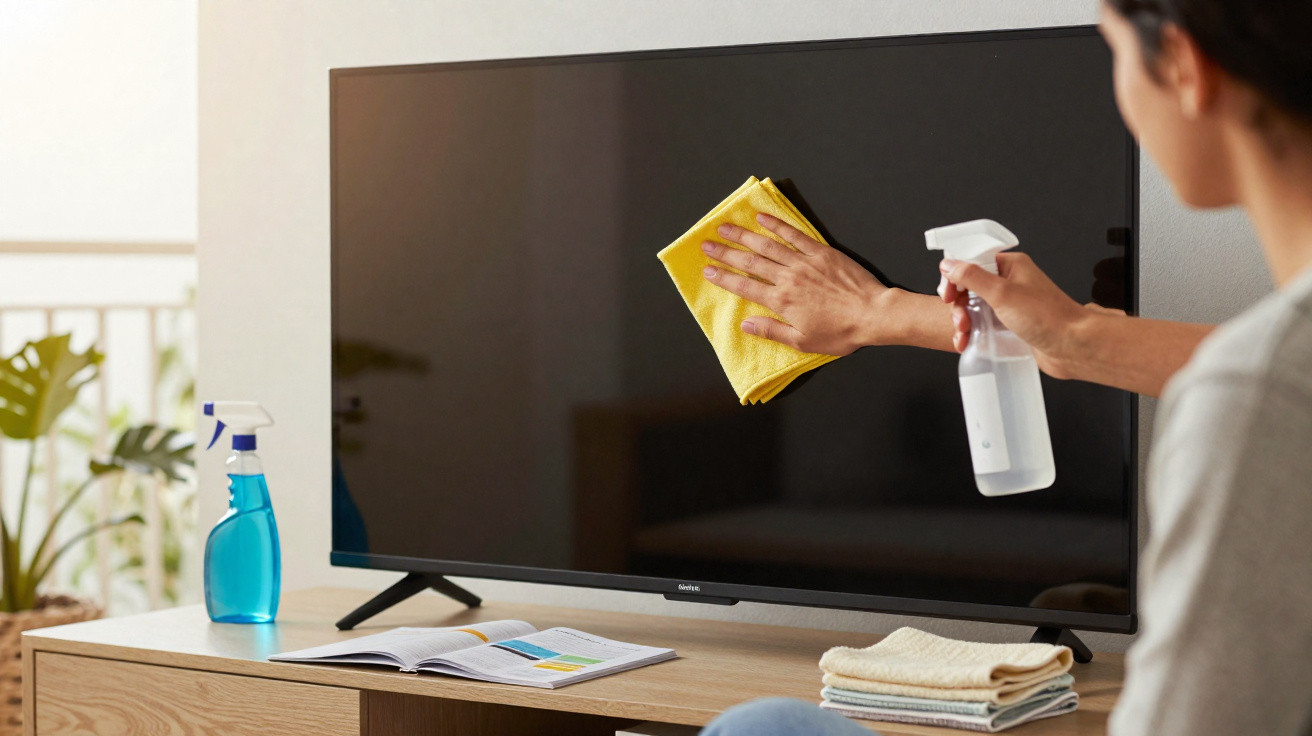
That misty fingerprint in the corner of the television, the light layer of dust visible during your favourite programme, the unexplained smear at a child’s height: instinct says to reach for window cleaner. Glass means window spray, surely. A couple of sprays, a fast wipe, job done.
Then a small hesitation sets in: didn’t the manual mention harsh cleaning products? And where is that manual now? In a drawer, a box, or the rubbish. So you stand there with Windex in hand while the TV glows quietly behind you. It is a £700 screen, a £3 bottle, and suddenly the decision feels much more significant than removing a little dust.
What if that familiar blue spray is precisely what TV manufacturers tell you not to use?
Why your TV really hates Windex, even when the screen looks like glass
Modern televisions may look and feel like glass, persuading you that they are simply oversized windows on a stand. In reality, they are not. Their shiny outer layer is generally a complex stack of plastics, coatings, filters and anti-glare films, all of which can react poorly to the chemicals stored in your cleaning cupboard. Ammonia, alcohol and fragrances might seem harmless when you are cleaning a bathroom mirror.
On a television, though, they can cause problems. The effects may not be visible after the first clean, or even the fifth. Eventually, you may spot a cloudy area that will not disappear, faint marks that seem “baked in”, or fine rainbow-like swirls around the edges. That is not grime. It is damage.
Most of us have learned that a minor shortcut can become an expensive mistake. For TVs, that shortcut is spraying before considering the consequences. A 4K or OLED display is not merely a panel: it is a delicate surface protected by a very thin layer that performs an important job. Ammonia-based cleaners can gradually wear away that layer, creating micro-scars that scatter light. Dark scenes can develop milky areas, while bright sports broadcasts may reveal uneven sections where black levels no longer appear truly black. And no, this is not covered by “standard warranty”.
Manufacturers mention the risk discreetly in the small print most people overlooked on the first day. Samsung, LG, Sony, Philips and others offer broadly the same advice: avoid window cleaner, avoid products containing ammonia or alcohol, and never spray liquid straight onto the display. From their perspective, Windex is not a cleaner. It is sandpaper in a bottle, acting slowly.
The safe TV-cleaning method manufacturers actually recommend
The lowest-risk approach is almost frustratingly straightforward. Switch off the TV and allow the display to cool for a few minutes. Next, use a clean, dry microfibre cloth - the soft type used for spectacles - and lightly wipe the screen in circular movements. No spray, foam or blue liquid is required: only cloth and patience.
For marks that will not lift, take a second microfibre cloth and dampen it very slightly with plain water. It should not be wet or dripping. Aim for barely damp, like breath on glass. Gently wipe the affected area, then use a dry cloth to finish so that water cannot run into the bezel or lower edge. That is essentially the whole process. It may be dull, but it is the method manufacturers set out in their guidance, sometimes in almost identical terms.
The uncomfortable reality is that many people only consider cleaning the television once it is already noticeably dirty. There are sticky fingerprints, children’s handprints and unexplained splashes from last night’s takeaway. That is when panic leads to the strongest nearby product. A UK survey into home technology care a few years ago found that most people used ordinary household cleaners on electronics at least once a month. The same research found that most respondents had never read their television’s care guidance.
A London repair technician told me that he frequently encounters “ghost streaks” on relatively new displays. Their owners insist that they clean them “properly”. When he asks what product they used, the answer is nearly always some form of window spray. The same sequence occurs repeatedly: the first few cleans produce a crystal-clear finish, then the coating begins to deteriorate, and the television looks dirty even when the surface is spotless. At that stage, replacing the panel is the only genuine solution - and that normally costs nearly as much as buying a new TV.
The reasoning behind this gentle technique is starkly simple. Fine anti-reflective and anti-glare coatings are made to control light, not withstand chemicals. Powerful solvents damage their structure on a microscopic scale. That is why the advice relies on the least risky combination: soft fibre, minimal water and no chemicals. It is not glamorous, but it suits the way the screen is constructed.
Spraying directly onto the display also introduces another, less obvious danger. Liquid can run down the panel and enter the narrow gap between the screen and frame. It may then reach the electronics, backlight or speakers. Moisture damage does not always appear immediately; it can corrode components quietly over several weeks. This is one reason manufacturers repeat the same instruction: use a damp cloth only, and apply moisture to the cloth rather than the screen.
How to clean your TV as the professionals and manuals advise
Begin by switching everything off at the wall. This is not only a safety measure. A dark screen makes dust, marks and streaks easier to see, allowing you to clean more accurately. Leave the display to cool for five to ten minutes, then remove dust with a dry microfibre cloth. Use extremely light pressure and work either from top to bottom or in broad circular movements.
For stubborn smudges, moisten one corner of the cloth slightly with water. Do not use sprays or apply anything directly to the television. Treat it as “polishing condensation”, rather than washing a window. Work over the mark with gentle, small movements, then immediately use a dry area of the cloth to remove remaining moisture. You can clean the frame or stand with the same damp cloth, as plastic and metal are less sensitive than the panel.
Let’s be honest: nobody truly does this every day. Most people clean the television only when dust is genuinely spoiling Match of the Day, rather than following a neat schedule. That is completely fine. The issue is not the frequency of cleaning; it is the product you grab in the moment. An old T-shirt from the gym bag is too abrasive. Kitchen roll can leave tiny scratches and fibres. Disinfectant wipes from the bathroom are often packed with alcohol and bleaching agents.
If you wear glasses, consider the care you give their lenses. You would not scour them with paper towels and bleach. Instead, you use soft fabric and gentle movements, or a cleaner created specifically for the task. Your TV display deserves the same consideration, only on a much larger - and more expensive - scale. A microfibre cloth costs a couple of pounds and may last for months. Making that one change removes half the risk immediately.
“Most screen damage I see isn’t from drops or hits,” a Manchester-based TV engineer told me. “It’s from people lovingly destroying their panels with the wrong cleaning stuff.”
To make things easier when life is hectic, keep a small “TV kit” close to the remote control. Have one dry cloth and another labelled “damp cloth only”, and nothing else. No chemicals or unidentified sprays. You will not need to think twice when the children leave their home-made artwork on the screen.
- Never spray liquid directly onto the TV screen.
- Use a clean, soft microfibre cloth kept solely for screens.
- Use plain water only for persistent marks, and apply it sparingly to the cloth.
- Avoid products containing ammonia, alcohol or claims of “multi-surface shine”.
- Read your TV’s manual once: most include a brief, clear cleaning section.
The subtle benefit of treating your TV as the expensive item it is
When manufacturers insist on their “no Windex, no chemicals” guidance, it can feel as though they are being excessively cautious. The benefit, however, becomes clear gradually. A screen cleaned carefully over the years retains its contrast, deep blacks and crisp detail. Films appear more cinematic, sport looks smoother, and even browsing the Netflix menu keeps that sharp, clean glow.
That may seem dramatic for a task as ordinary as dusting. Yet consider how much of life takes place in front of that rectangle: late-night box sets, football with friends and Sunday morning cartoons with the children. A damaged coating can subtly diminish every one of those moments. Viewing the TV as an investment rather than a large wipeable tile provides a better canvas for them.
There is also a minor psychological change. Once the blue spray bottle is no longer used on the TV, you may start noticing how many other devices receive similarly rough treatment. Phones rubbed on jeans, tablets cleaned with baby wipes and laptops scrubbed with whatever happens to be under the sink. A more thoughtful approach based on fabric and water can spread through the home. Shared screens remain in better condition for the entire family, while costly technology has a longer and less troublesome life.
Perhaps that is the real point beneath this small household question: it is not simply about one brand of cleaner or one group of instructions hidden in a PDF. It is about how we look after the objects that shape so much of everyday life. The blue bottle will always be waiting, offering instant shine. The question is whether that shine is worth gradually erasing the image you bought the TV to enjoy in the first place.
| Key point | Detail | Benefit for the reader |
|---|---|---|
| Avoid window cleaners | Ammonia- and alcohol-based products attack screen coatings | Reduces the risk of permanent marks and irreversible haziness |
| Use microfibre and water | Soft cloth, TV switched off, with water applied lightly to the fabric | Cleans effectively without damaging the television’s delicate surface |
| Follow the manufacturer’s guidance | Samsung, LG, Sony and other manuals explicitly recommend this method | Extends the TV’s lifespan and avoids warranty refusals related to cleaning |
FAQ:
- Can Windex permanently damage a TV screen? Yes. Repeated use of ammonia-based window cleaners can strip anti-glare and protective coatings, causing cloudy patches and streaks that do not wipe away.
- What do TV manufacturers actually recommend for cleaning? Most brands advise turning the TV off, letting it cool, then using a soft, dry microfibre cloth. For stubborn marks, they allow a slightly damp cloth with plain water, applied gently.
- Is it safe to use alcohol wipes or disinfectant wipes on my TV? Generally no for the screen itself. They often contain alcohol and other solvents that can damage coatings. Some may be safe for the plastic frame, but always check your manual.
- How often should I clean my TV screen? There’s no strict rule. Light dusting with a dry microfibre cloth every week or two is usually enough, with a slightly damp clean only when you see visible smudges.
- What kind of cloth is best for TV screens? A clean, lint-free microfibre cloth designed for glasses or camera lenses is ideal. Avoid paper towels, tissues, or rough fabrics that can leave scratches and fibres behind.
Comments
No comments yet. Be the first to comment!
Leave a Comment