
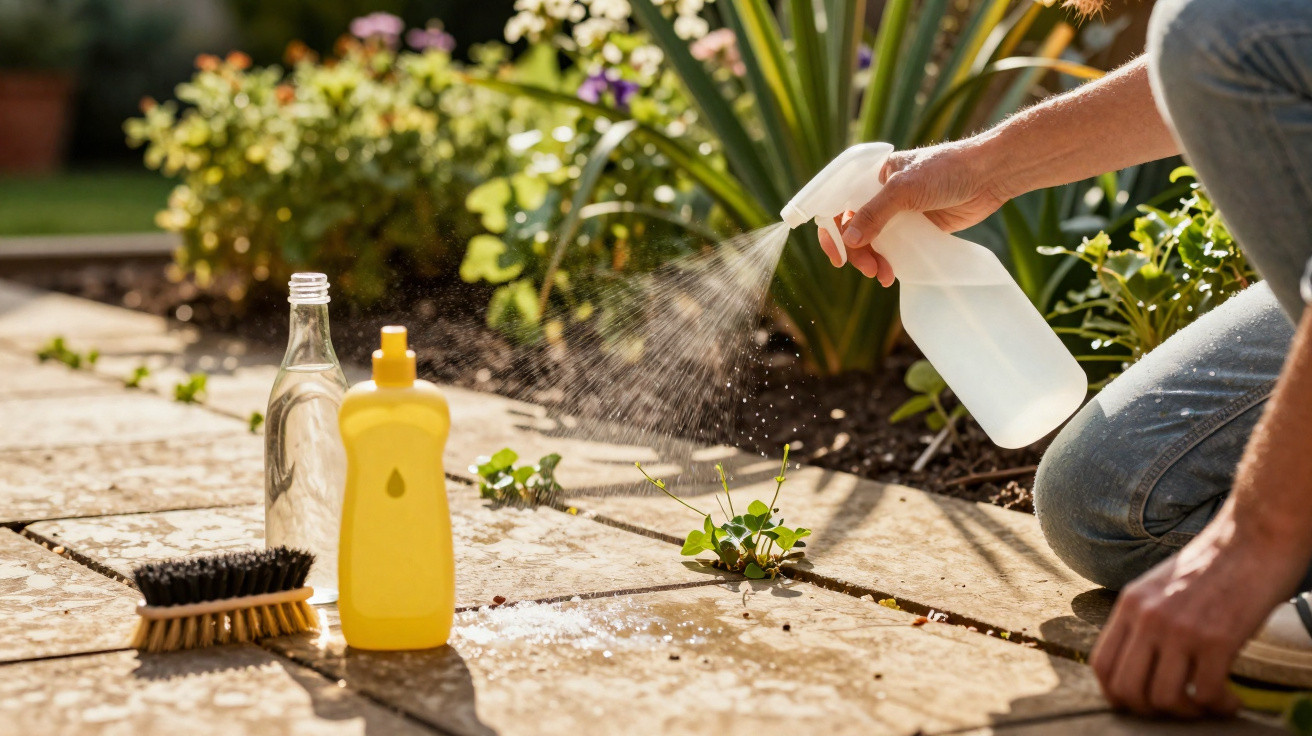
A kitchen cupboard staple can help – with no scraping required.
For years, many amateur gardeners have instinctively reached for the vinegar bottle as soon as weeds appear between paving stones or through gravel. It can look tidy at first, but a few weeks later the green shoots are back in full force. Meanwhile, another everyday item from the kitchen has become the clear favourite in gardening circles because it keeps surfaces looking cleaner for longer with very little effort.
Why vinegar often disappoints against weeds in paving joints
Vinegar mainly destroys what’s visible: leaves and stems. The acid attacks the parts above ground, they discolour, wilt and collapse. From the outside, the area can look as though it has been freshly cleaned within a day.
Below the surface, however, things are often very different. In many cases the roots remain largely unaffected. The underground network carries on living and soon pushes out new growth. That is exactly why driveways, paths and patios can turn green again after only a few weeks.
Vinegar can still be enough for a few very young seedlings. But if you’re treating entire rows of joints or large gravel sections, you end up constantly going back out with a spray bottle. It takes time, becomes a chore, and doesn’t deliver lasting results. That’s why many gardeners look for an approach that boosts vinegar’s effect - or even replaces it in part.
Washing-up liquid as the secret star: why gardeners rate it
The unexpected answer is usually sitting by the sink: ordinary washing-up liquid. The reason lies in its chemical make-up. Washing-up liquid contains surfactants, which dissolve grease and also break down the plant’s natural waxy protective layer on its leaves.
Under normal conditions, water and many liquids bead up and roll off that coating. When washing-up liquid is added, the spray clings to the leaf surface, penetrates more effectively and dries the plant out more aggressively. Even without vinegar, a concentrated film of washing-up liquid can make it harder for the plant to retain moisture, so it slowly dries out.
"Washing-up liquid works like a door-opener: it cracks the protective layer of the leaves so the rest of the mix gets to where it needs to work."
When combined with vinegar, washing-up liquid is what makes the real difference: the acid reaches the cell structures more directly, stays on the plant longer, and spreads more evenly. Especially for weeds in paving joints, gravel paths or along the garage drive, plenty of hobby gardeners now swear by this mixture.
The popular basic mix - quick to make, easy to apply
A straightforward recipe has proved itself in many gardens. It takes only minutes to prepare and works well on smaller areas.
- 1 tablespoon washing-up liquid
- 1 litre water
- optional: 1 cup of vinegar
Stir briefly, then pour into a spray bottle or pressure sprayer. Choose a dry day, ideally with some sunshine. Don’t treat plants right before rainfall, otherwise the mix will be washed off too quickly.
Spray directly onto the clumps you want to remove - in joints, along edges, across gravel beds or at the side of the drive. If you’re working near borders, lawns or the vegetable patch, go slowly and make a point of hitting only the unwanted growth.
Three strength levels: from gentle to drastic
Option 1: a mild mix for young weeds in joints
For new, delicate shoots, a lighter mix is often sufficient. Many gardeners use:
- 1 litre water
- 1 tablespoon eco-friendly washing-up liquid
This version suits paving joints and small areas where no sensitive ornamental plants are meant to grow later. It acts more slowly, but is less harsh on the soil than stronger recipes containing large amounts of vinegar and salt.
Option 2: a stronger vinegar and washing-up liquid mix for heavily affected areas
Where joints or gravel paths are already thick with growth, many people opt for a much more intense blend:
- 1 litre vinegar
- 2 teaspoons washing-up liquid
Here, the acid-led effect is far more pronounced, while the washing-up liquid ensures thorough wetting. The plants usually wilt severely within a few days. This option should only be used on areas where you do not intend to grow vegetables or delicate perennials later on.
Option 3: the radical salt solution - only for dead zones
If the aim is to stop anything growing at all in certain places for the long term, some choose an even more drastic formula:
- 1 litre vinegar
- 40 grams salt
- 10 millilitres washing-up liquid
This mix is intended for stone patios, narrow strips along walls, or pure gravel areas where you want no growth for years. Salt damages roots and soil life very persistently. Precisely for that reason, this option belongs only on clearly defined, fully mineral areas.
"Salt in the mix acts like a scorched-earth approach for the soil - nothing grows there again quickly. That may be the aim, but it always affects useful organisms too."
Where household remedies reach their limits
Even if washing-up liquid mixes work well in everyday use, they are no substitute for careful garden maintenance. Deep-rooted troublemakers such as dandelion or ground elder will keep returning from leftover root pieces. In these cases, the only real fix is removing as much of the root material as you can.
Spraying also reaches its limits quickly on large areas. If you have a long drive or extensive gravel spaces, you’ll struggle without mechanical tools: joint scrapers, joint brushes, or hot-water/hot-steam machines can greatly reduce how much you rely on anything from a bottle.
Risks for soil, groundwater and pets
Even though the ingredients come from the kitchen, they remain chemically active. Vinegar can shift the soil’s pH, washing-up liquid can affect soil structure and may worsen water absorption. Salt harms microorganisms and can leave areas infertile for a long time.
If you have pets, avoid freshly treated patches. Dogs and cats can walk through damp areas and then lick their paws clean. Small children also tend to touch everything and put their fingers in their mouths. Keep a safe distance and only allow access once surfaces are fully dry.
Practical tips: making it work day to day
- Avoid spraying in blazing midday heat, as the liquid evaporates too quickly.
- Treat only on dry days, ideally with a light breeze or none at all.
- Set the spray bottle to a coarse jet to reduce drift.
- Always test first on a small, inconspicuous area.
- Wear protective gloves, especially with recipes high in vinegar and salt.
If you want less work over the long run, you can re-point joints with specialist jointing mortar or swap fine gravel for coarser chippings. Coarser material leaves less fine substrate where seeds can settle. Densely planted beds with ground cover also cut down spontaneous growth around patios and paths.
Nature-friendly alternatives and smart combinations
Many councils now use hot water or hot foam for weed control on paths. For private gardens, smaller machines are available that work with hot water or hot air. They don’t burn the plants directly; instead, they denature proteins in the cells. The plants then die off over the following days, with no additives in the water.
A mix of mechanical removal and targeted spraying with washing-up liquid blends is often the best compromise. Larger tufts are loosened first with a weeding knife or joint scraper. Fine remnants in awkward corners can then be treated precisely with a sprayer. This reduces how much liquid you need and puts less strain on the soil.
If you value a lively, species-rich garden, you can deliberately allow some growth in less visible areas. A narrow strip of wild herbs along the boundary provides food for insects and saves effort. On the more prominent areas, washing-up liquid mixes, vinegar and mechanical methods - used thoughtfully together - help keep patios, drives and paths looking neat.

Comments
No comments yet. Be the first to comment!
Leave a Comment