
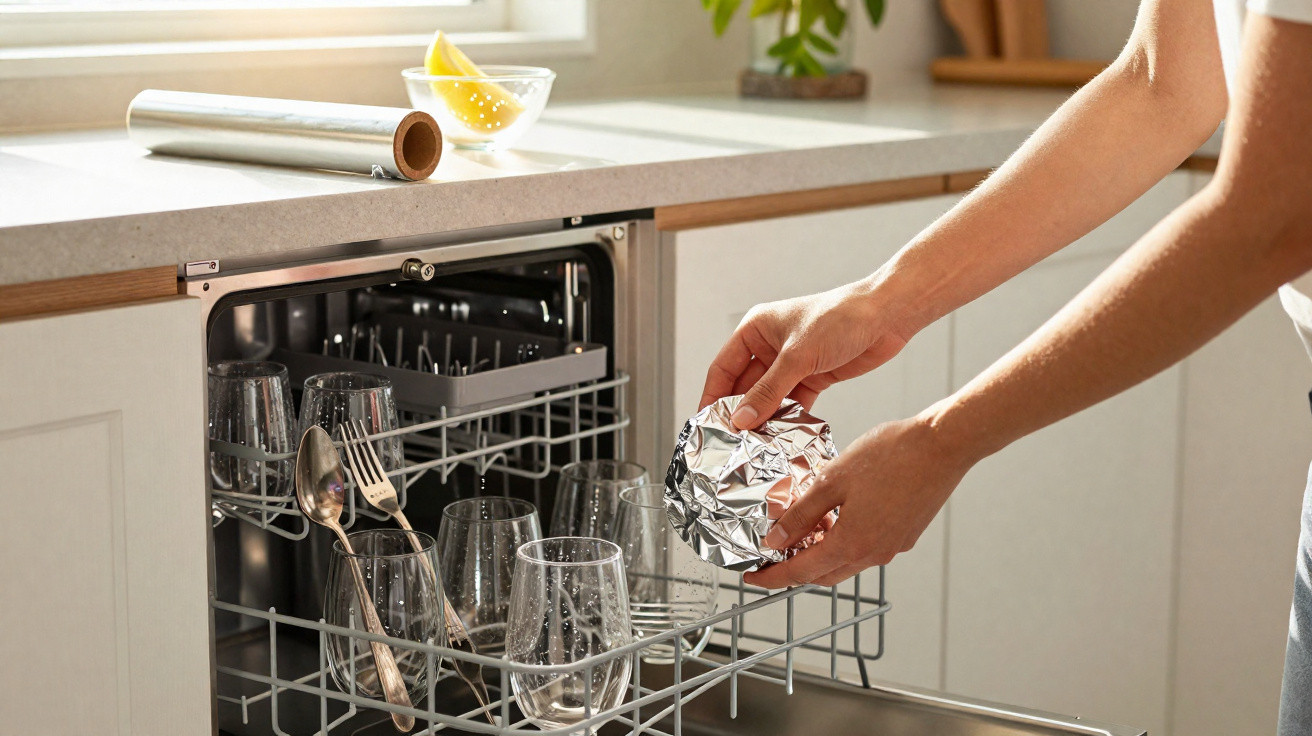
For the past few months, people on social media have been showing the same little hack again and again: before the programme starts, a scrunched-up ball of aluminium foil goes into the cutlery basket. No new appliance, no pricey specialist tablets - just a bit of kitchen foil. It sounds like an internet joke, but there is a solid, practical explanation rooted in chemistry.
Why the dishwasher so often causes frustration
Plenty of households know the scenario: the dishwasher appears to run normally, yet after a while the knives look damaged, forks develop tiny rust specks, and glasses turn cloudy.
- brown specks on cutlery
- dull glasses despite rinse aid
- tarnished blades and spoons
- matte patches on metal bowls
The irritation is understandable. If you own quality knives or inherited cutlery, you do not want to accept that an expensive dishwasher is slowly ruining the finish. Many people then reach for harsher cleaners, specialist powders or hand polishing - and end up paying mainly in money and time.
The aluminium foil ball: what’s really behind the hype
This newer trend tackles the problem from a different angle. Instead of using stronger products, it brings in an everyday item: ordinary aluminium foil from the kitchen drawer. The method looks almost ridiculously straightforward: tear off a piece, loosely form it into a ball and place it in the cutlery basket - that’s it.
"The aluminium foil ball works like a small magnet for rust particles and limescale deposits in the dishwasher."
The reasoning is that aluminium reacts readily with its surroundings. In hot water, alongside detergent and metal items, small electrochemical effects can occur. Put simply, the aluminium “sacrifices” itself first, meaning more sensitive metals such as steel or chrome-plated surfaces are attacked less.
How the trick works on a chemical level
Inside a dishwasher, several factors come together:
- high temperatures
- water containing dissolved minerals (especially limescale)
- salt and detergent
- metals such as stainless steel, blade steel and fittings
Between these metals and the aluminium foil, small differences in electrical potential can form. Specialists describe this as an electrolytic effect. The aluminium is preferentially attacked, while other metal surfaces are better protected. Rust particles and certain contaminants are more likely to deposit on the foil rather than settle on knives and forks.
At the same time, the ball can lightly rub against nearby cutlery during the wash. That gentle contact helps loosen fine deposits that have already built up. Many users describe the result in similar terms: fewer rust specks and a generally shinier look on cutlery and metal cookware.
How to use the trick correctly
So the hack is not just for show but has a chance of working, a clear step-by-step approach helps.
- Tear off a piece of aluminium foil measuring roughly 30 × 30 centimetres.
- Loosely crumple the foil into a ball about the size of a table tennis ball.
- Place the ball in the cutlery basket - not in the compartment for tablets or dishwasher salt.
- Run the dishwasher as usual with detergent, rinse aid and salt.
- Replace the ball after a few cycles if it looks heavily shredded.
"One ball per wash cycle is enough - using more does not automatically improve the result."
If you have very delicate glasses or coated items in the machine, it is best to position the ball close to sturdier cutlery. That keeps the effect where it is most useful.
What effects you can realistically expect
An aluminium foil ball is not a substitute for proper appliance care. However, it can take the edge off common weak points:
- Cutlery with light rust marks often looks noticeably cleaner after several cycles.
- Newly appearing rust specks tend to reduce significantly.
- The shine on forks and spoons lasts longer.
Nobody should expect miracles in the sense of a completely new appearance after a single wash. Most reports describe a gradual, yet clearly visible, improvement after a few runs.
When the trick does little - or can even cause issues
As with almost any online anecdote, there are limits. A ball of aluminium foil cannot fix every kind of damage.
- Deep surface rust: pitted rust marks or chipped areas on cheap knives will remain visible.
- The wrong types of steel: very soft or poorly chrome-plated alloys can still react badly.
- A heavily neglected appliance: a dishwasher that has not been cleaned internally for years can all but swallow the effect.
There is also something many people miss: aluminium foil wears down with each cycle. Small fragments can break off and end up in the filter. If you want to try the trick, you should check and clean the filter at the bottom of the machine more often.
Delicate coatings - for example certain non-stick layers on pans - should not go in the dishwasher anyway. Combined with aluminium foil, wear can become even more pronounced.
How to increase the effect with simple habits
The foil trick works best when the basics are right. Three routine steps make a big difference:
- Top up dishwasher salt regularly: only softened water helps reduce limescale and deposits.
- Clean the spray arms: blocked jets significantly reduce performance because water does not reach everything properly.
- Rinse the interior through: an empty run with dishwasher cleaner removes old residue that would otherwise cling to items.
"If you rely only on the aluminium ball but have a neglected appliance, you’re giving up most of the potential effect."
Loading also matters. Knives with sharp edges should be positioned so they do not rub against other metal. Rust often forms precisely where two different metals touch. Spacers in the baskets help minimise these contact points.
How sustainable is using aluminium foil in the dishwasher?
A fair objection concerns environmental impact. Aluminium foil is hardly a model material when it comes to resource use. If you roll a fresh ball for every wash, you create unnecessary waste.
A more practical approach is to make a ball from previously used, cleaned foil - for instance from wrapping leftovers or covering baking dishes. That foil often ends up in general waste anyway. In the dishwasher, it can do an extra job first.
Using the trick only for a limited period - for example when cutlery is looking particularly marked - keeps consumption even lower. For sturdy everyday forks, you probably do not need a foil ball every week.
What’s behind terms like flash rust and electrolysis
Rust is not all the same. In many dishwashers, what appears is so-called flash rust: tiny rust particles that “fly” from one item to another, meaning they are carried around by the water flow. Triggers can include cheap tin openers, rusty screws on cookware or damaged racks.
This is where aluminium foil can help. Through the electrochemical effect - known as electrolysis - the more reactive points on the aluminium oxidise first. Better-quality steel surfaces can stay smoother and shinier for longer.
For everyday purposes, this picture is enough: the foil acts as a “lightning conductor” for corrosion inside the dishwasher. It absorbs part of the reaction that would otherwise end up on the cutlery.
When it’s genuinely worth testing the trick
If you are already happy with your dishwasher results and have never seen rust marks, you do not urgently need this. It becomes interesting in three common situations:
- In areas with very hard water, where limescale is a constant problem.
- In households that wash lots of metal cookware and run frequent cycles.
- When older machines no longer deliver consistently good results.
The cost is minimal and the risk is low, as long as you regularly check the filter and spray arms. If you see no difference after one to two weeks, you can simply stop using the ball.
It will be interesting to see how long this simple hack lasts - whether it remains a short-lived online trend or becomes part of everyday kitchen routines. Either way, the humble aluminium ball will probably be taking the occasional ride in many cutlery baskets for a while yet.

Comments
No comments yet. Be the first to comment!
Leave a Comment