
The moment you pull off the sheet, it hits you like a small slap: that faintly musty, somehow “used” smell rising from your mattress. It looks fine at first glance-no huge stains, nothing dramatic-but the air tells a different story. You think of sweaty summer nights, a spilled coffee, children’s feet in pyjamas, and maybe even a few tears that quietly soaked into the pillow.
We spend a third of our lives on this rectangular slab of foam. Yet we treat it like a piece of furniture that’s simply there and expected to cope. Flip it once a year, throw on a fresh fitted sheet now and then, job done. Let’s be honest: nobody cleans their mattress every week, no matter how strongly the advice articles insist you should.
And then you come across this simple bicarbonate of soda trick that supposedly makes everything smell hotel-fresh again. It sounds like a social-media fairy tale-until you try it and, with that first proper shake and vacuum, you realise what’s actually been living in your mattress.
Why your mattress smells musty - and why you don’t notice for ages
A musty smell rarely appears overnight. It creeps in, like a bad habit. Each evening you lie down, your body warms the mattress, you sweat without noticing, you breathe, you shed tiny flakes of skin. For the first few months you notice nothing-the smell is mild, familiar, almost invisible to your own nose.
Then, at some point, someone visits, sits on your bed, and says the sentence nobody wants to hear: “Does it smell a bit… damp in here?” And suddenly it all rushes back-the summer without a fan, the week you spent ill in bed, the tea you spilled and only half-wiped away. In the end, that musty smell isn’t mysterious at all; it’s a very straightforward record of everyday life.
There’s one scene many people recognise: you move into a new place and put your mattress directly on the floor-“just for a few weeks”. A few weeks becomes months. The floor is slightly cold, you don’t always air the room because mornings are a rush. Then you notice darker patches underneath, and the smell turns clearly heavier, damper-almost like an old cellar.
Or picture this instead: children who creep into the parents’ bed at night. Little feet lying across you, the occasional small “accident”, a glass of juice tipping over when someone’s half-asleep. You rub, you dab, maybe give it a quick blast with a hairdryer. The surface looks saved. But the core of the mattress has already absorbed it all. That’s how you get odours you barely detect in the daytime, yet at night-when the room is quiet-suddenly feel very present.
The practical explanation is simple: mattresses are basically sponges wrapped in fabric. They soak up moisture, hold warmth, and all of that mixes with organic material-sweat, skin oils, skin flakes. That’s a buffet for bacteria and mites. Without proper airflow, moisture sits in the centre, microorganisms multiply, and at some point the smell shifts from neutral to musty.
On top of that, there are external factors: a bedroom that’s rarely aired, a bed base without slats, a mattress placed directly on the floor, or pushed tight against a wall. All of that slows drying after the night. So the smell is simply stagnant moisture plus a miniature ecosystem. Not dangerous, but uncomfortably honest-and that’s exactly where your chance to change things begins.
The bicarbonate of soda trick: how to make your mattress genuinely fresh again
Bicarbonate of soda looks unimpressive: a white powder, costs a few pounds, and sits somewhere between baking ingredients and cleaning supplies. That’s precisely why it’s so useful. For a proper mattress reset, you only need three things: bicarbonate of soda, a bit of time, and air.
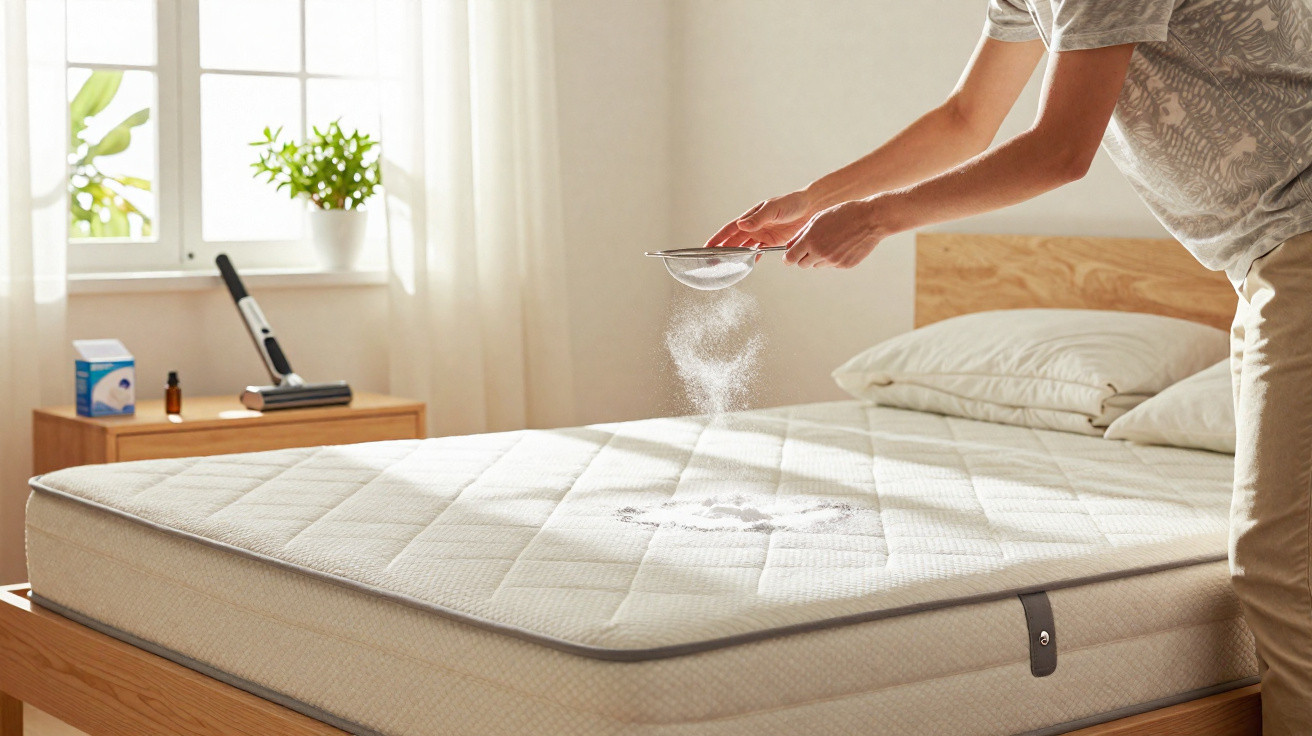
Strip off all covers, then vacuum the mattress surface slowly once. Next, sprinkle a visible, even layer of bicarbonate of soda across the entire surface-right to the edges, corner to corner.
Leave the powder on for several hours; four to eight is ideal, and a full day is even better. During this time, bicarbonate of soda binds odours, absorbs moisture, and has a mild antibacterial effect. If sunshine reaches the room, open the window wide and let light and fresh air help. When it’s done, vacuum everything thoroughly. The surface may not look dramatically different-but very often it suddenly smells like a freshly aired spare room.
The most common mistake is impatience. People sprinkle a little bicarbonate of soda only on the “dodgy spot”, wait an hour, and then wonder why the smell is still there. A mattress is thicker than it looks, and odours sit deeper than a coffee mark. So: treat the whole surface, give it time, and ideally prop the mattress slightly so air can circulate underneath too.
Another mistake is going overboard with fragrance. Fabric sprays, clouds of softener scent, reed diffusers right beside the bed-these only mask the odour briefly. After that, you’re left with a blend of vanilla and stale damp. Bicarbonate of soda isn’t a magic wand that makes mould vanish; it’s more like a quiet helper that neutralises smells rather than covering them up. Keep that in mind and the result feels more genuine-and your bedroom less like a perfumery.
Some people have sworn by their “bicarbonate Sunday” for years: a free morning, strip the bed, dust the mattress, windows wide open. One of them once told me:
“Since I started treating my mattress with bicarbonate of soda twice a year, my bedroom smells more like fresh air than like the day before. It’s like giving yourself a small new bed every time.”
If you don’t want to rethink it each time, a simple routine helps:
- Once or twice a year, cover the entire mattress with bicarbonate of soda and leave it for several hours.
- After each treatment, vacuum both sides and flip or rotate the mattress.
- For fresh stains (coffee, urine, sweat), start with a lightly damp cloth and a mild cleaner; only then use bicarbonate of soda to tackle lingering odour.
- Never leave a mattress directly on the floor long-term-having some air under the bed works like a natural dryer.
- Change fitted sheets regularly, and much more often in summer than in winter.
What a fresh bed does to your everyday life
A fresher mattress changes more than you might expect at first. Getting into a bed that smells neutral makes you feel more mentally settled. Your brain scans the room without you realising-light, temperature, sounds, and smell. When that check doesn’t get stuck on “a bit stale”, it’s easier to let the day go. That isn’t wellness fluff; it’s a small, physical form of respect for yourself.
We underestimate how much the “invisible” affects us. A musty mattress smell is like quiet background noise-you only notice it once it’s gone. Some people say they sleep more deeply after a thorough bicarbonate treatment; others say they no longer feel embarrassed about their bedroom when guests stay over. A clean, good-smelling mattress doesn’t mean you’re a perfect person. It simply says you’re allowing yourself to feel properly looked after in your everyday life. And perhaps that’s the understated luxury we too rarely give ourselves.
| Key point | Detail | Benefit for the reader |
|---|---|---|
| Understanding musty odours | Combination of moisture, skin flakes and poor ventilation | Helps you see the smell isn’t a “fault”, but a normal process you can control |
| Using bicarbonate of soda deliberately | Cover the whole surface, leave for several hours, vacuum thoroughly | Gives you a simple, low-cost way to noticeably refresh a mattress |
| Routine instead of panic-cleaning | Bicarbonate treatment 1–2 times a year, regular airing and flipping | Builds a relaxed, realistic care routine you can actually stick to |
FAQ:
- How often should I treat my mattress with bicarbonate of soda? For most households, once or twice a year is enough. If you sweat heavily, let pets on the bed, or have small children, you can shorten the interval to every three to four months.
- Can I use bicarbonate of soda on every mattress type? Yes-nearly all common mattresses (foam, latex, sprung) can handle bicarbonate of soda on the surface. The key is to use it dry and vacuum thoroughly so no powder remains in the cover.
- Does bicarbonate of soda help with stains too? It’s excellent for odours. For stains, you’ll need a gentle damp clean first; bicarbonate is better as a second step to neutralise lingering smells.
- How long should bicarbonate of soda stay on the mattress? At least three to four hours, ideally six to eight. The more time the powder has, the more moisture and odour it can absorb. A full day by an open window is perfect.
- Is bicarbonate of soda safe for allergy sufferers and pets? Bicarbonate of soda itself is generally well tolerated and is even used in cooking. Important: vacuum thoroughly afterwards so neither you nor pets breathe in or lick up any powder.



Comments
No comments yet. Be the first to comment!
Leave a Comment