
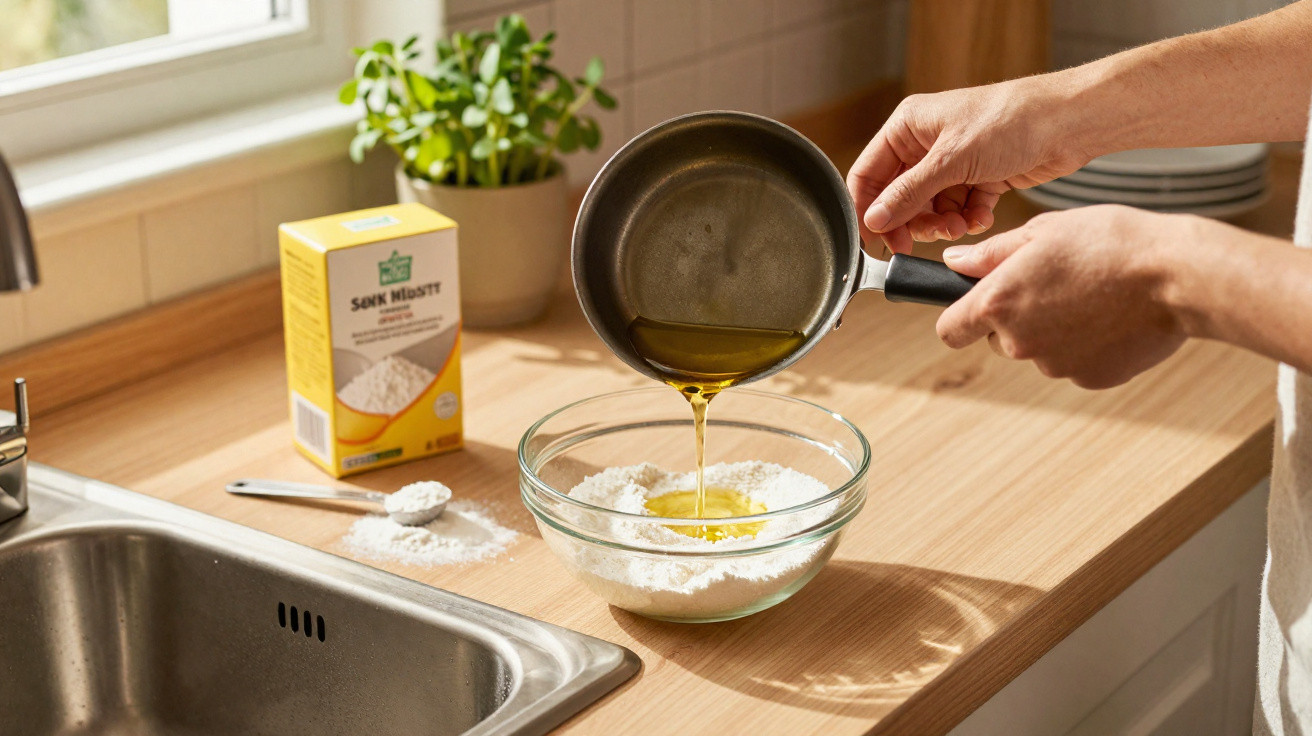
A single everyday cupboard ingredient can make all the difference.
When you clean up after frying schnitzel or using a deep-fat fryer, it’s tempting to look for the quickest fix. Liquid fat seems harmless: it disappears down the sink and is out of sight. In reality, that’s where a problem starts-one that often only shows itself weeks later, when the drain starts gurgling, smelling unpleasant, or even blocking completely. A humble powder from your kitchen can prevent that drama entirely-no chemicals, no drain cleaners, no emergency plumber.
Why your kitchen sink really “hates” cooking oil
Frying oil and cooking fat can be deceptively tricky. While it’s still hot, it runs smoothly through the strainer and into the waste pipe. Once inside the pipework, though, it meets cold water and cools down rapidly.
“Liquid fat turns into a sticky film inside the pipe, building up layer by layer until it becomes a solid plug.”
That film is the real issue: it clings to the pipe walls and then traps food scraps, hair, coffee grounds and anything else that later passes through the line. The result:
- slower draining water
- unpleasant smells coming up from the U-bend
- in the worst case, a complete blockage and backing up
Plumbing firms have been reporting for years that a large share of call-outs in city flats comes down to fat in the pipes. People often don’t notice anything for a long time-until the water suddenly sits in the bowl and an emergency visit becomes unavoidable.
There’s also the environmental impact. In wastewater treatment works, fats combine with other residues to form real “fatbergs” that have to be removed with significant effort. That takes energy and staff time and puts pressure on public infrastructure. Less oil down the drain means less strain on local systems.
The unassuming powder solution from your kitchen
Instead of pouring fat into the sink, you can turn it into a solid lump that can go into your general waste as normal. The trick is a starchy, fine powder such as cornflour.
“A dry, high-starch powder soaks up the fat and binds it into a semi-solid mass that can no longer flow.”
Those fine particles contain lots of tiny spaces. They absorb the oil like a sponge, combining with it into a paste that becomes noticeably firmer within a few hours. What was a slippery, hard-to-control liquid becomes a solid residue that can’t reach your pipes.
Unlike flushing with hot water or relying on harsh drain cleaners, this approach doesn’t just move the problem further along-it stops it happening in the first place. No handling boiling water, no aggressive chemicals that later end up in rivers and lakes-just a straightforward kitchen product.
Step-by-step: how to bind used cooking oil
It couldn’t be much simpler, but it only works properly if you keep two things in mind: temperature and patience.
What you’ll need
- used cooking oil or frying fat (for example, from a frying pan or deep-fat fryer)
- 1–2 tablespoons of a fine kitchen powder (for example, cornflour)
- a jar or another sealable container
- a spoon for stirring
What to do
- Let it cool: Allow the fat to cool a little after cooking. It can be warm, but it must not be hot and steaming.
- Pour into a container: Tip the warm oil into a jar or an old plastic container that you were going to throw away anyway.
- Add the powder: Sprinkle 1–2 tablespoons evenly over the surface and stir in slowly.
- Wait for it to thicken: Keep stirring until the liquid clearly becomes more viscous. Then seal the container.
- Leave it to stand: Set the container aside at room temperature for at least a few hours-overnight is ideal.
- Dispose: The next day, a compact mass will have formed, and you can put it (container and all) into your general waste bin.
If you fry regularly or do a lot of browning, you can keep an old screw-top jar as a dedicated collection container and build up layers of fat and powder over time. Once it’s full, close it and put it straight in the bin.
No cornflour at home? These alternatives work too
Many kitchens already have other powders that absorb fats just as well. The key is simple: as fine as possible, as dry as possible, and very absorbent.
| Product | Suitability for binding fat | Note |
|---|---|---|
| Wheat flour | good | widely available, binds a little more slowly |
| Baking powder or dried yeast | good | fine texture, blends well with oil |
| Fine food starch (for example, rice or potato starch) | very good | similar effect to cornflour |
| Arrowroot | very good | binds particularly quickly, often found in gluten-free kitchens |
| Coffee grounds (dried) | moderate | eco-friendly, but coarser and more uneven |
| Fine wood shavings / sawdust (untreated) | moderate to good | only suitable if free of varnishes or chemicals |
If sustainability matters to you, there’s room to be creative here. What matters most is that the powder is dry. Damp coffee grounds, for instance, need to air-dry first-otherwise they won’t absorb the oil effectively.
Why this protects not just your pipes, but the environment too
Fat poured down the drain doesn’t simply vanish. In the sewers, fats react with limescale and other substances to form hard chunks. Council services then have to remove these deposits with considerable effort, driving up costs and energy use.
“Every gram of fat that goes into general waste instead of the pipework reduces the burden on sewers, treatment works, and ultimately rivers and lakes.”
By binding your cooking oil, you reduce several pressures at once:
- less risk of blocked pipes in your own home
- less reliance on harsh drain cleaners
- less build-up of fat deposits in the urban network
- less work and energy consumption at wastewater treatment works
There’s a financial angle as well: avoiding even one emergency plumbing visit can easily save a three-figure sum. A spoonful of powder, by contrast, costs only pennies.
How to make the trick part of your everyday cooking routine
The biggest obstacle isn’t the method-it’s habit. Many people go on autopilot when washing up, especially when they’re in a hurry. Two simple changes can help the new routine stick:
- Keep a jar for fat residues in plain sight next to the hob.
- Store the cornflour (or another powder) right beside it.
- Make it a rule: oil goes into the jar first-never into the sink.
- Tie the mixing step to a fixed moment after cooking, such as while you clear the table.
After a few weeks, it stops feeling like “extra work” and simply becomes part of cooking-much like opening a window after frying.
What else you should know about used cooking oil
If you have large quantities of leftover frying oil, it’s also worth checking local collection points. Many waste services provide containers where used cooking oil is gathered and processed into biodiesel or other products. For smaller amounts from a frying pan, the powder-binding method is completely sufficient.
Important: never pour burning or very hot fat into a container-there’s a burn risk, and the container could melt or split. Only proceed once you can handle the pot without an oven glove; that’s a good sign the oil is cool enough for the next step.
The powder trick is also useful on campsites or in holiday lets, where drains can be more sensitive. Packing a small bag of cornflour can prevent an unpleasant surprise on the last day of your trip.




Comments
No comments yet. Be the first to comment!
Leave a Comment