
Some people have them tucked away and don’t realise they’re sitting on a quiet little goldmine.
Between perspiration, detergent build-up and years spent folded in a cupboard, white sheets often lose their crisp brightness fast. Rather than passing them on without a thought, it’s worth pausing: that yellowing can hide genuinely good cloth that can be turned into surprisingly current home décor projects - without spending a penny in an interiors shop.
Why yellowed sheets so often end up in the donation bag too quickly
The usual reaction is simple: sheet looks yellow, the look is “meh”, so out it goes. The intention is fair - nobody wants to bin textiles for no reason. The catch is that a yellow tinge rarely means the fabric is finished.
Very often it’s just surface oxidation. The cloth underneath is still firm, the fibres are sound; it’s mainly the top layer that’s aged. If you donate or throw them away too quickly, you can easily give up fabric that’s noticeably tougher than what you later buy new.
Yellowed sheets are rarely rubbish - they’re often better raw material than many of today’s cheap fabrics from the shops.
There’s another detail many people miss: older bedding - especially from the 1950s to the 1980s - was frequently woven more densely. That tighter weave is exactly what makes it ideal for a second life around the home.
Where does the yellowing actually come from?
That yellow cast usually comes from several common factors that tend to stack up:
- Sweat: salts, acids and proteins settle into the fibres.
- Body oils and skincare products: greasy residues deepen staining.
- Too much detergent: overdosing leaves a film that darkens over time.
- Fabric softener: coats the fibres, can make laundry seem “clean”, then later turns yellow.
- Damp storage: bacteria and micro-fungi create a musty, yellowish haze.
- Light: UV rays alter fibres gradually, especially if stored where sunlight hits the fabric day after day.
Some of this happens slowly over years, which is why a sheet can look far more “aged” in the cupboard than it feels when you handle it.
The anti-yellow routine: what genuinely helps
Many people reach straight for chlorine-style bleach, but that can put unnecessary strain on the fibres. A gentler approach is a small, consistent routine you repeat every few months.
In the washing machine: simple ingredients, big results
For typical yellowing, a few household staples plus the right temperature are often enough:
- Add white vinegar (diluted vinegar essence): about one cup in the fabric-softener drawer. It helps lift detergent residue and neutralises odours.
- Use percarbonate (oxygen bleach) for stubborn cases: soak the sheet overnight in very hot water with plenty of powder, then wash at 40–60 °C.
- Dose detergent moderately: extra powder doesn’t mean cleaner washing - it often means more residue.
- Skip fabric softener: if you want a softer feel, use a little vinegar or bicarbonate of soda instead.
If you sweat heavily, washing sheets weekly is sensible; otherwise, every two weeks usually does the job. That way the yellow film doesn’t get a chance to build up.
Drying and storage: where the fabric’s future is decided
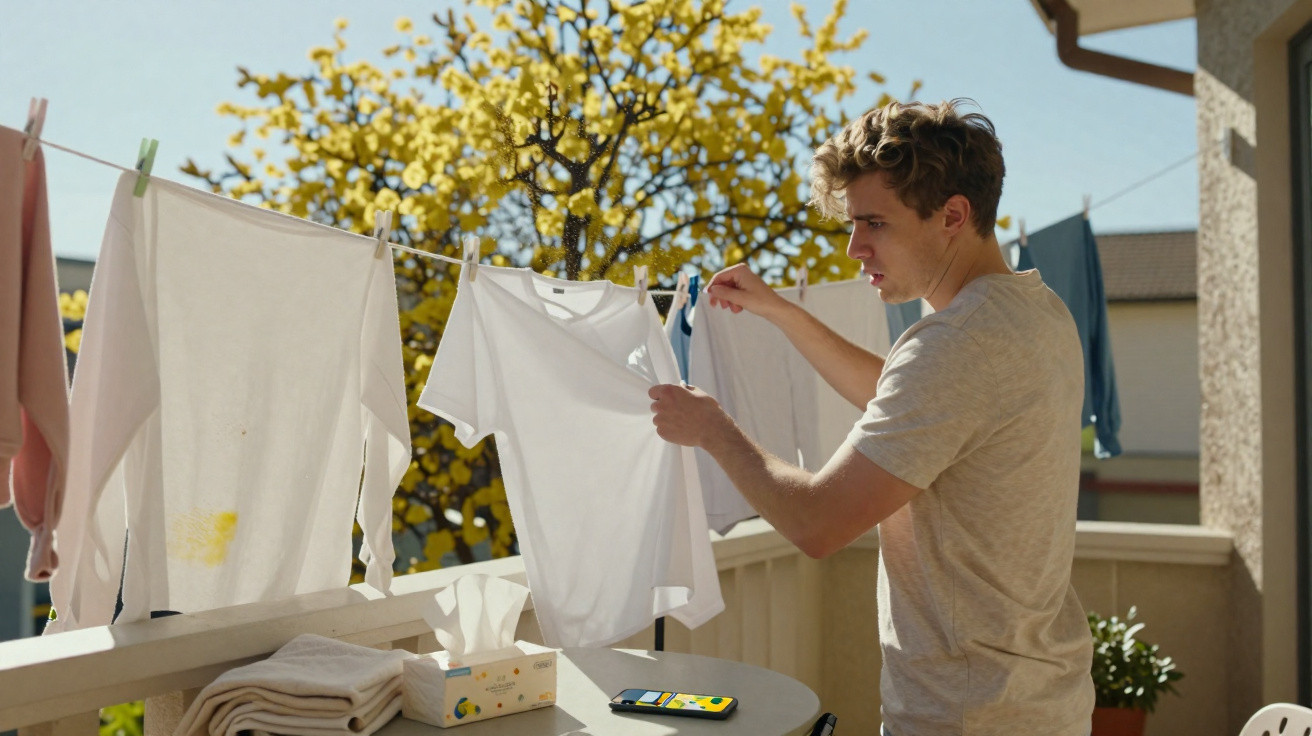
When it comes to drying, sunlight works in your favour: UV light naturally lightens fabric a little. A few hours outside on the line is enough. After that, store linens fully dry, airy and in the dark - not in a damp cellar and not in an unheated box room. Done this way, the material stays fresh for much longer.
Why old sheets are often far better than new ones: linen, hemp & co.
If you’re holding bedding made before the 1990s, there’s a good chance it’s truly premium cloth: linen, hemp, or so-called Metis fabrics (a linen–cotton blend) with a high grams-per-square-metre weight. 180 g/m² and above was not unusual at the time.
In practical terms, that tends to mean:
| Property | Old linen/Metis sheets | Many new low-cost fabrics |
|---|---|---|
| Fabric weight | high, dense hand-feel | low to medium, often thin |
| Durability | strong tear resistance, lasts for years | more prone to abrasion, pilling |
| Moisture absorption | linen: up to about 20 % of its own weight | often feels “clammy” sooner |
| Use as décor | hangs nicely, looks substantial | looks lighter, less textured |
On these materials, the yellowing is usually caused by surface oxidation or old finishing agents from manufacturing. As long as you can’t see holes, tears or brittle patches, the fibres themselves typically remain stable.
An old linen sheet is less “rag-bag” and more a quiet luxury textile that never made it onto an interiors shelf.
One more angle: continuing to use what you already own avoids the CO₂ burden of new production. Environmental agencies such as France’s ADEME have been pointing out for years that extending the life of existing clothes and home textiles is one of the strongest levers for everyday sustainability.
Teint-Nuage: when yellowing becomes the design idea
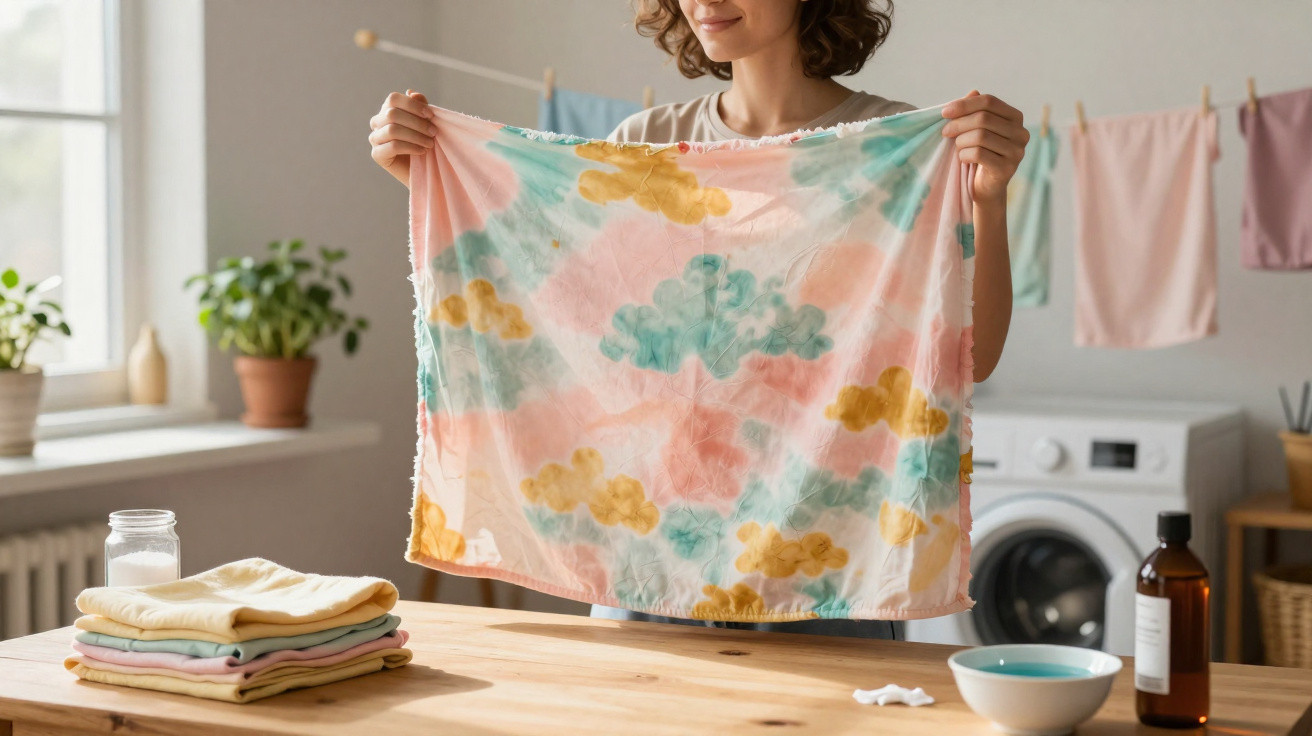
Things get especially interesting with a trend currently doing the rounds among DIY fans: “Teint-Nuage”, also known as Cloud Dyeing. The concept is simple: instead of trying to erase discolouration, you turn it into a marbled pattern that looks intentional.
How Cloud Dyeing works step by step
To get an evenly nuanced finish, a clear sequence helps:
- Pre-wash: wash the sheet at 60 °C with a little washing soda crystals to remove finishes and softener residue.
- Dampen the fabric: wet the sheet evenly so the dye spreads more softly.
- Loosely roll or scrunch: form a relaxed ball and secure it with elastic bands or string. This is what creates the characteristic cloud shapes.
- Mix the textile dye: prepare an Oeko-Tex-certified dye according to the instructions. If required, add the specified salt quantity (for example 500 g).
- Apply the dye: either immerse the sheet fully in the dye bath or use a pipette/brush for partial application, depending on how marbled you want it.
- Processing time: leave for around 45 minutes, then rinse thoroughly and wash again.
The result is a softly shaded pattern reminiscent of clouds, smoke or stone - ideal for turning stiff “hotel white” into a modern, designer-looking piece.
Practical décor ideas: what old sheets can actually become
Once you realise how hard-wearing older sheets are, they start to look like a stash of raw materials. Large, wide flat sheets in particular are worth cutting up.
One sheet - several projects
A classic double-bed sheet from the 1950s, for instance, can be enough for:
- A large dining or farmhouse tablecloth: cut to roughly 240 x 140 cm, perfect for long dining tables. In muted tones such as greige, pearl grey or terracotta, the cloth quickly reads like expensive linen from a concept shop.
- Fabric napkins: cut the offcuts into 40 x 40 cm squares, hem them, and you’ve got a sturdy set that makes any disposable option look second-rate.
- Tea towels: linen and Metis dry glassware without streaks. Long cuts work brilliantly as high-quality “glass cloths”.
- Cushion covers: matched to the tablecloth or napkins, they look like a coordinated décor scheme.
A sewing machine helps, but simple hems are also manageable by hand. With robust linen in particular, the fabric forgives small inaccuracies; that slight imperfection suits the vintage feel.
What to check before you start upcycling
Before you commit to a bigger design project, a quick inspection pays off:
- Check the fabric: hold the sheet up to the light. If lots of thin areas show through, stick to smaller makes (napkins, patches).
- Do a smell test: a musty old odour usually disappears after two or three intensive washes with added vinegar.
- Look at the seams: older stitching can be fragile. If in doubt, resew seams before putting them under tension.
- Assess stains: stubborn spots can be placed in less visible areas during cutting - or sent straight to the bin.
If you give the sheet a proper “screen” like this, you avoid frustration later and can choose the right project from the start.
How this affects everyday life, your wallet and the environment
A brief reality check makes the impact tangible. Imagine a household has five old, yellowed sheets. Normally, they’d go into a donation container, and replacements would come from a furniture discounter: a new tablecloth, new napkins, new kitchen towels.
If, instead, you refresh all five sheets, you can produce several large tablecloths, a full napkin set, stacks of tea towels and a few cushion covers - without spending a single pound on new fabric. The purchases you avoid also cut down on transport miles, packaging waste and new production. At the same time, you’re not adding to the piles of unwanted textiles that are difficult to process anyway.
Why yellowed sheets, of all things, spark creative projects
The supposed flaw - the yellowing - can be oddly freeing. When you buy a flawless white designer sheet, you often hold back: you don’t want to “ruin” it. With an older piece of fabric that already carries a bit of history, experimentation feels less risky.
That has an interesting side effect: you start to view textiles as materials, not as finished products with fixed jobs. A bed sheet becomes a tablecloth; the tablecloth later becomes a picnic mat; the leftovers turn into fabric napkins for children’s parties. It’s a cycle that can last for years.
Approach your cupboards that way and you stop seeing yellowing as a defect - you see it as the starting signal for something new. That’s exactly the appeal of this understated décor idea, and it’s rarely what anyone expects when they open the cupboard door.
Comments
No comments yet. Be the first to comment!
Leave a Comment