
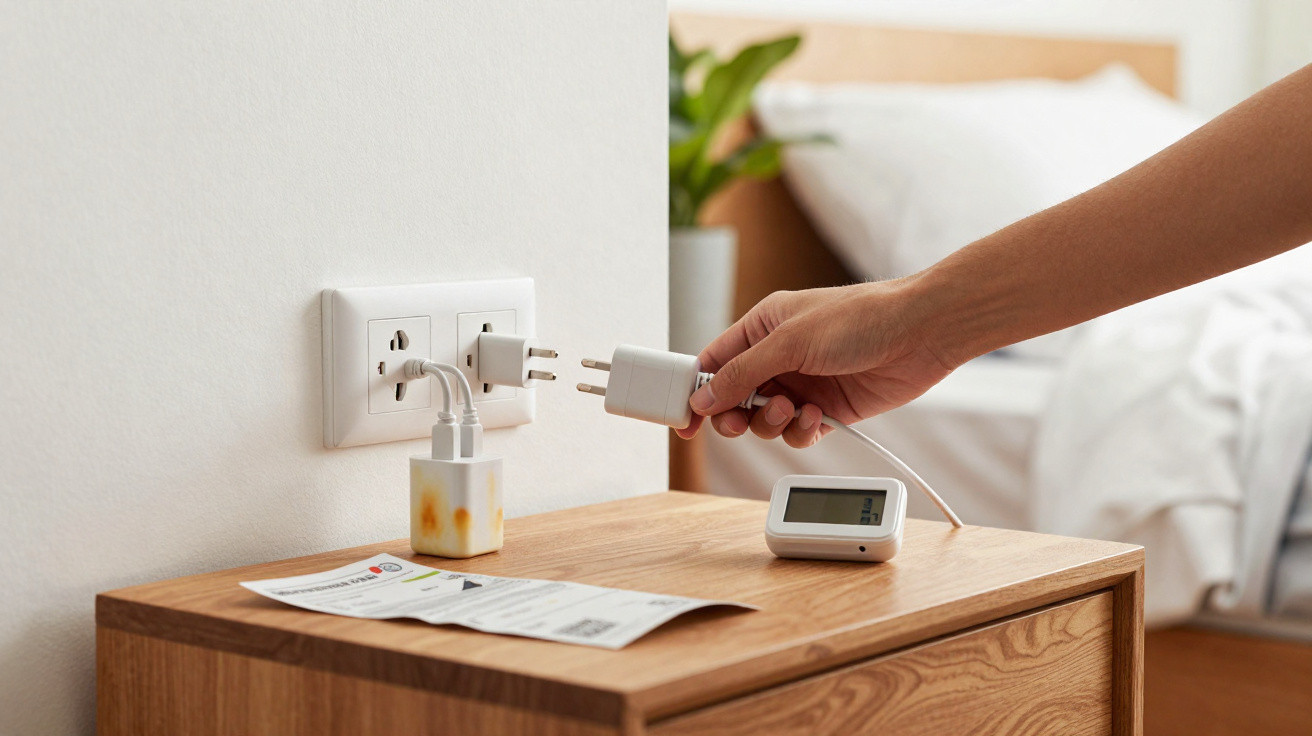
Most people only reach for the cable when the battery is flat, and rarely stop to consider that the charger itself is often left connected to the mains around the clock. That convenient habit can carry risks that are easy to dismiss - from fire hazards to needless electricity costs.
A daily reflex with hidden downsides
It is a familiar routine: you unplug your phone, glance at a message, sit down on the sofa - and the plug stays in the wall. The reasoning seems sensible: “I’ll charge it again later, so the cable can just stay in.” That is exactly where the trouble begins.
A charger is still “live” the moment it is left in a plug socket. Even when no phone is attached, internal electronics continue converting mains voltage into a lower, safer output. That process does not simply pause because a smartphone is not connected.
A plugged-in charger is not a dead object - it keeps working in the background, uses energy and can warm up.
With well-made models, the danger is usually limited. The situation becomes far more problematic with bargain chargers picked up for a few pounds online, at a supermarket checkout, or as a last-minute travel purchase. In that price bracket, manufacturers often cut corners on components, insulation and temperature monitoring.
Why a charger left in without a phone can become dangerous
Cheap components, high temperatures
Low-cost power adaptors often contain transformers, capacitors and coils that are put under greater strain when they run continuously. If quality is poor, these parts can overheat. The result can be a hot casing, softening or melting plastic, and even deformed contacts.
Electricians repeatedly describe call-outs where plug sockets are discoloured or slightly scorched - not because of a large appliance, but because of small charging adaptors. In many cases, the device has been quietly drawing power for hours or even days, with nobody paying attention.
The typical early warning sign is a faint smell of singed plastic near a plug socket where a cheap charger is connected.
In rare but genuine cases, that build-up of heat can lead to smouldering or open flames - especially if the adaptor is in an extension lead tucked behind furniture, where heat cannot escape.
Standards help - if you follow them
Regulators and testing bodies set clear safety requirements for chargers. Only products with the appropriate marks (such as CE, ideally alongside additional European certification seals) are designed to meet these standards. They typically include, for example:
- limits on maximum temperature during continuous use
- sufficient insulation between high and low voltage
- fuses or other protection that cuts the circuit in an emergency
- materials that are difficult to ignite
Chargers sold via questionable marketplaces without recognisable certification often compromise precisely on these points. Leaving those adaptors plugged in 24/7 increases the risk significantly.
The quiet power drain: “electricity from nowhere”
Alongside safety, there is the issue of wasted energy. Technicians refer to “standby consumption” or “phantom power” when devices draw electricity despite not being actively used.
A single charger left in a socket typically consumes only a few tenths of a watt. That sounds negligible. It becomes more meaningful once you scale it up: many homes have several adaptors permanently plugged in - in the living room, bedroom, home office area and children’s rooms.
What feels like a tiny amount adds up across millions of households into a noticeable share of electricity use.
Studies by energy agencies indicate that standby and unused devices connected to the mains can account for up to around ten per cent of a household electricity bill. Laptops, televisions and games consoles usually have a bigger impact, but chargers still play their part.
The dripping tap of the electricity grid
The idea is easy to picture: one drip from a leaking tap seems insignificant. Yet, over time, the bucket fills. In the same way, small amounts of electricity flow day and night into plugged-in chargers, even when no phone is charging.
| Situation | Electricity use | Day-to-day impact |
|---|---|---|
| Charger actively charging a smartphone | relatively higher, but time-limited | necessary to use the device |
| Charger plugged in with no phone attached | low, but continuous | no benefit at all - only costs and risk |
The key point is that this consumption brings no comfort or advantage. It does not deliver a full battery or any visible benefit - just a slightly higher bill and an unnecessary burden on the grid and the environment.
Living more safely and cheaply with a few small actions
Simple routines that cut risk and cost
You do not need to overhaul your day to reduce the problem. A few small habits are enough:
- unplug chargers consistently once charging is finished
- dispose of power adaptors immediately if they show visible damage, cracks or loose connections
- use only certified branded products or properly tested models
- use extension leads with a switch to disconnect several chargers at once
- set defined charging areas at home rather than scattering individual plugs everywhere
Every plug you pull reduces both fire risk and unnecessary standby consumption.
When leaving the house in the morning or going to bed at night, it helps to do a quick “power glance” around the rooms: are any chargers hanging empty in a socket? One quick movement takes them off the mains.
Where the charger should be at night
Many people put the phone - and the charger - under a pillow or on the sofa seat. For several reasons, that is a poor choice. Cushions, duvets and fabrics trap heat and can ignite more easily if something overheats. There is also mechanical strain: cables bend sharply and contacts can loosen.
A safer option is a firm, clear surface such as a bedside table, a shelf or a sideboard. Air should be able to circulate around the adaptor. Unplugging after use and storing it in a drawer also reduces the risk of children tugging at cables or pets chewing them.
Why even good chargers should not be left plugged in all the time
You might argue: “My charger is from a well-known brand, so nothing will happen.” Certified adaptors are indeed much safer. Even so, leaving them permanently connected achieves little.
High-quality electronics still age. The longer components sit under voltage, the more they are exposed to heat, moisture and spikes on the mains supply. Over the years, the likelihood rises that a capacitor dries out, a solder joint becomes brittle, or a protective circuit fails.
If you only use chargers when you genuinely need them, you extend their lifespan and reduce the chance of faults.
There is also a psychological element: when a plug is always in place, you become used to the sight and may be less alert to warning signs such as unusual warmth or smells. If you regularly plug in and unplug, you are more likely to notice changes.
What can happen in a real emergency - and how to respond
A plausible scenario: late in the evening you notice a faint smell of burnt plastic in the living room. The television is off, but an extension lead is lit up. A cheap charger for an old phone is plugged into it. When you go near it, the adaptor feels hot.
In that situation, the first step is to switch off the extension lead or pull the plug out, without grabbing the adaptor itself if it seems extremely hot. Once it has cooled, dispose of the charger - do not keep using it. Any slight discolouration around the socket is a sign to consult an electrician.
Better still is preventing the stress in the first place: do not rely on suspicious or unbranded adaptors as permanent fixtures. If you are unsure, choose the original charger from the smartphone manufacturer or products from suppliers that can clearly demonstrate compliance with safety standards.
How digital habits are changing electricity use
As homes fill with more devices - smartphones, tablets, smartwatches, headphones and e-readers - the number of chargers rises almost unnoticed. Each one seems trivial, but together they reshape a flat’s or house’s electricity profile. Many households now have half a dozen power adaptors permanently on the mains without realising.
If you think ahead when buying new tech and aim to manage with fewer chargers, the long-term savings add up. A single power adaptor with multiple USB ports for the whole family can replace roughly four individual adaptors. Paired with a switched socket or switched extension lead, the entire “charging hub” can be disconnected with one click.
Fewer chargers, used more deliberately - that approach lowers risks, saves money and reduces unnecessary strain on the electricity grid.
Ultimately, it comes down to a small change in behaviour: a charger is not a fixed part of the home, but a tool. You use it, unplug it and put it away. That seemingly minor step separates everyday convenience from avoidable danger - and makes the difference between a silent power drain in the wall and safe, controlled use of electronics.






Comments
No comments yet. Be the first to comment!
Leave a Comment