
The humble washing-up sponge has long been considered one of the biggest breeding grounds for germs in the home. Researchers warn that many popular cleaning tricks achieve very little - and some can even make matters worse. A small accessory from Action, costing under €3, is being touted as a way to keep dishwashing cleaner without having to overhaul your whole routine.
Why the classic kitchen sponge turns into a germ problem
At first glance, the yellow or green sponge by the sink looks harmless. In reality, hygiene specialists rank it among the most contaminated items in many households - often worse than the toilet bowl. Food particles, grease and detergent residue collect inside the damp fibres, creating ideal conditions for bacteria.
A research team at Furtwangen University of Applied Sciences took a close look at what happens inside these sponges. Their finding: after only a short period of use, huge numbers of micro-organisms take hold and multiply quickly. Even thorough rinsing only reduces the germ load for a short time.
The sponge remains a permanently damp, warm breeding ground - perfect for bacteria that later end up back on plates, glasses and worktops.
Why rinsing, the microwave and vinegar often do very little
Many households try to “revive” a sponge - using hot water, vinegar, washing-up liquid, or a brief spell in the microwave. The Furtwangen study suggests that, over time, these approaches are not enough to keep contamination reliably low. In some cases, hardier bacterial strains survive and then spread even more.
The underlying issue doesn’t change: a sponge rarely dries out fully. It sits in a wet sink, in a puddle, or in a well-meaning but poorly ventilated sponge holder. That keeps it damp for hours or days - and that’s what makes it a problem.
What hygiene specialists recommend instead
Experts tend to advise a straightforward approach: rescue less, replace more often. If you wash up daily, you should change your sponge roughly weekly; some recommend even shorter intervals with heavy use.
- Replace the washing-up sponge regularly (guideline: every seven days)
- Rinse it thoroughly after washing up and squeeze it out
- Store the sponge so it can dry properly
- Use separate cloths or brushes for heavily soiled areas
- Clean worktops with washable microfibre cloths instead
Washable sponges or cloths can be cleaned in the machine at high temperatures and create less waste. However, the researchers still point out that as long as the material stays wet for long periods, germs remain an issue. The goal is to reduce contact time with water and get rid of residual moisture as quickly as possible.
The Action gadget for under €3: washing-up liquid dispenser with sponge holder
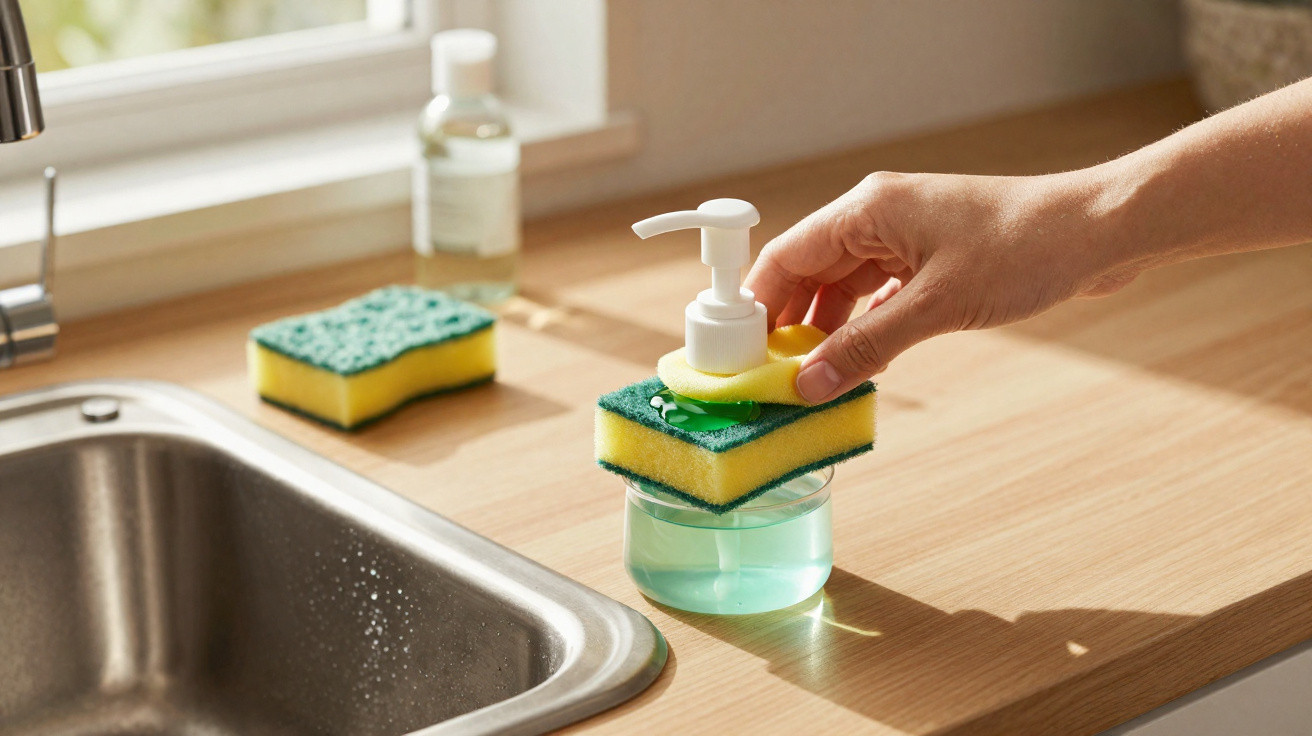
This is exactly where a kitchen helper from Action comes in - one that’s currently getting a lot of attention on social media. It’s a compact washing-up liquid dispenser with an integrated sponge platform. Price: under €3.
The design is straightforward. At the bottom is a container you fill with washing-up liquid. On top sits a flat area where the sponge rests. Pressing down with your hand activates a simple mechanism that pumps washing-up liquid straight into, or onto, the sponge. That makes an extra plastic bottle perched on the edge of the sink unnecessary.
With one press, a defined amount of washing-up liquid comes out from the centre of the platform - you only get more if you press again.
How the dispenser doesn’t kill germs, but does make day-to-day washing up more hygienic
The key isn’t the washing-up liquid itself so much as the build. The sponge sits raised on the dispenser platform rather than soaking in sink water. Any water that drains out after use collects in the lower container, which can later be emptied and cleaned.
That has several benefits:
- The sponge dries faster because it isn’t sitting in a pool of water.
- The washing-up liquid is dispensed more sparingly, which many users find helpful.
- The sink area looks tidier because there’s no loose bottle of washing-up liquid.
- The catch container can be emptied and washed regularly.
Testers particularly praise how easy it is to use at the sink: one press and you can get started. If you often “accidentally” pour too much washing-up liquid from a bottle, this can cut costs while also reducing unnecessary foam and residue in the sink.
Is that enough to make the sponge hygienic?
Hygiene professionals are clear: no. The dispenser doesn’t disinfect anything - it simply creates better conditions. The basic advice still applies. Even with this system, the sponge should be replaced regularly. Research also notes that many pathogens can survive for a long time in damp environments, even when a surface looks “clean”.
The gadget only really makes sense alongside a few simple rules:
- After every wash-up, rinse the sponge well and squeeze it out.
- Store the sponge only on the dispenser platform, not in the sink beside it.
- Empty the container at least once a week and clean it thoroughly.
- Throw the sponge away and replace it consistently after about a week.
If you stick to these points, you can significantly reduce the bacterial load. At the same time, you’ll use less washing-up liquid - which not only helps your budget, but also reduces what ends up going into wastewater.
More hygiene in the kitchen: sensible alternatives and add-ons
The sponge is only one part of kitchen hygiene. Many people now use brushes with plastic or natural bristles. They dry more quickly and are easier to clean. For stubborn residue on trays or pans, they’re often more effective than soft sponges.
A useful mix can look like this:
- A brush for coarse food scraps and heavily soiled pans
- A sponge for glasses, delicate crockery and surfaces
- Washable microfibre cloths for worktops and tables
All of these tools benefit from clear routines: separate use for different zones, frequent rinsing, enough drying time, and regular replacement. Anyone who cooks often will need multiple cleaning tools in reserve anyway - which is ideal for rotating between items that are damp and those that are almost dry.
What many people underestimate: you can’t “feel” germs
A sponge can smell fine and feel clean while still being heavily contaminated with bacteria. The typical musty odour usually appears only later. If you rely on smell or appearance to decide when to replace it, you’ll often keep the same sponge for far too long.
A fixed system is more practical. For example, if you throw out the old sponge every Sunday evening and put a new one on the dispenser, you don’t have to think about it. Families with children can benefit from simple routines like this, because snacks between meals, sticky hands and spilled drinks put extra strain on the kitchen.
Conclusion without a sign-off: a small item that makes a big difference day to day
The Action washing-up liquid dispenser doesn’t eliminate the germ problem entirely, but it does bring more structure and tidiness to the sink area. The sponge stays drier, the washing-up liquid is used more precisely, and the container is easy to clean. Combined with weekly sponge replacement and clear hygiene habits, this simple accessory can significantly reduce the risk of spreading invisible “housemates” across plates and glasses while washing up.
If you want to organise your kitchen in a more modern, hygienic way, a low-cost gadget like this can be a starting point - and you can then adjust other routines step by step, from how often you change tea towels to how you clean chopping boards and worktops. Small changes often have a bigger impact than many people expect.


Comments
No comments yet. Be the first to comment!
Leave a Comment