
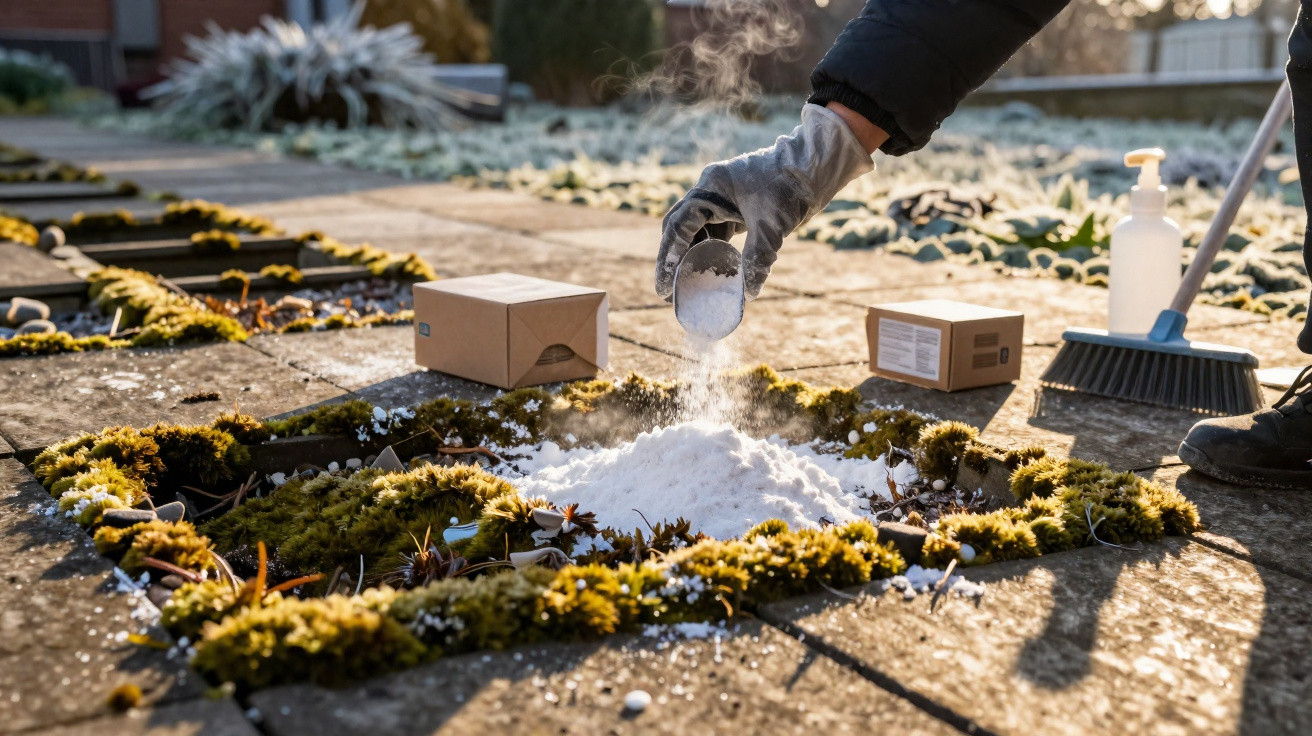
Rather than spending hours in spring scraping joints, blasting with a pressure washer or reaching for harsh chemicals, you can shift the job into the colder months. A familiar white powder found in most kitchen cupboards tackles moss and weeds right down at the root - taking advantage of the fact that plants are far weaker in winter.
Why moss and weeds are so vulnerable in winter
At first glance, winter looks like a pause button: beds appear bare and the patio seems dormant. In the narrow gaps between slabs and paving, however, it is a different story. Roots, spores and seeds sit sheltered in the joints, ready to take off as soon as a milder day arrives.
When plants are in this slowed-down state, even small interventions can knock unwanted growth back for the long term. Acting between January and February is particularly effective because:
- plants are barely growing,
- their metabolism is running at a low rate,
- they struggle to repair damage,
- you have less hassle with watering and follow-up work.
Many people automatically reach for boiling water or vinegar. Both can cause issues: on waterlogged slabs, boiling water may encourage fine cracks, while vinegar may scorch the green top growth but often leaves the roots untouched - so the weeds quickly return.
The overlooked powder from the kitchen
Garden and landscaping professionals often use a different household staple: bicarbonate of soda (sodium hydrogen carbonate). At home it is usually kept as a raising agent or general cleaner. Outdoors on patios, it has another, less well-known advantage.
"Bicarbonate of soda acts like a mineral drying agent: it draws water out of plants and disrupts delicate cells all the way down to the root."
The result comes down to two mechanisms:
- Osmotic effect: the salt changes the concentration at the plant surface and pulls water out of the cells. The plant effectively dries out.
- Alkaline effect: in joints, bicarbonate of soda gently raises the pH. Many mosses and typical joint weeds find this far less comfortable and germinate less readily.
Unlike conventional herbicides, bicarbonate of soda does not rely on complex chemical reactions inside the plant. It simply leaves the tissue short of water. That is exactly why it suits winter use: plants have very little energy to recover.
How the winter treatment works as a dry powder
The simplest approach is to apply it dry straight into the joints. This is best as a preventative measure when the patio has not yet turned heavily green.
Step-by-step guide for dry joints
- Give the patio a quick sweep to remove loose dirt and leaves.
- Measure or estimate the bicarbonate of soda: around 20 grams per linear metre of joint (roughly a small handful).
- Sprinkle the powder lightly over the joints.
- Work it down into the gaps with a stiff brush or broom so it makes contact with the material in the joint.
- Do not rinse - moisture from dew, rain or fog will gradually carry the salt deeper.
Because it dissolves slowly, the active ingredient seeps bit by bit into the top layers beneath the stones. Moss, leftover roots and germinating seeds are put under pressure for weeks - without you needing to scrub at all.
Liquid treatment for heavily greened-over areas
If the patio is already clearly covered in algae and thick moss cushions have formed, the dry method is usually not enough. In that case, a stronger liquid application is more effective.
Simple mixing ratio for a spray solution
| Amount of water | Bicarbonate of soda | Where to use it |
|---|---|---|
| approx. 1 litre | 2 tablespoons | light growth |
| approx. 1 litre | 3 tablespoons | thick moss cushions, stubborn weeds |
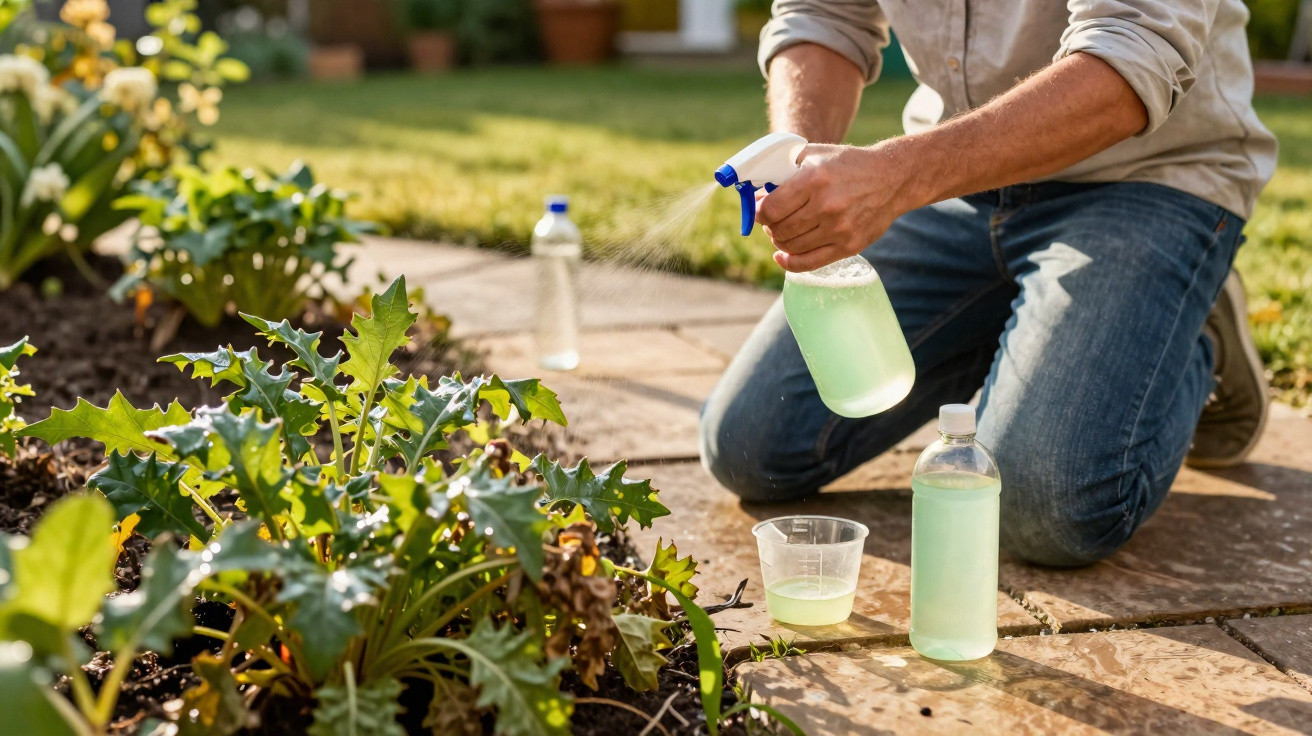
Dissolve the powder completely in hand-warm water, then pour it into a watering can with a narrow spout or a pump sprayer. After that, aim carefully:
- spray or water only the joints and moss cushions,
- choose a dry day with no rain and no strong wind,
- avoid letting it run onto nearby beds.
After one to two days, you will see a clear change in colour: first yellowish, then brown. The plants become brittle and can be swept out of the joints easily the next time you brush the area. Any stubborn patches often respond well to a second, targeted application.
"If you dose it well, in spring you often only need half an hour with a broom - instead of losing half a Saturday to a scraper and pressure washer."
Where bicarbonate of soda makes sense - and where it doesn’t
Although this mineral is very useful on patios and paths, it should not be applied without a bit of thought. At high concentrations it can stress soil and disrupt soil life. Using it in the right place is what matters.
Suitable surfaces
- patio slabs and block paving
- driveways made from concrete or natural stone
- garden paths with firm joints
- outdoor steps
No-go areas
- vegetable beds and fruit plantings
- lawns
- areas where you intend to plant deliberately later
- places with direct run-off into ponds or other sensitive water areas
If you keep bicarbonate of soda on mineral surfaces and prevent run-off towards edible beds, the impact stays low. In most cases, one or two applications per year are entirely sufficient.
How bicarbonate of soda affects moss and soil chemistry
Moss thrives in slightly acidic, damp conditions. Patio joints often provide exactly that: rain, leaf debris, shade, plus a surface that can become more acidic over time. Bicarbonate of soda targets this weak point.
It gently raises the pH at the joint surface and shifts the local environment. Many mosses - and typical joint weeds too - then struggle more. When used sparingly, the effect generally remains limited to a few millimetres in depth. Deeper layers of soil life are relatively unaffected, as long as large quantities are not washed into beds.
Practical tips for less work in spring
Once people have tried the winter approach, they often make it part of their routine. A simple schedule helps keep the patio low-maintenance:
- Late autumn: sweep leaves and organic debris off the patio regularly.
- January/February: pick a dry day and brush bicarbonate of soda powder into the joints.
- Early spring: check visually - if needed, treat small spots with the liquid mix.
- Summer: only light sweeping, remove heavier dirt, and keep an eye on any joint growth.
This method is especially popular with older people or homeowners who do not want heavy machinery. If you would rather not lug a pressure washer around or spend hours kneeling, this white powder offers a quiet, relatively gentle alternative.
Risks and sensible combinations with other measures
Even though it comes from the kitchen cupboard, it is still an attack on plants. If you have very delicate ornamental perennials right along the patio edge, take care that the solution does not seep into those areas in larger amounts. A narrow strip of gravel between bed and paving can act as a buffer.
Another useful long-term companion measure is the joint filler itself. Where joints are very wide, it can be worth using a specialist jointing compound or polymeric sand to make germination harder. Combined with winter bicarbonate of soda treatment, the green growth between stones is often noticeably reduced.
If you want to be cautious, start with a small corner of the patio. That makes it easy to see how quickly moss and volunteer plants respond, without treating the entire area at once. With a bit of judgement on quantity, a simple kitchen staple can become a quiet ally against green film on stone and concrete.


Comments
No comments yet. Be the first to comment!
Leave a Comment