
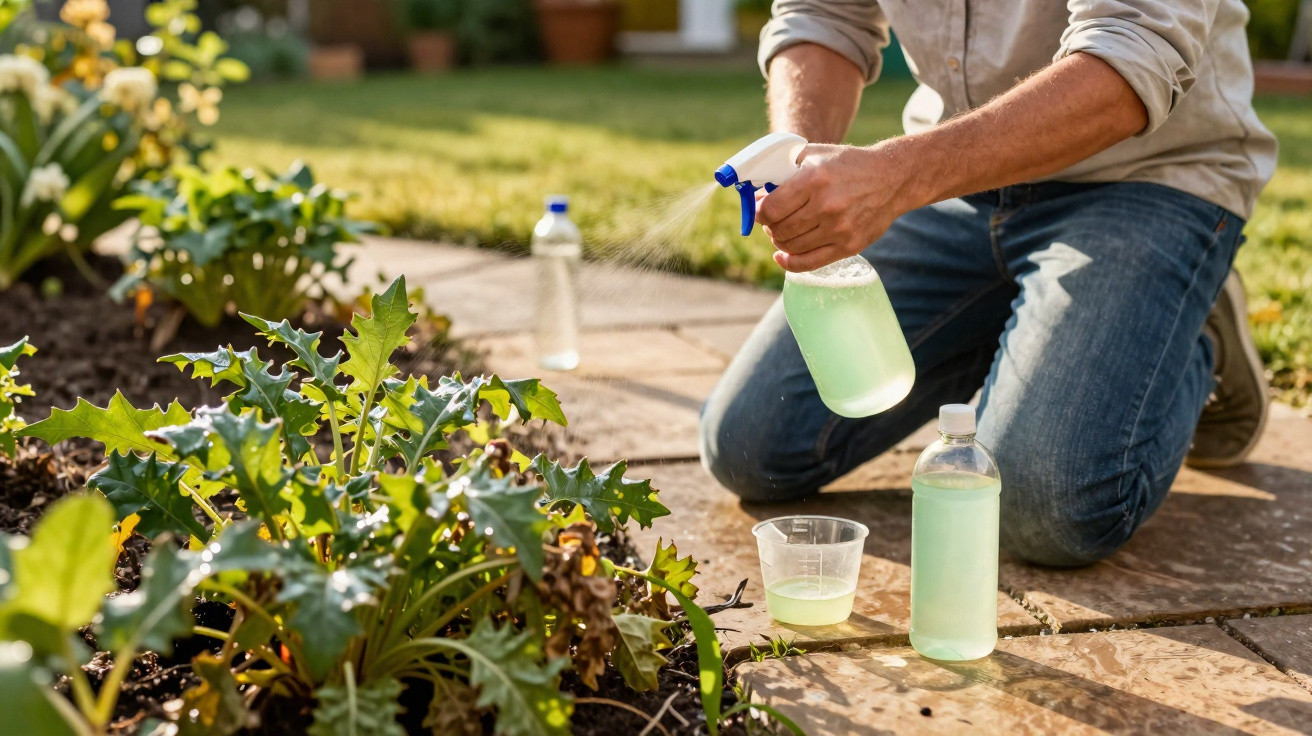
Many keen gardeners reach for white vinegar as soon as weeds appear, or go straight to chemical sprays. Both can work - but often only briefly, or with a nagging sense you’ve taken things a step too far. A different approach is now gaining ground, and it uses something already sitting in most kitchens: washing-up liquid, which becomes a surprisingly effective tool against unwanted growth with one simple tweak.
Why washing-up liquid in the garden is suddenly a game-changer
How surfactants break through a plant’s protective layer
Washing-up liquid is more than fragrance and colouring. What really matters are the surfactants. In the home they lift grease and grime - and outdoors they can interfere with how plants protect themselves.
"The surfactants in washing-up liquid break through the waxy surface of leaves, so liquids stick far better and can penetrate more easily."
Leaves are usually coated with a thin, water-repellent film. It acts like a raincoat: droplets bead up and run off, and additives such as vinegar or salt only sit on the surface for a short time. Add a little washing-up liquid and that changes:
- The protective coating is attacked.
- Water mixed with additives clings to the leaf for longer.
- The liquid can enter the cells more readily.
- The plant loses moisture faster and dries out.
You tend to see the strongest effect on paving, gravel areas and between patio slabs. Weeds in these spots often have shallow roots, yet the hard surface makes them awkward to pull out by hand. A vinegar-and-washing-up-liquid mix weakens them quickly from the top down.
A simple recipe: turning washing-up liquid into a weed helper
The basic blend is straightforward and avoids any specialist chemicals. For many patios and driveways, it’s more than enough.
Base recipe for the garden:
- 1 litre of water
- 1 tablespoon of washing-up liquid (ideally without an aggressive perfume mix)
- optional: 1 cup of standard household vinegar
How to use it:
- Pour the water into a watering can or, better still, a clean pressure sprayer.
- Stir in the washing-up liquid until there are no thick streaks left.
- If you want the extra acidic effect, add a little vinegar.
- Choose a dry, sunny spell - with no rain expected for the next few hours.
- Spray directly onto the leaves of the problem plants, rather than misting the entire area.
Before long the leaves start to droop. Over the following hours to days they discolour, dry out and snap off easily. Compared with pricey specialist products from DIY stores, this approach costs only a few pence per treatment.
Know the risks: where washing-up liquid doesn’t belong in the garden
When a “natural solution” can become a problem
Washing-up liquid sounds harmless - after all, it goes down the drain every day. In the garden, though, surfactants act directly in the soil. If you spray too generously, you can alter the structure of the ground and affect soil life.
"Too much washing-up liquid can compact the soil, disrupt water uptake and put micro-organisms under stress."
For that reason, washing-up-liquid mixes are best kept mainly to mineral, hard-surfaced areas such as:
- patio joints
- paved driveways
- gravel paths and edge strips
- concrete steps and stairways
On flowerbeds, lawns or in the vegetable patch, the mixture has no place. There it can harm not only wild plants but also ornamentals and the soil’s delicate balance.
Be careful with salt: long-term damage is likely
Some gardeners add extra salt to make the mix hit harder. In the short term it can work - but over time it causes clear harm.
Salt builds up in the soil. With each application, the concentration rises. Beyond a certain point, plants can barely take up water because salt deposits around the roots. The ground is effectively “burnt” and can remain difficult to use for years.
It’s better to avoid salt altogether - or, if used at all, keep it to places where nothing should ever grow again, such as under old, fixed kerb edges well away from beds. Even then, there’s still a residual risk that rain will wash salt into neighbouring areas.
How washing-up liquid and vinegar complement each other
Why vinegar alone often disappoints
Vinegar scorches leaves, but with larger or well-established plants it rarely reaches the root. The visible greenery disappears, yet new shoots soon emerge from what’s left below ground. Anyone who relies on vinegar alone will recognise the pattern: not long after, the area looks much the same as before.
Combined with washing-up liquid, the outcome is noticeably better. Vinegar stays on the leaf longer, soaks in more effectively and penetrates deeper into the plant tissue. That increases the pressure on the root system. Even this pairing doesn’t guarantee perfect results, but the boost in effect is clear.
Adjust the strength to the problem area
Not every part of the garden needs the same mix. If you always use the strongest version, you put unnecessary strain on the soil and surrounding areas. A stepped approach makes more sense.
| Situation | Recommended mix |
|---|---|
| Fresh, soft shoots in joints | 1 litre water + 1 tablespoon mild washing-up liquid |
| Dense growth on gravel areas | 1 litre water + 1 tablespoon washing-up liquid + 1 cup vinegar |
| Stubborn clumps on pure stone surfaces | Same mix, applied on several dry days in a row |
If you care about ecological gardening, it’s wiser to choose environmentally certified washing-up liquids with as little perfume as possible. They tend to be less stressful for soil organisms and are entirely adequate for this purpose.
Everyday tips: keeping effort low and the garden tidy
Act early instead of fighting large areas
Washing-up-liquid mixes are most efficient when you don’t wait until the driveway looks like a meadow. As soon as the first plants appear in the joints, a quick sweep with the sprayer pays off. Small weeds respond much faster, and deep roots never get the chance to develop.
If you combine this with occasional mechanical removal - for instance with a joint scraper or joint brush - patios and paths stay presentable with minimal time investment. The mix of hands-on work and targeted spraying significantly reduces the need for harsher chemicals.
Practical and legal points to keep in mind
Many conventional weedkillers are subject to strict rules, particularly on sealed surfaces such as driveways. Using household products like washing-up liquid and vinegar sits in a grey area: they aren’t approved as plant-protection products, yet they are effectively used as such.
If you want to play it safe, keep use small-scale and limited to private areas. Larger plots, public spaces or rented properties may require a check with the owner or management company. As a general rule, the more precisely you spray, the lower the impact on soil, groundwater and the surrounding environment.
What’s behind the terms and effects
What surfactants can actually do in soil
Surfactants cling to soil particles and change their surface tension. In moderate amounts, earthworms, fungi and bacteria can usually cope. Frequent, wide-area use can, however, lead to soil holding water less effectively - or cause water to rush through too quickly. In dry summers this is especially noticeable: areas with higher surfactant exposure dry out faster.
So if you use washing-up-liquid mixes regularly, keep an eye on the surface. If cracks appear in the ground or puddles linger for a long time, that area needs a break, some organic matter and possibly aeration through gentle loosening.
Real-world scenarios from an amateur gardener’s routine
A common example is a concrete-block driveway that gets doused once a year with a washing-up-liquid-and-vinegar mix. After two or three years, more stones show discolouration, a white deposit appears around the drainage edge, and rainwater hardly drains away. In that situation it makes sense to switch to spraying only the visible weed patches and following up with mechanical cleaning.
The picture is different for a small city terrace where only the occasional grass blade appears between slabs. There, a targeted treatment with a weaker mix every few weeks is usually enough - without any notable impact on soil life or the environment.
Ultimately, washing-up liquid is a useful tool in the fight against unwanted growth, but it isn’t a miracle cure. If you understand how it works, respect its limits and apply it carefully, you can keep patios, paths and driveways largely weed-free with little effort - without immediately reaching for harsh chemical solutions.


Comments
No comments yet. Be the first to comment!
Leave a Comment