
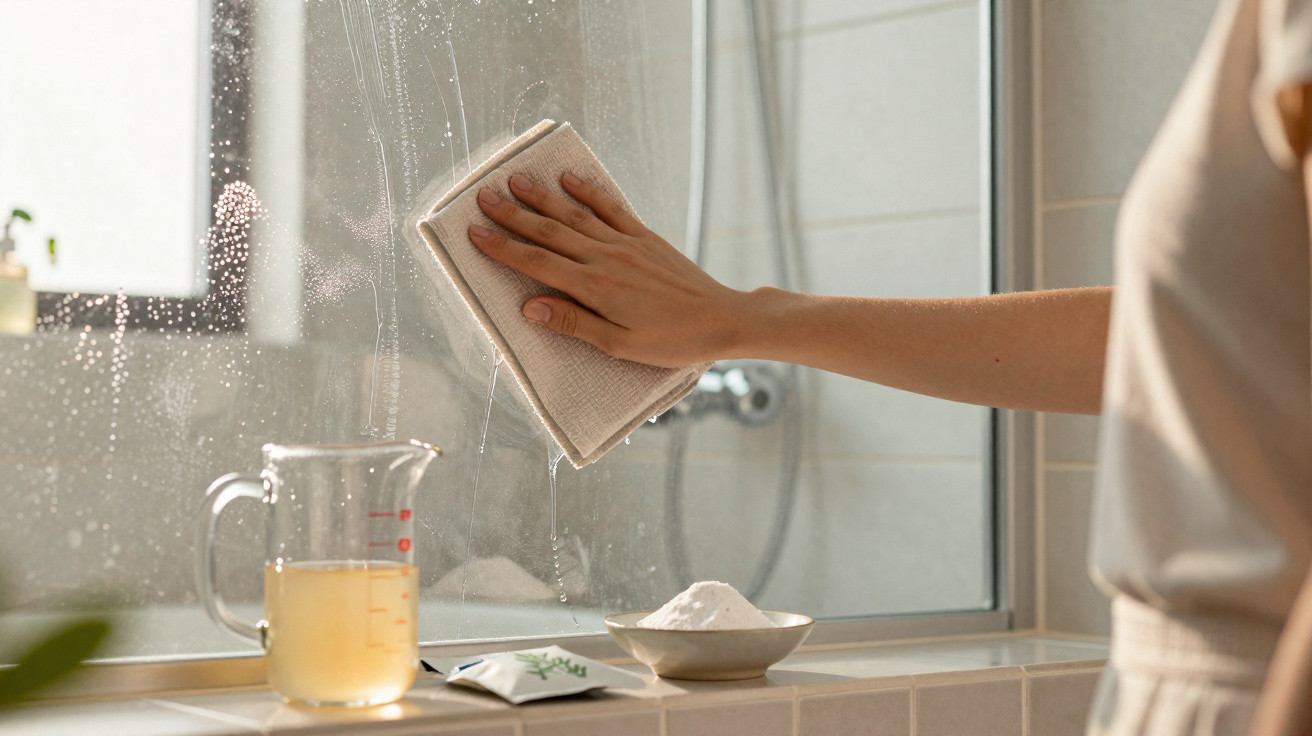
Dusting a shower screen with a white powder, giving it a quick scrub and watching it “shine like new” is a popular social-media promise. A cleaning professional pushes back against that idealised picture, explaining that while bicarbonate of soda can be very effective on limescale, it is often awkward to use in day-to-day cleaning. Instead, she recommends a surprisingly straightforward alternative that fits far more neatly into a weekly cleaning routine.
Why so many people rely on bicarbonate of soda in the shower
Bicarbonate of soda is widely seen as a household all-rounder. It is inexpensive, many people already keep it in the kitchen cupboard, and it has countless uses-from cleaning an oven to freshening carpets. On a shower screen, it behaves like a gentle abrasive: the fine grains help lift dull soap scum and mineral deposits without scratching the glass.
Two approaches are especially common:
- as a paste made from bicarbonate of soda and a little water, spread across the glass
- as a stronger mix of bicarbonate of soda and household vinegar, intended to tackle limescale as well
For grout lines, many guides suggest a heavily diluted solution applied with an old toothbrush. On paper, it sounds fast, thorough and pretty effortless.
"Bicarbonate of soda removes even stubborn build-up, but handling it across large glass surfaces makes the trick more tiring than it looks in tutorials."
Where bicarbonate of soda reaches its limits in the shower
In real life, the issues start quickly. A thicker paste only clings to a shower screen to a point: once you spread it over a larger area, it tends to slide down the vertical glass. The taller the screen, the more work it becomes, because you often have to go back over the same areas several times.
Rinsing can also take longer than expected. If any paste residue remains on the glass after cleaning, it can dry into a white haze-particularly noticeable in backlight or when dark tiles sit behind the screen. To remove every trace, you may end up spending far longer with the handheld shower than many videos imply.
The popular bicarbonate-of-soda-and-vinegar combination adds another wrinkle. Although it fizzes impressively, an acid and a base are reacting with each other. That means some of the cleaning potential is simply cancelled out as the ingredients neutralise one another. The spectacle is big; the benefit is limited.
For these reasons, many people keep bicarbonate of soda for targeted jobs: badly stained corners, greyed grout, or shower screens that have gone a long time without proper attention. For a quick weekly clean, though, most people prefer something that needs less mixing and less effort.
Vinegar in gel form: an easy routine instead of a big deep-clean
A more practical, everyday alternative is increasingly popular: household vinegar in a gel. Plain vinegar is strong against limescale, but on vertical surfaces it can run off in seconds. A simple tweak using a plant-based gelling agent solves that problem.
The key ingredient is agar-agar, a seaweed-derived setting agent often used in the kitchen for desserts. When combined with vinegar, it creates a light gel that stays put on the glass. That way, the vinegar can work where it is needed instead of disappearing straight down the drain.
How to use vinegar gel on a shower screen
A typical at-home recipe combines two ingredients:
| Ingredient | Amount | Purpose |
|---|---|---|
| Household vinegar (clear) | approx. 500 ml | dissolves limescale and soap residue |
| Agar-agar | approx. 2 g | creates the gel-like texture |
Heat the two briefly so the agar-agar disperses, then leave the mixture to cool. You end up with a flexible gel that can be spread like a thin mask over glass and grout. It does not immediately slide off and will stay in place for 15 to 20 minutes.
"The gel gives the vinegar one thing above all: time. Only with longer contact can the acid truly dissolve limescale."
After the dwell time, a thorough rinse is usually enough, followed by pulling off the water with a squeegee or drying with a microfibre cloth. This approach works well on glass, taps and tiles-but it is not suitable for natural stone or other delicate, porous materials.
When bicarbonate of soda makes sense - and when the gel is clearly better
The expert draws a clear line between “emergency use” and routine upkeep. In her view, bicarbonate of soda is a powerful option for special cases:
- grout with dark deposits
- badly neglected shower screens with a thick limescale film
- small corners where mould appears
In these situations, the mildly abrasive action helps-especially when paired with a brush. For weekly bathroom cleaning, however, it often does not fit most people’s time constraints. If you are doing a quick pass through the bathroom after work, sprays-or a gel you can spread quickly-tend to be more realistic, particularly as you can leave it working while you do something else.
Vinegar gel shows its strengths wherever limescale builds slowly but consistently: on the glass screen, on the shower rail, or around the tap base. The chemistry does the work, while your arms get a break.
How often a shower screen really needs cleaning
How frequently you need a proper clean depends heavily on where you live and how the bathroom is used. In hard-water areas, limescale appears much faster. Households where several people shower daily will also need shorter intervals.
Useful rules of thumb:
- in hard-water areas: clean the glass screen once a week
- with medium water hardness: do a more intensive clean every one to two weeks
- after every shower: quickly pull the water down with a squeegee to reduce build-up
Even a 20-second squeegee after showering can noticeably slow the formation of stubborn limescale. That, in turn, reduces the need for harsh products and long scrubbing sessions.
Risks and limits of home remedies in the bathroom
As popular as vinegar and bicarbonate of soda are, neither is suitable for every surface. Natural stone such as marble, travertine or slate can react badly to acids. The result can be dull patches or pale marks that cannot be polished out.
For acrylic shower trays and certain plastics, it is also wise to check the manufacturer’s care guidance. Overly abrasive sponges or solutions that are too concentrated can roughen the surface, making dirt adhere even more easily later on.
A simple precaution is to do a small patch test: if you want to try a new cleaner, apply it first in an inconspicuous spot. If the surface stays unchanged, it is usually safe to proceed.
Why “less scrubbing” is often the smarter plan
The expert is clear that this is not about demonising bicarbonate of soda. The powder can be extremely helpful when glass and grout are already in poor shape. For everyday life, though, the bigger question is different: how do you keep a shower screen looking good without turning it into a workout?
Frequent, short cleaning intervals-paired with products that cling properly-beat the occasional marathon deep-clean where thick layers have to be shifted. Vinegar in gel form suits that approach well. If you like, you can tweak it by adding a squirt of washing-up liquid for greasy soap residue or a few drops of lemon for extra shine.
Little by little, that becomes a routine that feels like a normal habit rather than an entire Saturday lost to cleaning. Bicarbonate of soda can then stay in the cupboard for the tough jobs, while the gel keeps the shower screen clear day after day.
Comments
No comments yet. Be the first to comment!
Leave a Comment