
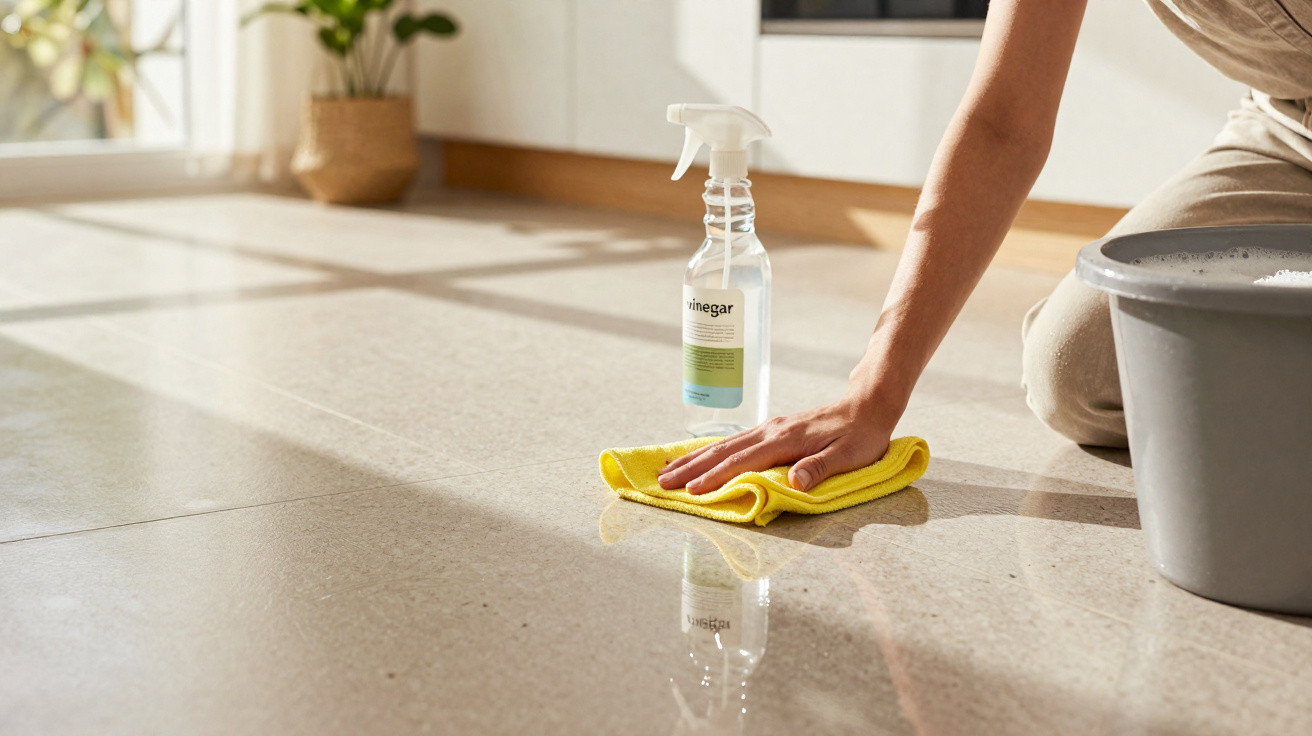
In kitchens and living areas with stoneware tile flooring, a grey haze can appear surprisingly quickly. Even if you mop routinely, the same frustration often follows: marks remain, streaks catch the light, and the surface looks dull. It’s hardly surprising that many people reach for ever-stronger solutions - from harsh cleaners to improvised mixes of powder and acid. Cleaning professionals, however, tend to recommend a straightforward product that most people already have in the cupboard.
Why stoneware floors turn dull so quickly
Stoneware - often sold as porcelain stoneware or grès cérame - has a reputation for being hard-wearing, low-maintenance and well suited to busy rooms. In day-to-day use, it can feel very different: after only a few months, the floor may look far less premium than it did in the showroom.
- Fine dust and grit act like sandpaper.
- Kitchen grease settles as a film over the surface.
- The wrong cleaners leave residues that attract dirt again.
What many people don’t realise is that the issue isn’t limited to aggressive chemicals: some traditional household remedies can also damage the surface over time. Once the thin sheen on top is compromised, dirt grips more easily. The result is a vicious circle - you clean more often, yet the finish still looks worse.
Why citrus juice and powders can ruin the floor
When a floor starts to look flat, plenty of households instinctively reach for citrus juice or alkaline powders. The thinking is simple: one breaks down grease, the other is seen as a universal fix. On stoneware, that combination can be a gamble.
Acidic mixtures, used repeatedly, can start to attack the glaze. Alkaline powders, at stronger concentrations, can behave like an abrasive. The damage is rarely immediate; it tends to build quietly until, months later, the floor loses its deep shine and begins to look patchy.
There’s another drawback as well: many DIY blends contain multiple ingredients that don’t rinse away cleanly. What’s left behind is a streaky, washed-out film that becomes obvious in backlight. The tiles can end up looking permanently smeared, even straight after cleaning.
"Professionals rely on a small number of clearly dosed products - and on thorough rinsing rather than chaotic mixtures."
The overlooked miracle product from the cupboard
Specialists in professional building cleaning most often recommend one product for stoneware floors: clear table vinegar. Used correctly, it cuts through grease, removes light limescale marks, reduces germs and refreshes the look - without unnecessarily stressing the surface.
The ideal everyday mix
The pros suggest a simple ratio:
- 1 part table vinegar
- 3 parts hand-warm water
Pour the solution into a clean mop bucket that’s reserved for floors only. Warm water boosts the effect and loosens greasy deposits more quickly.
Just as important as the liquid is the tool: choose a microfibre mop head or microfibre pad. The fine fibres lift dirt more effectively and spread the solution more evenly.
How professionals do it step by step
- Remove loose debris first: vacuum or sweep thoroughly so small stones can’t scratch the floor.
- Mix the solution: add water to the bucket, pour in the table vinegar, then stir briefly.
- Dip the mop and wring it out well so the floor isn’t left sitting in water.
- Mop in lanes, section by section, rather than zig-zagging, so you don’t miss areas.
- Rinse the mop, then go over the floor a second time using clean water only, to remove any leftover acidity.
- Finish by drying with a dry cloth or a dry microfibre mop until no droplets remain.
"The difference comes less from the product and more from the combination of correct dilution, rinsing, and drying."
Why drying is what really brings out the shine
Many people mop wet and simply let the floor air-dry. That’s exactly where the biggest shine boost is lost. Water spots and the last traces of residue become visible as soon as light hits the floor from the side.
If you buff the surface afterwards with a dry cloth, you prevent those marks. The cloth picks up the final droplets and fine particles. The floor looks more even, noticeably brighter, and it feels cleaner underfoot.
Gentle ground rules for caring for stoneware
For everyday use, a lightly dosed neutral cleaner is usually enough. It lifts dust and typical daily grime without attacking the finish. A few simple habits help keep the shine for the long term:
- Take off shoes with heavy tread by the door where possible.
- Put down large door mats to catch sand and grit.
- Treat stains locally instead of mopping the entire floor with strong products.
Targeting stubborn marks
If a few spots still won’t shift with the vinegar mix, professionals tackle them as locally as possible:
- Grease marks: sprinkle a little alkaline powder directly onto the affected area, work it in gently with a soft brush, then rinse very thoroughly.
- Rust traces: mix a small paste from table vinegar and powder, apply it, leave it for about 15 minutes, then rinse off without heavy pressure.
The key point is not to spread these specialist treatments across the whole surface. That way, the rest of the floor remains protected.
What damages the floor over time
Stoneware can cope with plenty, but not with everything. Experts repeatedly see the same mistakes that gradually ruin the finish:
- Frequent use of strong acids or highly concentrated cleaners.
- Cleaners with abrasive particles, or scouring pads.
- Overdosing care products that build up in layers.
Once the shine has been worn away, the only real fix is often professional refurbishment - which costs far more than a bucket of water and clear table vinegar.
How to enhance the shine even further
For special occasions, or when the floor in a living space should look particularly refined, some professionals use an optical trick. An ultra-thin layer of natural oil or wax can intensify the sheen.
The amount is crucial: a tiny drop on a cloth is enough for an entire tile. Spread it extremely thinly, then buff for a long time and with firm pressure using a dry cloth. The goal is a subtle shimmer, not a greasy surface. If you have pets or small children, use this method very sparingly near the edges to reduce the risk of slipping.
What the term “stoneware” actually means
Many flat or house owners aren’t entirely sure what type of tile they have at home. Stoneware is made from very densely fired material. That’s why it absorbs less water and is considered harder than standard ceramic flooring. The surface can be glazed or matt. Glazed versions, in particular, look elegant but are more sensitive to strong chemicals and abrasives.
If you’re unsure, check with the developer, in the property particulars, or on old invoices. Once you know the exact material, it’s easier to choose suitable cleaners - and reaching for simple table vinegar can save you expensive experiments with specialist chemicals.

Comments
No comments yet. Be the first to comment!
Leave a Comment