
The lid snaps shut with a dull “plop”, and then that faint wisp rises from the bin. At first it’s barely there, then-every time you walk into the kitchen-it becomes a touch more noticeable. Not truly revolting, but enough to make you wrinkle your nose without thinking. Food scraps, organic waste, a hint of washing-up liquid: that familiar blend every home seems to collect sooner or later.
On one of those days, I ended up with a squeezed lemon half in my hand. Instead of dropping it into the food waste, I impulsively put it into the general-waste liner. The next morning the bin smelled… different. Brighter. Cleaner. Almost as if someone had quietly cleaned the place-except nobody had.
Why a piece of lemon peel can change the smell of the whole bin
We all recognise the pattern: the bin is only half full, yet the smell is already telling you it needs to go out now. It’s especially bad in summer, when kitchen leftovers at 27 °C start to take on a life of their own.
And then, all of a sudden, there’s this unremarkable strip of lemon peel sitting in the liner-and it actually makes a difference. That stale undertone, the sour-rotten mix, fades into the background. In its place you get a suggestion of a fresher kitchen, the kind of “just cleaned” impression. It’s almost ridiculous how little it takes: a fleck of yellow, a bit of pale pith, and the whole mood of the room shifts.
A friend told me she picked it up from her grandmother. She never used room sprays, she said-she’d simply keep a bowl of citrus peel in the kitchen, and she’d always put a piece into the bin as well. Once she forgot for a few days. “I immediately noticed something was missing,” she said with a laugh. “It smelled like completely normal life.”
In a small Instagram poll, more than 60% of my followers said they regularly put citrus peel into the bin or the dishwasher. Not a scientific study, obviously-but it’s a clear signal all the same: this little hack is quietly passed around in plenty of homes, like a kitchen secret you only share when someone complains, “Ugh, my bin stinks again.”
What’s behind it isn’t magic-it’s chemistry you can literally smell. Lemon peel contains essential oils, especially limonene. That oil can bind certain odour molecules and mask others with a fresh, citrus scent. At the same time, the lemon’s natural acidity lowers the pH on the surface of the waste slightly, making it harder for some odour-producing bacteria to thrive. That doesn’t mean your rubbish is being “disinfected”, but the worst of the decomposition note loses some of its punch.
Our brains love that fresh citrus scent because, for decades, it’s been associated with cleanliness and order. A small piece of peel triggers that exact feeling-right in the middle of the smelly reality of a kitchen bin.
How to use lemon peel in the bin like a pro
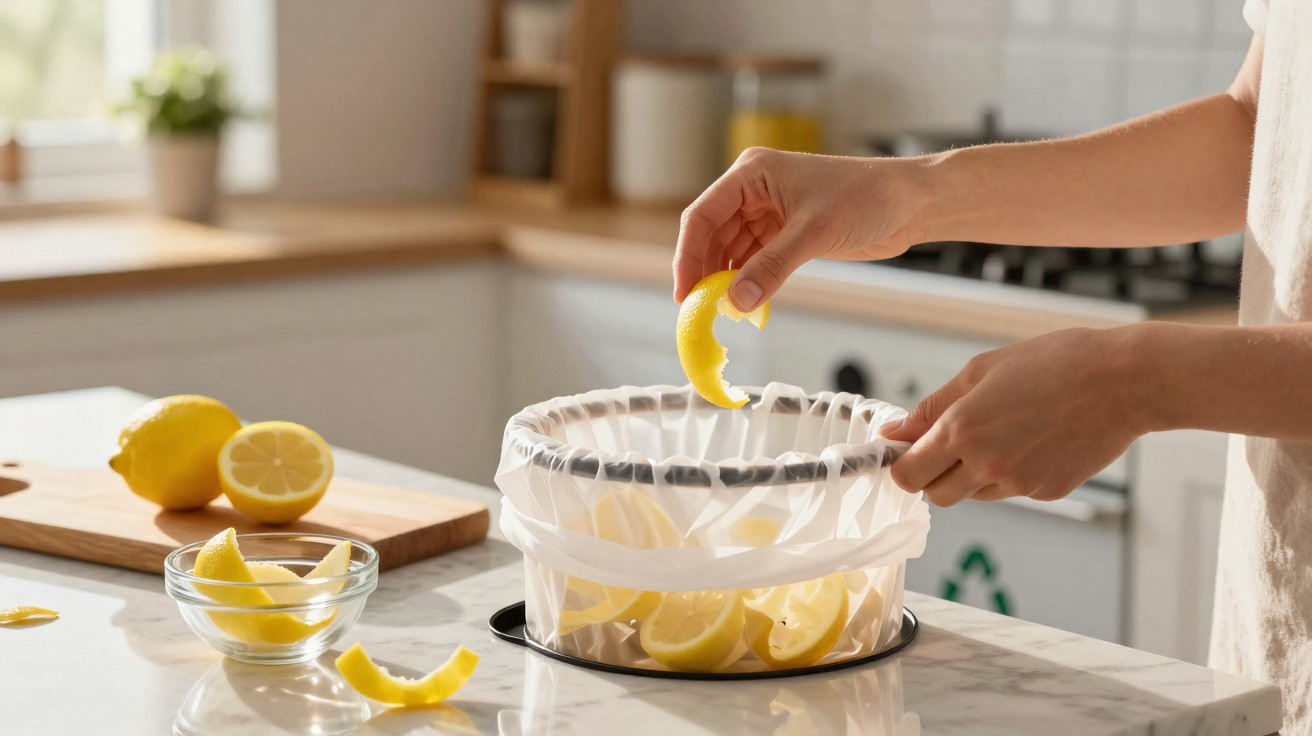
The idea is straightforward: whenever you use a lemon, put a bit of the peel in the bin. Ideally, place it into a fresh liner before any truly pungent rubbish goes in. You can cut off a piece about 2–3 centimetres long, or roughly tear up the squeezed half. What matters is that some of the yellow outer skin remains visible, because that’s where most of the oils sit.
If you want to take it a step further, let the peel dry out briefly before adding it. That way, the scent releases more slowly and tends to last longer. A small ritual with a surprisingly big effect.
Many people simply throw all citrus peel into the food waste, where it quickly disappears among everything else. For smell control, that only helps to a limited extent: the peel gets wet fast, turns mushy, and is overpowered by other odours. In a general-waste liner-positioned a little higher up or near the edge-it can spread its “scent cloud” far more effectively.
A common mistake is to “park” the peel inside a sealed bag within the bin. If the oils can’t reach the air, they can’t do much. And let’s be honest: nobody manages this every single day, and plenty of us cook without lemon. That’s exactly when it helps to keep a few peels in the fridge-stored in a jar and allowed to dry slightly.
A household expert once told me, half joking and half serious:
“Lemon peel is like a free mini air freshener-but one that at least pretends to be part of nature.”
If you want a noticeable result, this short checklist helps:
- Don’t bury lemon peel deep in the food waste-place it in the top third of the liner instead.
- Lightly score or squeeze the peel so the essential oils release more easily.
- Use several smaller pieces rather than one large chunk, so the scent spreads more evenly.
- Replace it every two to three days to keep things fresh and stop the peel turning unpleasant itself.
- Prefer organic lemons to reduce the risk of wax coatings and residues.
Between the illusion of freshness and real waste hygiene
Here’s the sober truth: a piece of lemon peel is not a substitute for basic bin hygiene. If you leave a liner sitting in a warm kitchen for two weeks, even three lemon halves won’t deliver a “freshness boost”.
Even so, this trick has a psychological effect that can genuinely matter in everyday life. It’s a bit like swapping harsh changing-room strip lighting for something softer: nothing fundamentally changes, but it feels more tolerable. Walking to the bin seems a little less grim, and the kitchen smells less like “last night”.
At the same time, lemon peel in the bin says something about how much we crave quick solutions. Tossing in a bit of peel is easy; taking the rubbish out more often, washing the bin occasionally, or storing leftovers differently takes more effort.
Still, that tiny step can be the start of something better. Once you notice that a small ritual can improve day-to-day life, you may be more willing to take a second step: empty the bin more often, rinse it out now and then, or dispose of food scraps separately. You don’t have to be perfect to do better.
That’s exactly what fascinates me about this lemon story: it’s a quiet compromise between comfort and responsibility. Not a grand eco statement, not radical minimalism-just a small, yellow piece of peel that shows how strongly smell can steer our mood, and how easily we can nudge it back.
You could even pay attention to how your own view of the bin changes when there’s a soft citrus note drifting along with it. Perhaps “Ugh, again” becomes “Alright, it can wait one more day.” And perhaps someone else will end up telling their own small kitchen story-about a lemon that turned out to be more than just a squeeze in a cup of tea.
| Key point | Detail | Benefit for the reader |
|---|---|---|
| Lemon peel binds and masks odours | Essential oils such as limonene overlay musty notes and influence the microclimate inside the bin | Understands why a simple household leftover can make everyday life noticeably more pleasant |
| A simple ritual with an everyday lemon | Put peel into a fresh liner, replace regularly, ideally slightly dried | Gets a practical method they can use immediately without buying extra products |
| A small trick instead of chasing perfection | Lemon peel doesn’t replace bin hygiene, but it can complement it and provide motivation | Feels relieved and encouraged to take pragmatic steps rather than making big promises |
FAQ:
- Does lemon peel really help with smells, or does it just cover them up? It does a bit of both: the essential oils mask many unpleasant notes, while the acidity makes conditions slightly less appealing for odour-forming bacteria-though, of course, the rubbish itself is still there.
- Can I use orange or lime instead of lemon? Yes. All citrus fruits contain essential oils that work in a similar way; orange often smells a bit sweeter, lime more intense and sharper-ultimately it’s down to preference.
- How long does the fresh smell of lemon peel last in the bin? Depending on temperature and how much waste is in there, usually one to three days. After that, the scent fades noticeably and the peel should be replaced before it starts to smell unpleasant itself.
- Is lemon peel in the bin hygienically safe? Yes. It’s no more problematic than other organic waste; if you’re particularly sensitive, let it dry slightly first-then it moulds more slowly and stays stable for longer.
- Does this help with nappy bins or strong fish smells? It can soften the smell a little, but with very intense sources, lemon peel alone usually isn’t enough-emptying the bin more often and cleaning it thoroughly also helps.




Comments
No comments yet. Be the first to comment!
Leave a Comment