
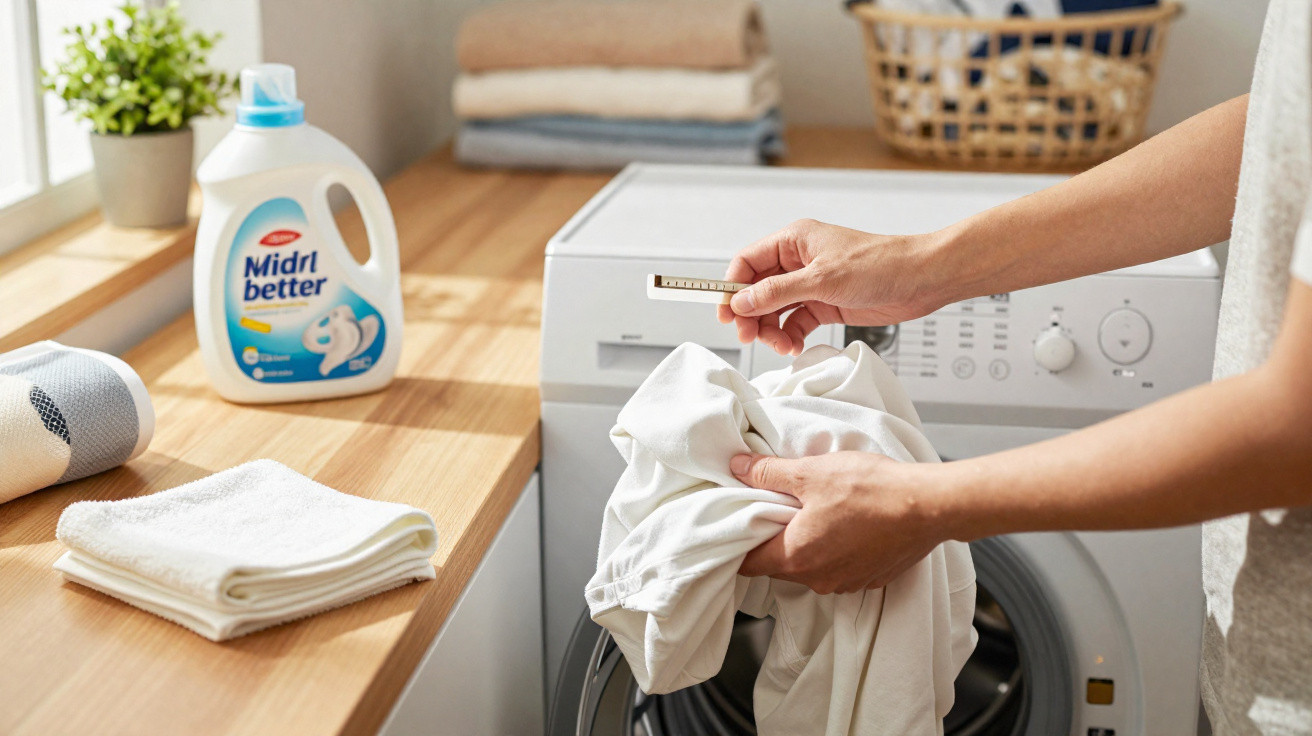
Shirts emerged looking dull, towels felt scratchy, and your favourite hoodie suddenly had a smell that was “not quite clean”, even after a lengthy cycle. The machine had spun, the detergent drawer was filled and everything appeared normal. But the outcome plainly was not.
You may point the finger at the detergent brand, the temperature or even an ageing appliance. That is what most people assume. In plenty of households, however, the real cause is far simpler, far less exciting and silently undermines every wash.
It is one small daily habit that hardly anyone ever challenges.
The quiet mistake almost everyone makes
Watch a family load go into a washing machine and the same pattern appears time after time. Someone scoops up a huge armful, packs it into the drum, shoves it down with their forearm and gives the door one final push. The clothes are compressed against the glass and cannot move. They press “Start”, leave the room and believe they have been efficient.
That is the error: overloading. Not the spectacular kind where the machine looks ready to burst, but the subtle sort where the drum is not completely wedged full, yet there is too little space for the water, detergent and garments to circulate. The programme will still run, but the results deteriorate a little more each week.
At first glance, it seems sensible: one large wash rather than two. It means less time, water and effort. Your back is grateful, and so is your bank balance. Your clothes, however, are not.
Picture an ordinary Sunday evening. Work shirts, school uniform, gym kit and tea towels are piled into one heap on the floor. You are exhausted, the weekend is nearly finished and the dinner dishes are still waiting in the sink. So you “optimise”: you force it all into the drum, perhaps even lean on the door slightly to get it shut. It brings a strangely satisfying feeling, as though you have won a private contest against the machine.
The following morning, though, a T-shirt still carries a faint deodorant odour. One sock is only half dry. A towel has that worrying musty smell that brings forgotten washing to mind. You may frown, then dismiss it. It must be the detergent. It must be the quick programme. Next time, you turn the programme up.
Several consumer tests and manufacturers’ recommendations indicate that an overloaded drum can cut washing performance by 20 to 40 percent. This is not a minor issue. It means losing almost half of the cleaning power… simply to squeeze in “just a bit more”. Over months and years, the result is greyer whites, thinned fabrics and elastic that wears out much sooner than it should.
The principle is painfully straightforward. A washing machine does not clean garments merely because they are sitting in water; it cleans them as they move, rub and circulate through soapy water. Overfill the drum and that movement stops working properly. Water cannot reach every item, detergent remains caught in creases and dirt has nowhere to escape. Rather than being rinsed out, it simply transfers from one fibre to another.
Your machine detects the weight and attempts to manage it: it might reduce its spin speed to prevent damage, lengthen the programme or draw in extra water. Energy consumption rises, while the motor and bearings take more strain. You “save” one load but quietly reduce the lifespan of an appliance worth hundreds of pounds. Clothes start to look worn, so you wash them again or replace them earlier. That everyday overloading becomes a long-term drain on your money.
How to load your washing machine the right way
Put complicated charts and endless instructions aside for a moment. There is one straightforward technique that technicians regularly recommend: the hand test. Fill the machine, then place your flat hand above the laundry inside the drum. It should fit in easily with your fingers facing downwards, without pushing or squashing the clothing.
If you cannot get your hand in, the washing machine is overloaded. If there is ample room around your hand, it is under-loaded and you are wasting energy. That small hand-sized gap is where the important work happens: fabrics can drop, lift and rotate inside the drum. Water can travel through the load, detergent can dissolve and circulate, and the fibres can be properly rinsed. This modest space separates “looks clean enough” from genuinely fresh washing.
That gap matters even more with weighty items such as towels and jeans. They absorb water, become heavier and need enough room to move. For bedding or thick fabrics, a drum filled to three-quarters is generally the ideal level.
Many people feel a vague sense of guilt about how they run their washing machine. They know they are meant to separate colours, choose gentle programmes, use specialist detergents and follow all those supposedly perfect habits. Then real life intervenes. Children spill food, partners go to the gym, the dog discovers a puddle and the laundry pile increases faster than your energy does.
This is why overloading happens so often. It seems like a useful shortcut rather than a “mistake”. There is also something strangely pleasing about seeing a full drum: it feels as if you are getting maximum value from every cycle. But that feeling rests on a misunderstanding of the machine’s operation. It does not need to be full; it needs to be able to move what is inside.
Let’s be honest: nobody really weighs their laundry before putting it in the washing machine. And almost no one reads page 27 of the instruction manual explaining “maximum dry weight per programme”. Instead, we estimate, shove in a little extra and overlook the gradual fall in washing quality. Fortunately, this is among the easiest household behaviours to change, with no need to buy anything or master a complicated new routine.
“The number one problem we see in ‘broken’ machines isn’t a faulty part,” confided a repair technician who’s spent 15 years visiting overflowing laundry rooms. “It’s users treating an 8 kg drum like it’s a bottomless suitcase.”
Once you view it in those terms, making small changes can feel surprisingly freeing. Keep it straightforward:
- Always leave a hand’s thickness of room at the top of the drum.
- For heavy fabrics, do two medium loads rather than one “mega” load.
- Keep bedding and towels separate from lighter clothing.
- Select a programme that suits the fabric, rather than using “Mixed 60°C” for everything.
- Clean the detergent drawer and rubber seal from time to time to prevent residue building up.
These simple habits make a bigger difference to genuine cleanliness than hunting for the newest miracle detergent.
The quiet pay-off of doing less, better
There is something unexpectedly soothing about watching a sensibly filled drum turn. Clothes rise and fall in distinct arcs, water splashes evenly and the glass lightly steams up while still allowing you to see the movement. It seems almost… right. Nothing is rushed or forced. That subtle visual change often reflects what you notice when opening the door: less heavy dampness, more lightness and a more authentic freshness.
Your wardrobe benefits in practical ways, too. Colours remain brighter, black T-shirts take longer to turn grey and elastic waistbands retain their stretch. Towels recover some softness instead of becoming crisp, crunchy rectangles. There is no magic involved. It is simply the effect of gentler mechanical action and more effective rinsing. Clothing that is not crushed and churned in an overfilled drum naturally lasts longer. That means fewer urgent shopping trips for “replacement basics” and less concern about textile waste.
There is a less visible benefit as well: the health of your washing machine. A regularly overloaded drum places extra pressure on the suspension, bearings and motor. The appliance has difficulty balancing before spinning and may have to lower its speed. Eventually, this shows up as noise, vibration and, ultimately, faults. Maintaining that hand-width of room means fewer call-outs, fewer baffling error codes and more years before a replacement model even enters your thoughts.
Then there is the mental burden of it all. It is the low-level irritation when laundry does not feel clean, when something must be washed again because it failed to dry properly, or when the laundry basket appears never to empty. Altering your loading routine will not remove all of that at once. Still, it can make the entire process feel easier. Washes become more reliable and results more consistent. It is one of those quiet domestic adjustments that may not look dramatic, yet steadily improve part of everyday life.
With bills rising, climate anxiety growing, fast-fashion fatigue setting in and the plain reality of dirty socks on the floor, washing can seem like a never-ending compromise. Yet this particular compromise – packing in too much to “save” time and water – saves very little in reality. It swaps obvious effort for hidden losses. The next time you stand before an open drum with your arms full and too little evening left, you may still want to force everything in. Or you may recall that tiny hand-sized gap: the almost unseen room in which your washing machine can finally do its job properly.
| Key point | Detail | Benefit for the reader |
|---|---|---|
| Correct drum load | Leave roughly the space of a flat hand above the laundry | Improves washing without changing your machine or detergent |
| Movement of textiles | Clothes need enough room to fall, turn and rub against one another | Cleaner results, fewer odours and fresher laundry |
| Lifespan of laundry and machine | Avoiding overloading reduces mechanical wear and fibre damage | Fewer breakdowns and fewer purchases of clothes and appliances |
FAQ:
- How do I know if I’ve overloaded my washing machine? If you cannot slide a flat hand over the laundry inside the drum, it is too full. Clothes tightly pressed against the door glass are another warning sign.
- Is it bad to under-load the machine? No, not occasionally. But frequently running very small loads wastes water and energy, and some machines have trouble balancing a tiny load for spinning.
- Do different fabrics change how full the drum should be? Yes. Heavy items such as towels, jeans and bedding need extra space, so aim for around two-thirds to three-quarters full rather than filling the drum close to the top.
- Can overloading damage the washing machine? Yes, over time. It puts greater strain on the bearings, suspension and motor, and may lead to noisier spins, unbalanced loads and earlier breakdowns.
- Will loading correctly really make clothes last longer? Often, yes. More thorough rinsing and gentler mechanical action cause less fibre damage, reduce detergent residue and allow colours to fade more slowly.




Comments
No comments yet. Be the first to comment!
Leave a Comment