
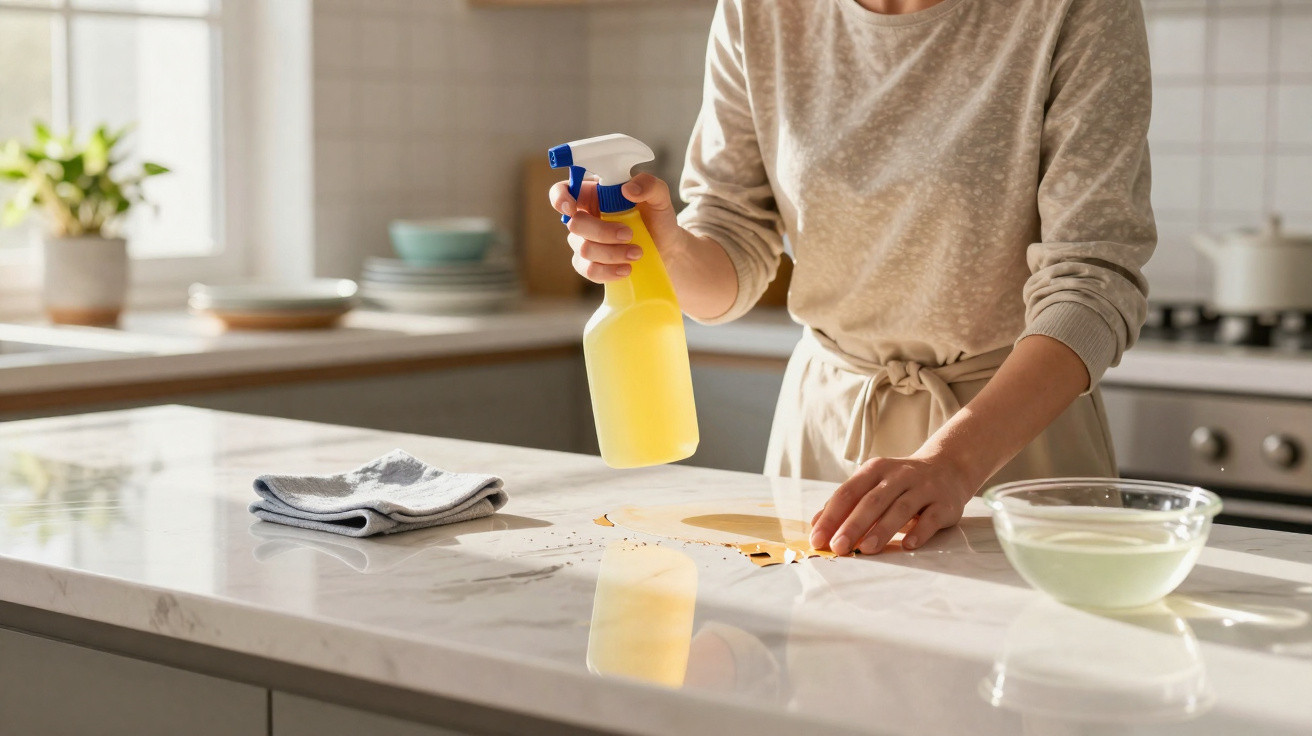
It has a fresh scent, claims to work wonders on grease, soap scum and “tough stains”. It is inexpensive, sold everywhere, and probably has plenty of fans among your friends. But cleaning professionals are increasingly making the same warning: this supermarket staple may be silently damaging surfaces throughout our homes.
Stainless-steel fridge doors. Stone worktops. Luxury vinyl flooring and polished bathroom taps. Often, the harm only becomes visible weeks later, after the receipt has disappeared and the warranty claim is met with a polite refusal.
The product under scrutiny is one many of us reach for automatically: multi-surface spray with bleach or strong alkaline degreasers. It is the bottle we use without a second thought.
The “miracle” spray that destroys finishes
The first sign is often a tiny white patch: a hazy ring on what was once a smooth, silky finish. It is the sort of flaw you spot only when sunlight falls across the kitchen at precisely the right angle.
You try buffing it with a cloth and perhaps use more product, only to find that the stain appears to grow. The more you attempt to clean it, the worse it seems to become. The surface can start to feel dry, coarse and almost chalk-like.
For many cleaning professionals, this pale halo is a familiar sign of a powerful alkaline or bleach-based product gradually eating through a protective layer. Wood varnish, laminate factory seals, polyurethane coatings on luxury vinyl planks and even anti-fingerprint finishes on stainless steel are not made to tolerate harsh chemicals day after day.
Professional cleaners report the same situation repeatedly. A client proudly produces the “magic spray” they use for every surface. The label says “multi-surface” or “kitchen and bathroom”, and may even feature images of a gleaming worktop and a wooden table.
Then the cleaner enters the kitchen. The laminate worktop is cloudy and uneven around the sink. A matt-black tap carries pale drips that cannot be wiped away. The once-deep colour of an oak table is interrupted by light rings left behind after someone disinfected it following chicken preparation.
One cleaner based in London described a new-build flat where a tenant used a chlorine bleach cleaner on a quartz worktop every evening “for hygiene”. Within six months, the area around the hob had become permanently rough and etched. The manufacturer declined the full warranty claim, referring to its care guidance: pH-neutral products only.
There is some unforgiving chemistry at work. Many widely used “power” cleaners are highly alkaline and formulated to break down fat, oil and organic grime. That makes them effective on ovens and grills, but far less suitable for sensitive finishes tested with mild, neutral soaps in laboratory conditions.
Bleach creates an additional risk. It may react with metal particles, dyes and resins in engineered materials, causing discolouration or microscopic pitting. Stone sealants and wood varnishes can be especially vulnerable to repeated exposure, particularly when the product is left sitting on the surface for longer than a few seconds.
After the protective top coating has worn away, the material beneath is left open to water, staining and everyday abrasion. That is when wood begins to swell, stone develops dark marks and metal trims show rust-like specks. By then, no miracle cleaning product can put the damage right: repair or replacement is usually required.
How to clean effectively without damaging your home
Cleaning professionals repeat one principle almost like a mantra: start gentle, and use strength only for emergencies. Even on very dirty surfaces, they typically begin with a pH-neutral cleaner and a microfibre cloth. The secret is not simply stronger chemicals; it is dwell time and the right method.
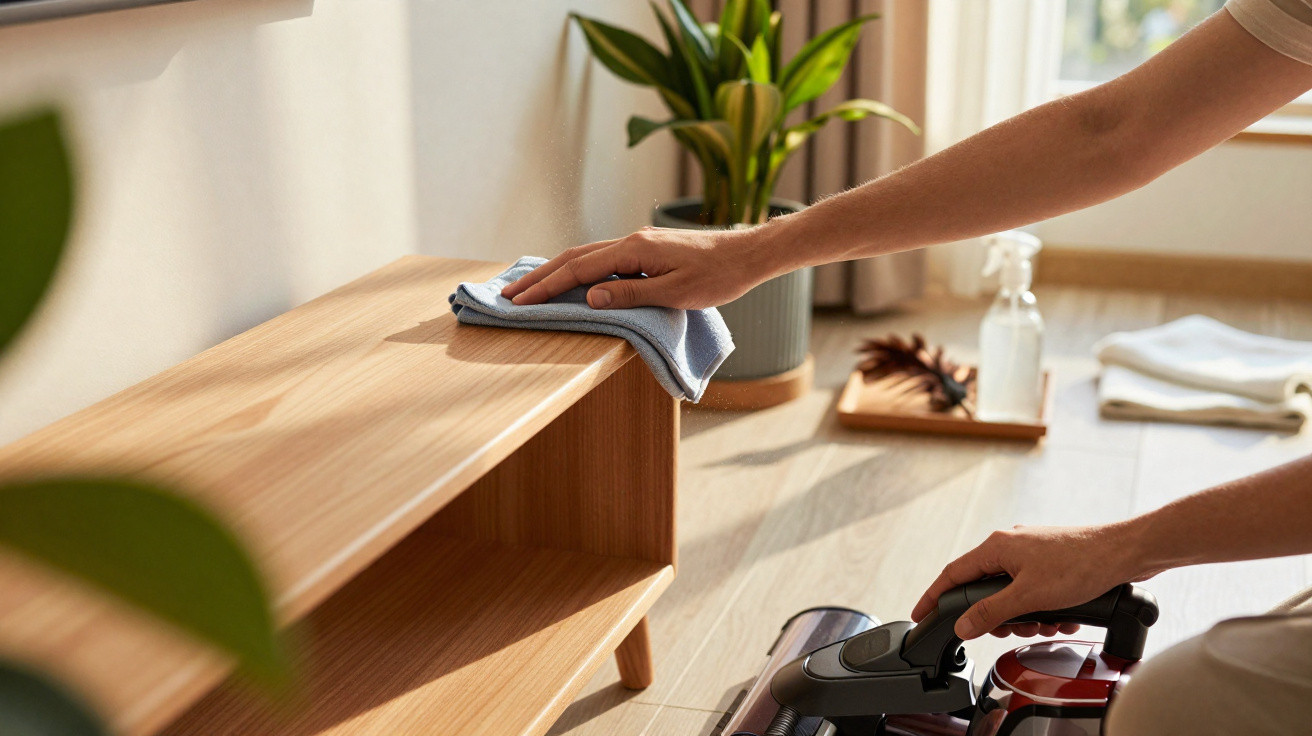
For kitchen worktops, a few drops of mild washing-up liquid in warm water will often do most of the work. Spray it on, leave it for a minute, and wipe in straight strokes rather than aggressive circles. For bathroom taps and shower glass, they use white vinegar diluted with water and applied with a soft cloth, rather than a scouring pad.
When a stronger degreaser is genuinely necessary, such as for an oven door, extractor-hood filter or barbecue grill, they keep its use tightly contained. They do not spray broadly across surrounding cupboards and worktops. Instead, they put it on a cloth rather than directly on the surface, then rinse fully with clean water afterwards. Strong cleaners should be a precise tool, not an everyday habit.
Most of us ignore the small symbols on product labels: the bucket icon, warning triangle or pH figure tucked away at the bottom. Yet these details are normally among the first things professionals check when they begin a new job.
For sealed wooden floors, they avoid daily products labelled “degreaser”, “bleach”, “disinfectant” or “kills 99.9% of bacteria”. A purpose-made wood-floor cleaner or diluted neutral soap is sufficient. Let us be honest: nobody truly does that every day, and that is perfectly fine.
On stone surfaces, including marble, travertine and limestone, they avoid both acidic products and strong alkalis entirely. They use only pH-neutral cleaners and microfibre cloths, blotting spills instead of rubbing them. Stainless steel should be cleaned with a mild soapy solution and soft cloth, always following the direction of the grain rather than wiping across it. Those fine lines are effectively the metal showing you how it should be cleaned.
One experienced cleaner who works in high-end Paris homes shared something memorable.
“People are not ruining their homes because they’re dirty. They’re ruining them because they’re scared of dirt and think stronger always means better.”
She believes that anxiety about germs after the pandemic encouraged many people to use bleach every day on surfaces that were never intended to withstand it.
Before allowing any new product near a kitchen or bathroom surface, she recommends three simple checks:
- Read the care instructions from the manufacturer of your flooring, worktop and appliances, rather than relying on spray-bottle marketing.
- Try a new cleaner on an inconspicuous area and wait 24 hours before using it more widely.
- Keep strong alkalis and bleach for occasional deep cleaning, never for your routine daily wipe-down.
We have all experienced that moment when the smell of “clean” chemicals makes us feel oddly reassured. But that scent commonly comes from fragrances and solvents, rather than hygiene itself. Many professionals discreetly move clients towards fragrance-free, neutral products, not to gain environmental virtue points but because they receive fewer return calls about “mystery damage”.
Rethinking what “clean” should mean
After seeing what an inexpensive spray can do to a £3,000 stone worktop or a newly fitted designer tap, it is difficult to forget. You start to notice hazy fridge doors in friends’ kitchens, uneven laminate tables in cafés and dull areas on hotel bathroom floors under bright lighting.
That widely used “kills-all” cleaner is unlikely to vanish from supermarket shelves soon. It has a purpose, particularly for specific cleaning tasks or health-related situations. The understated change among cleaning professionals is not about prohibiting it, but restoring it to its proper role: a tool-box product, rather than part of a daily routine.
From the outside, the real shift can look rather unremarkable. Fewer bottles beneath the sink. More warm water, microfibre cloths and pH-neutral cleaners that would never stand out in an advert. Less scrubbing and more gentle wiping. Less fragrance and more common sense.
Some homeowners discover this only after paying to have a floor sanded, a worktop refinished or a set of taps replaced. Others post pictures in group chats asking, “Has anyone seen this kind of stain before?” Increasingly, the professionals give the same three-word answer: wrong cleaner, repeatedly.
The issue is not whether we should clean less or stop disinfecting altogether. It is whether we can accept that “looking shiny today” may quietly mean “wearing out tomorrow”. Once that thought has crossed your mind, even the familiar bottle on the worktop may no longer seem quite so harmless.
| Key point | Details | Why it matters to readers |
|---|---|---|
| Bleach and strong alkalis strip protective layers | Repeated use of bleach sprays and heavy-duty degreasers can erode varnish, sealants and factory coatings on wood, laminate, stone and metal. | It explains why “mystery” dull areas and white rings can appear months after moving in or renovating, even when you have cleaned “properly”. |
| Daily cleaner should be pH-neutral | Professionals use neutral cleaners with microfibre for routine wiping, keeping aggressive products for infrequent, targeted tasks. | Changing your main cleaning product can help floors, worktops and appliances last longer without creating extra work in your routine. |
| Follow the surface maker, not the spray bottle | Flooring and worktop manufacturers usually provide specific instructions that differ from broad “multi-surface” claims on labels. | Reading one PDF or instruction leaflet can prevent costly warranty refusals and irreversible damage to finishes. |
FAQ
Which popular product are cleaners most worried about? They are chiefly concerned about strong multi-surface sprays that contain bleach or highly alkaline degreasers, especially products promoted for use in both kitchens and bathrooms. These are frequently applied to delicate finishes that were never tested against such severe chemistry.
How can I tell if my finish is already damaged? Watch for cloudy sections that remain dull after wiping, rough or chalky areas, pale drip marks on black taps, or patches that seem to absorb water instead of allowing it to bead. These are typical indications that a coating or sealant has been worn thin or removed.
What should I use on my kitchen worktop instead? For most laminate, quartz and sealed-stone worktops, a small amount of mild washing-up liquid in warm water, used with a microfibre cloth, is enough for everyday cleaning. Where disinfection is needed, choose a product approved by the worktop manufacturer and use it sparingly rather than several times each day.
Is bleach always bad for surfaces? No. Bleach can be helpful on certain hard, non-porous surfaces for particular hygiene purposes. The problem arises when it is used daily on coated, painted, sealed or engineered materials, where it gradually breaks down the protective finish.
How often should I deep clean with stronger products? Most professionals advise reserving powerful degreasers and bleach for occasional deep cleans: monthly, or even only a few times yearly, depending on your cooking and lifestyle. Everyday messes generally require no more than pH-neutral soap and suitable tools.
Comments
No comments yet. Be the first to comment!
Leave a Comment