
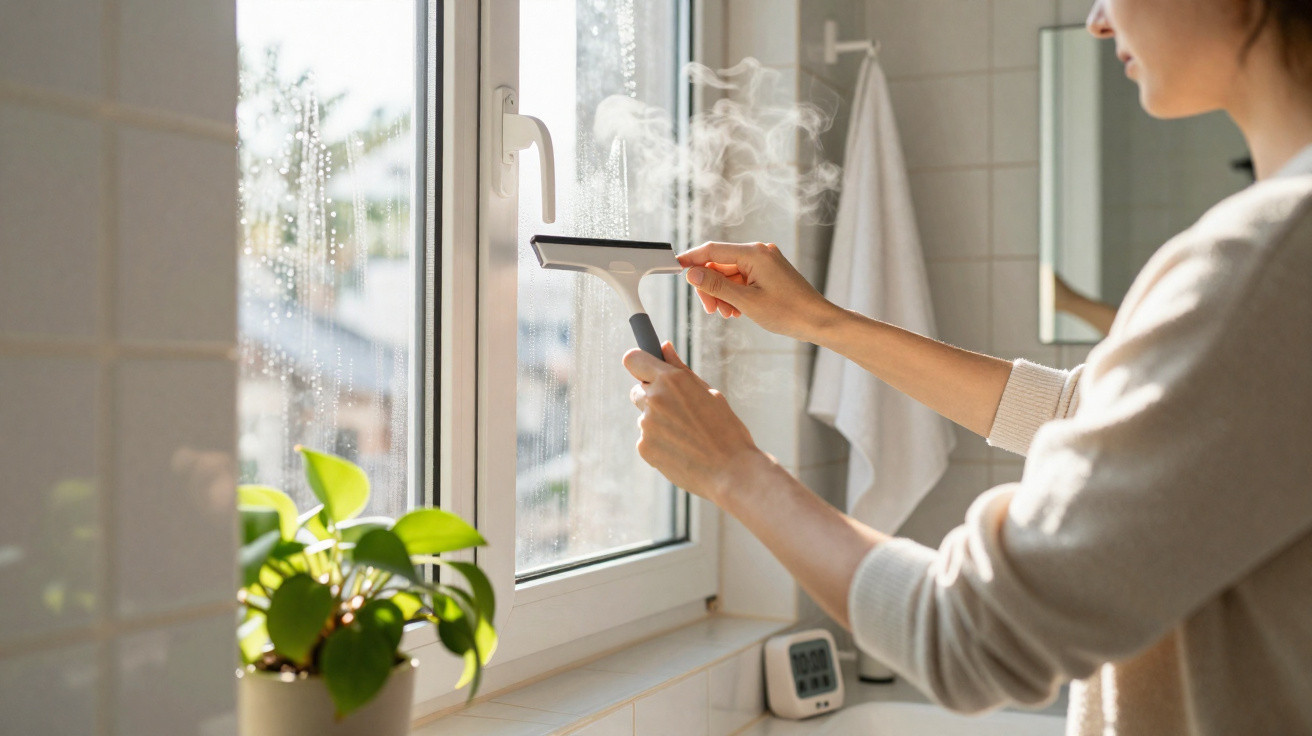
The mirror remains misted over, the floor tiles feel warm beneath your feet, and the air has the weight of a soft, dense cloud.
You leave the shower, pull a towel around yourself and, almost automatically, reach for the usual towel hook, the familiar bathroom door and the same established routine. A pale grey patch is beginning to deepen in a ceiling corner, unnoticed for now.
Beyond the window, the sky is cold and washed out. Your bathroom, meanwhile, feels like a tropical island. Steam gathers in beads around the window frame, with droplets already running into the narrow gap above the sill. You swipe a hand across the mirror, creating a smear, sigh, and carry on. It seems like an innocent moment. It is not.
What you do with one small window over the following 10 minutes can determine whether mould appears at all.
Why your bathroom becomes a mould factory so quickly
Enter a bathroom 20 minutes after a hot shower and it can feel as though someone has been boiling pasta inside. The air is heavy, the walls are faintly damp, and the ceiling seems a touch too glossy. That is not simply pleasant steam: it is surplus moisture searching for a place to settle.
Mould thrives in precisely this sort of unseen dampness. It does not require standing water or leaks; humidity, stagnant air and a surface that remains wet slightly too long are enough. Corners, silicone seals and the upper edge of a window frame are where the problem begins.
When moisture remains day after day, tiny airborne mould spores eventually settle in a spot where the conditions suit them. Then they take hold.
One rainy Tuesday morning in a small London flat, a young couple kept noticing the same strange flecks above their shower. They scrubbed and sprayed. The black marks would vanish for a week, only to return darker and broader each time, like a stain that knew exactly where it belonged.
They blamed the paint, the cleaning products, or the neighbours upstairs. Then, one evening, a friend visiting from Germany looked at the steam-filled bathroom and asked: “Why is your window always tilted like that?”
Like many people, they had left the bathroom window slightly open on tilt throughout the day. The room seemed “aired”, but humidity from every shower had no way to escape rapidly. Instead, it lingered and condensed gradually in the coldest corners. The mould was not a mishap; it was the result of a habit.
Humidity is deceptive. It makes no difference how clean you keep the room or how regularly you scrub the grout. Mould risk is governed by physics. Hot water loads the air with vapour, and warm air can retain more moisture than cold air. When this moist air hits a cooler surface - a pane of glass, an outside wall or the ceiling over the shower - the vapour becomes liquid. Those are the droplets you can see, along with all those you cannot.
Without rapid air circulation, that moisture can remain for hours and increase the room’s relative humidity. When levels stay above around 60% for extended periods, you have effectively laid out a welcome mat for mould spores. The answer is not to “fight” mould after it arrives, but to stop humidity from remaining long enough for it to establish itself.
The bathroom window habit that changes everything
The most overlooked and effective small habit is to open the bathroom window fully for a short time immediately after showering. Do not leave it barely open or politely tilted: open it wide for five to ten minutes. If possible, leave the door slightly ajar as well, giving air a route through the room.
During that brief period - literally a window of time - you create a fast exchange of air. The hot, humid air released from your skin and the shower surfaces escapes in one strong burst, replaced by cooler, drier outside air. The temperature may fall a little, but moisture levels drop much more, which is what matters for mould.
Rather than simply “airing the room”, picture it as pulling the plug on a bath of steam before it spills into your walls.
Many people approach bathroom ventilation as a vague healthy intention, rather like flossing or stretching: “I know I should… if I remember… maybe later.” In truth, keeping the window tilted for hours is the worst approach, particularly during colder weather. A tilted window produces sluggish airflow, while surfaces remain cool and lightly damp - ideal conditions for gradual, hidden condensation.
A quick, intense blast of fresh air achieves the reverse. It rapidly balances temperature and humidity, helps walls dry sooner, and prevents the silicone around the bath from remaining slightly wet all day. After a week of this one adjustment, that unexplained “bathroom smell” often becomes noticeably weaker.
Let’s be honest: almost nobody manages this every day at first. You are rushing, running late, and leave with the mirror still misty. That is precisely how mould gains ground: through small, cumulative decisions that are easy to overlook.
“Think less in terms of cleaning mold and more in terms of not giving it anything to eat,” says an indoor air specialist I spoke to. “Moisture is the main course. Warm, wet air that doesn’t move is like an all-you-can-eat buffet for mold.”
Seen this way, the routine of opening the window wide for ten minutes becomes less of a task and more like turning off a tap. You are cutting off the supply rather than merely addressing a symptom. The result may not be striking on the first day, but it becomes clear over months: no fresh marks, no grey corner shadow, and no bubbling paint near the window.
- Open it fully, rather than leaving a crack: Aim for a fast, forceful exchange of air, not a slow escape of warm humidity.
- Get the timing right: Target 5–15 minutes directly after showering, when steam levels are highest.
- Keep the door ajar: This draws in drier air from elsewhere in the home and speeds up the process.
Small routines that quietly prevent mould
After opening the window wide following a shower becomes instinctive, add a few easy, practical habits. Use a simple squeegee to remove water from the shower walls. Draw the shower curtain completely open so it can dry flat instead of staying folded and damp. Hang towels with enough space for air to move between them, rather than putting three on one hook.
There is no need to make this excessive. Two minutes with a squeegee, ten minutes of fresh air, and a towel laid out rather than left in a ball on the floor all reduce the time that surfaces remain wet. The less time they spend in that “just damp enough” condition, the less opportunity mould has to take hold.
The aim is not a completely sterile bathroom. It is a room that does not stay quietly clammy after every shower.
People often fall into familiar traps, and they are very human ones. You may assume a hotter shower is preferable “because it dries the room faster”. In fact, hotter water puts more vapour into the air. Or perhaps you leave a thick fabric shower curtain half closed because it looks tidier. That folded material turns into a moist cave that never dries completely.
You may spend money on costly anti-mould paint, then dry wet clothes on a radiator in the same room throughout winter. Or you may apply strong chemicals to a mouldy corner each month without ever changing airflow after a shower. It is rarely a matter of effort; it is a matter of focus.
A realistic approach is useful: you are unlikely to become someone who disinfects grout every Saturday. You can, however, become someone who opens the door a little, throws the window wide open and lets the room breathe after each shower. In many homes, that is enough to interrupt the cycle.
“Mold is less about cleanliness and more about habits,” a property manager told me. “I’ve seen sparkling bathrooms with mold, and messy ones without a single spot. The difference was always humidity and ventilation.”
Turning this into a simple mental checklist makes busy mornings easier. You do not need a spreadsheet, only a few routine prompts that gradually become automatic.
- Immediately after turning off the water: Open the window fully, leave the door slightly open and switch on the fan if you have one.
- Before you leave the bathroom: Quickly wipe tiles and glass, spread out towels and open the curtain completely.
- Once a week: Run your hand along corners, silicone and window frames; damp areas feel different before mould is even visible.
These small routines provide quiet insurance. They may not look dramatic on Instagram, but they are effective in everyday life.
A small bathroom habit that can transform how your home feels
Recall the last time you spotted mould in a bathroom. It may have been in a holiday rental that smelled faintly musty as soon as you opened the door. Perhaps it was your first flat, where a grey line crept along the silicone. That initial sight often produces both embarrassment and frustration, even when you have done nothing “wrong”.
We often view mould as a personal failing - not clean enough, not organised enough. It is seldom that straightforward. Physics, building design, weather and routines collide in a small tiled room. Opening a window directly after showering will not solve a leaking pipe or structural defect. However, in countless ordinary bathrooms, this single reflex can shift the balance strongly in your favour.
Its appeal lies in how ordinary it is. There is no specialist device, product to purchase or complicated timetable. There is simply the sound of a sash opening, a brief touch of cold air, and steam flowing into the open outdoors rather than into your ceiling. One small pane of glass, used differently, can quietly alter the outlook for your walls.
| Key point | Detail | Benefit for the reader |
|---|---|---|
| Rapid ventilation | Open the window wide for 5–15 minutes after showering | Greatly reduces humidity before it can condense on the walls |
| Fast-drying surfaces | Squeegee, well-spread towels and an open curtain | Reduces the time surfaces stay damp |
| Routine rather than effort | Small daily habits that are easy to repeat | Prevents mould without harsh products or major work |
FAQ:
- Do I still need to open the window if I have an extractor fan? Yes, particularly after hot showers. Fans help, but opening a window wide may clear humid air faster and reduce mould risk further.
- What if it is very cold or raining outside? Cold air holds less moisture, so brief, intensive ventilation remains effective. Even when it is raining, outdoor air is often drier than a steam-filled bathroom.
- Is it a good idea to leave the window tilted all day? Not particularly. Tilt mode often cools surfaces and promotes gradual condensation, without removing humidity quickly when it matters most.
- How long should a bathroom take to dry after a shower? Ideally, mist on mirrors and windows should disappear within 20–30 minutes. If it takes significantly longer, ventilation probably needs to improve.
- Can plants or “natural” remedies prevent bathroom mould? Certain plants can absorb small quantities of moisture, but they cannot replace effective ventilation. The most useful “natural remedy” is still moving humid air out quickly.
Comments
No comments yet. Be the first to comment!
Leave a Comment