
The odour reaches you before you have even loosened the laces.
Rain-soaked pavements, a crowded commute, freezing air outdoors… then, at last, you pull off your winter shoes and it is there: a heavy, persistent smell that feels as though it has matured for years in one day. Your feet surely do not smell this bad in July. December changes something. It is colder, wetter and much more difficult to disguise.
You push your trainers towards the radiator, trusting the warmth to sort it out. It does not. Instead, the smell seems to lift off them, hotter and stranger, like a gym bag left in a car boot. You search online for sprays, powders and ridiculous “foot detox” products. You leave the shoes out overnight. Still nothing works. Every morning, they somehow seem to smell worse.
Then somebody suggests an inexpensive laundry item that is already sitting in your cupboard: a soft white sheet normally used with towels, which could transform what is lurking inside your shoes.
Why winter makes your shoes smell worse
During winter, shoes turn into miniature portable saunas. Thick socks, waterproof uppers and insulated linings keep your feet warm, but they also hold sweat and moisture exactly where bacteria thrive. Your feet become hot inside the shoe while the outdoor air is freezing, and that contrast produces unseen condensation.
When you arrive home, your trainers or boots have spent hours in humid conditions with next to no airflow. The outcome is more than a mild “worn” scent. It is stronger, more acidic and it sticks to fabric, leather and foam in the way smoke clings to clothes after an evening in a bar.
One London podiatrist told me that winter brings a clear increase in patients asking about foot odour. It is not that they have abruptly become less hygienic; their shoes simply have no opportunity to dry between wears. The same pair goes to work, the supermarket and the pub. Then it spends the night in a hallway that remains slightly cold and damp. The moisture never properly disappears.
Look at it this way: in summer, daylight and moving air allow shoes to “breathe” and recover. In winter, they sit in darkness beneath a coat rack, in a shut cupboard or beside the front door where dripping umbrellas are kept. Every day deposits another layer of sweat and bacteria on top of what was already there. Eventually, the odour does not merely come back. It develops.
The underlying science is quite straightforward. Bacteria on the skin break down sweat and dead skin, releasing volatile compounds, particularly in the warm, confined areas between the toes and around the nails. Enclosed winter footwear effectively slow-cooks these compounds. Synthetic linings, memory-foam insoles and rubber soles retain the molecules rather than allowing them to evaporate.
Your socks play a part as well. Thick, comfortable fibres take in perspiration and push it into the inside of the shoe like a sponge. If the footwear does not dry completely, each morning you are stepping into an environment that is faintly damp and already warm. That is how “hardly noticeable” in October becomes “please leave them outdoors” by January.
The dryer sheet trick that changes everything
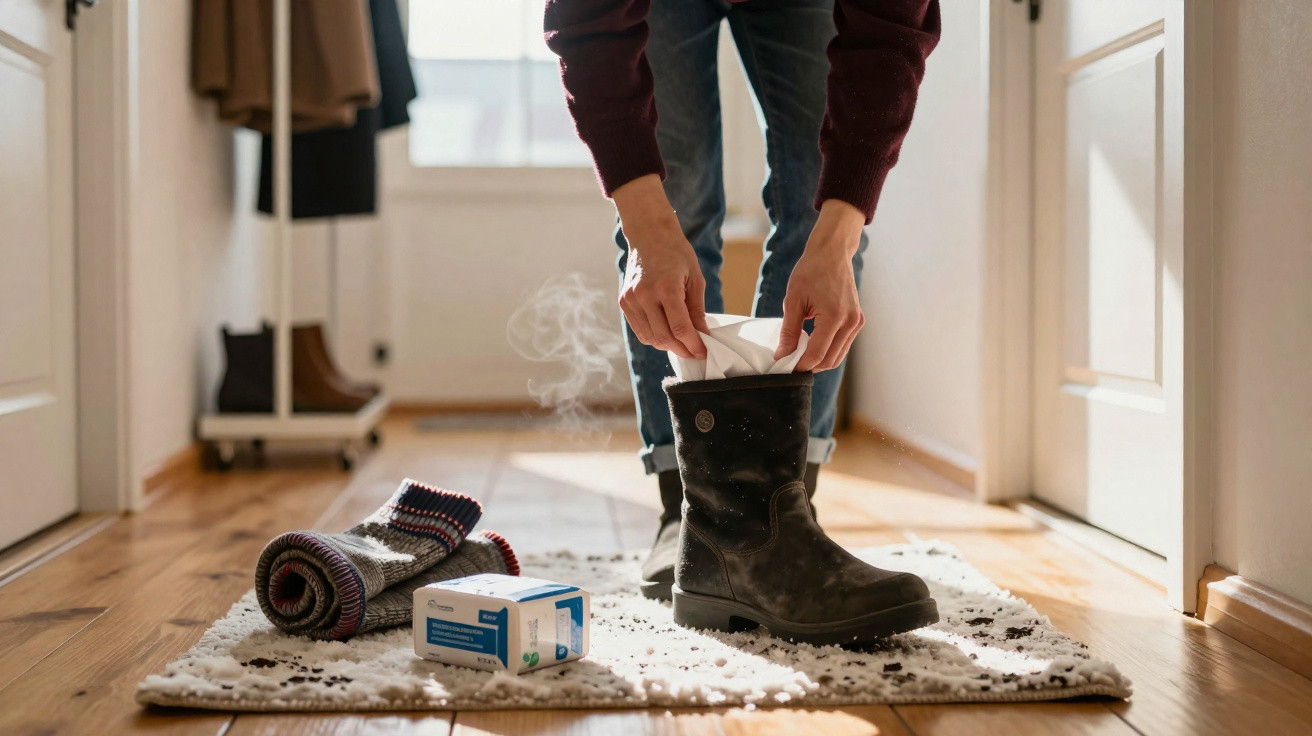
Here is the simple, pleasantly low-tech solution: take two unused dryer sheets from the packet beside your washing machine. Any standard variety is fine – fresh linen, cotton, “mountain air”, or whichever scent you usually pick up in the laundry aisle. Loosely scrunch each sheet in your hand and place one right down in the toe of each shoe.
Keep them there overnight, or for longer if possible. The sheet fibres gradually give off fragrance, while their soft, paper-like material draws some remaining moisture from the lining. Pull them out the following day and your footwear should smell more like tumble-dried towels than a changing room at closing time.
It is not magic; it is affordable chemistry. The scented compounds in dryer sheets attach themselves to the same kinds of surfaces that odour molecules cling to: fabric, foam and leather. They don’t erase all bacteria, but they disguise the strongest smells remarkably well for something that costs pennies each time. If your shoes have not reached the “burn them” stage, this may be the difference between embarrassment and “no big deal”.
Let us be honest: nobody genuinely manages this every day. Some evenings, you will forget the dryer sheets. You will hurry through the door, kick off your boots, step past them and head straight for the sofa. That is normal. The aim is to make the habit easy rather than flawless.
Put a small box of dryer sheets beside the front door or underneath the bench where your footwear is stored. Sliding one into each shoe can then become a three-second routine, much like dropping your keys into the same bowl whenever you come home. When snow or heavy rain has left your shoes very wet, let them air near a heat source first, then add the sheets once they are dry or only slightly damp.
If you forget one morning, there is no need to panic or soak them with half a can of spray. Let them have a rest day with clean dryer sheets and dry socks, and wear another pair instead. Rotating footwear is one of those small improvements to daily life that nobody mentions at school, yet your nose will appreciate it.
“We underestimate how hard winter is on our shoes,” says one foot-care specialist I spoke to. “People blame their feet, when in reality their footwear never gets a proper break or a chance to dry.”
The dryer sheet trick is most effective as part of a modest, realistic routine, rather than as a dramatic attempt to rescue shoes when the problem is severe. Treat it as an overnight refresh, not a miracle fix. Even when you are desperate, there are a few things to avoid:
- Do not combine it with strong perfume or cologne inside the shoe – that only produces a different, more bewildering odour.
- Do not reuse dryer sheets; after one night of work, they have finished their job.
- Do not overlook wet insoles. Remove them to dry whenever you can before putting in dryer sheets.
There is also a quieter benefit: the gentle, clean smell of laundry can alter how it feels to put your shoes on during a gloomy morning. It is not simply “less bad”; it is a small personal comfort before stepping back into the cold.
Beyond the smell: what your winter shoes are really telling you
There is a certain relief in recognising that this is not about having “gross feet”, but about weather, materials and routines working together. Seen that way, it feels less embarrassing and more practical, rather like dealing with a draughty window or a squeaking door. It is something to address rather than conceal.
Notice which pairs begin to smell most quickly. Are they heavy synthetic trainers with very little ventilation? Fashion boots with plastic linings? Those are likely to be the highest-risk pairs. Leather footwear with removable insoles and a little space around the toes generally performs better. When a pair starts to smell, it can also be a subtle indication that it is not drying fully between wears, and that your feet are working harder than you realise to stay warm.
Some people find their “winter foot smell” is harsher on days when they are stressed, short on sleep or more active than usual. Sweat is not purely water; it also carries traces of your hormones and the kind of day you have had. Shoes can become a rough record of how your week has felt. You need not analyse it too deeply, but spotting those patterns may help you be kinder to yourself rather than simply feeling disgusted by a pair of boots.
Most of us have experienced taking off our shoes at a friend’s home and suddenly remembering, too late, what is happening inside them. The dryer sheet trick is partly about controlling odour and partly about reclaiming some confidence. It shows how minor adjustments – carrying an extra pair of socks, keeping a box of sheets at the door or allowing shoes to rest for a whole day – can alter how you get through winter.
And if somebody asks why your shoes still smell fresh after a long, wet commute, you can simply shrug and say that you have a secret from the laundry aisle.
| Key point | Detail | Benefit for the reader |
|---|---|---|
| Winter amplifies shoe odour | Closed, insulated shoes retain sweat and moisture, creating an ideal environment for bacteria | Explains why odour can seem worse during colder months and reduces shame or confusion |
| The dryer sheet trick | Crumpled dryer sheets left inside shoes overnight provide fragrance and help manage lingering odours | Provides an inexpensive, straightforward, low-effort tip using something many people already own |
| Make it a small nightly habit | Store dryer sheets by the door, rotate footwear and allow insoles to dry before wearing them again | Makes an awkward issue into an easy routine that protects shoes and confidence throughout winter |
FAQ:
- Do dryer sheets actually kill the bacteria in my shoes? Not really. They chiefly mask odours and provide slight help with moisture, whereas bacteria are better dealt with by drying shoes properly, washing insoles or disinfecting them occasionally.
- Can I use dryer sheets in every type of shoe? They are suitable for most closed shoes, trainers and boots, but avoid delicate materials such as untreated leather or specialist running shoes where manufacturers advise against additional chemicals.
- How often should I use the dryer sheet trick? Fresh sheets work well after any long, sweaty or rainy day; some people use them after every winter wear, while others reserve them for their longest days.
- Are there fragrance-free options if I’m sensitive to smells? Yes. Unscented dryer sheets are available and can still offer a lightly “fresh” feeling and a little moisture management without strong perfume.
- What if my shoes already smell really bad? Begin by washing or replacing the insoles and allowing the shoes to dry completely for 24–48 hours. Then use dryer sheets as ongoing maintenance instead of a one-off rescue.


Comments
No comments yet. Be the first to comment!
Leave a Comment