
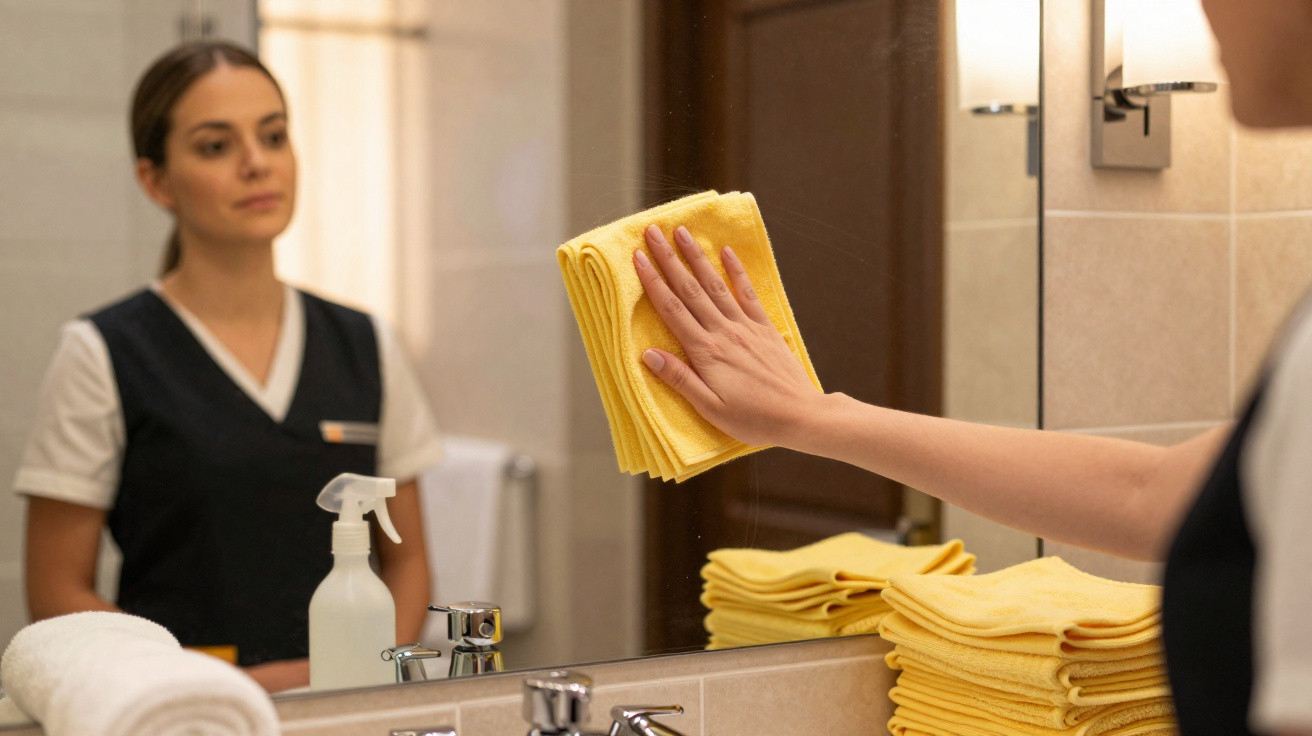
Only the low whirr of the extractor fan, unforgiving hotel lighting and a mirror marked with faint, ghost-like smears left by the previous guest. In under five minutes, the glass must be so spotless that nobody notices it. That is the task: invisible perfection.
She does not begin with the expensive-looking spray bottle. Instead, she takes a small, unremarkable tool from her apron, folds it with practised speed and gets to work in calm, economical motions. In moments, the dull film becomes a crisp reflection - the sort that makes guests question why their mirrors at home never achieve the same result. She gives the corners one final check, smiles and leaves silently.
The answer is not what most people expect.
The hidden routine behind “hotel perfect” mirrors
Ask hotel guests what stood out in their room and they will normally mention the bed, the view or breakfast. Hardly anyone says the mirror. Even so, that pane of glass is among the first things our minds register on entering a bathroom. When it is streaked, the whole room instantly appears less clean, however much everything else gleams.
Housekeepers understand this without needing to think about it. They work quickly with trolleys loaded with products, yet the mirror remains a small demonstration of their expertise. One poor movement can leave rainbow streaks, lint or a greasy outline at the edges. One correct movement makes the glass seem to vanish, with only your own face looking back at you.
In a large city hotel on a busy day, one housekeeper may deal with 40 or 50 mirrors. There is no opportunity to experiment. Over the years, they develop a set of tiny movements and shortcuts that transform a mundane task into a quiet skill. This lesser-known trick comes from there: one modest, repeatable step that saves time and delivers the uncanny “no streak, no trace” result that guests remember without knowing why.
Consider Elena, who has spent 17 years in housekeeping at a four-star airport hotel. She times herself almost automatically: a maximum of three minutes for each bathroom. “If I spend longer, I’m late everywhere,” she laughs. Yet when she stands before a mirror, her hands move with the confidence of someone who has ironed the same shirt a thousand times. There is no uncertainty and no revisiting the same patch ten times.
Every time, she begins in the identical corner. The cloth is folded the same way and her strokes follow the same route. Rather than pursuing each tiny mark in every direction, she works as though following a grid visible only to her. Once finished, she shifts slightly left and then right, using the light reflected at an angle to spot streaks, much like a mechanic listening for an unfamiliar sound from an engine.
Elena insists she is doing nothing unusual. “It’s just habit,” she shrugs, although few of us can achieve that result in our own bathrooms. Her technique does not rely on a miracle product or an expensive television-advertised spray. It combines an inexpensive tool, a deliberate fold and one firm decision: use almost no liquid.
Speak to professional cleaners for long enough and the same point emerges: mirrors do not respond well to excess product. Most streaks are not grime but residue - minute remnants of detergent, minerals from tap water or fabric softener remaining in the soft cotton cloth you like to use. Under bright bathroom lights, every line becomes as visible as highlighter ink.
The reasoning behind the housekeeper method is nearly the reverse of the usual approach at home. We spray freely, wipe in every direction, then continue until our arms ache and “good enough” wins. Professionals focus on control: less liquid, less fabric touching the glass and fewer changes in direction. They remove variables one at a time, then repeat the identical motion dozens of times daily until it becomes muscle memory.
There is a psychological aspect too. We often connect cleaning frustrations with particular jobs - scrubbing the shower or descaling the kettle - and the mirror becomes a sign of that never-ending fight against marks and water spots. The hotel method removes the drama. It is almost dull, and that is precisely its strength: a small, dependable process with no scope for disorder or guesswork.
The little-known hotel mirror trick: almost dry, always folded
This is what many hotel housekeepers really do. They do not start with glass cleaner. They begin with a barely damp microfibre cloth, folded into a tidy, substantial square that sits in the palm of the hand. It is neither limp nor rolled up, but forms a compact pad. The cloth is lightly dampened with water or a highly diluted glass-cleaning solution, then wrung out so thoroughly that it feels nearly dry.
They quickly clean the entire mirror using that almost-dry pad in horizontal rows from top to bottom, as though mowing a miniature lawn. There are no circular motions and no zigzags. Instead, they make clean strokes, overlapping each previous stroke slightly. This initial pass removes the main layer of steam residue, toothpaste spray and fingerprints. The real difference comes afterwards: they turn the folded cloth to a fully dry, unused section and repeat exactly the same pattern. This dry pass removes streaks before they can settle.
Let us be honest: nobody really does this every day. Most of us take the nearest paper towel, spray half a bottle over the glass and hope it works out. We then wonder why the mirror looks worse by the following day. Housekeepers identify two main culprits: fluffy cotton and fabric softener. Cotton often sheds fine lint that shows up in the light. Softener creates an invisible coating on cloths, which transfers directly to the glass regardless of how vigorously you clean.
They will also point out that every extra touch of the mirror increases the risk of fresh marks. This is why the folds are kept tight: each clean face of the cloth is valuable. After one side has been used, it is “dead” and must not touch the glass again. The underlying consideration is straightforward: everyone is tired and short of time. These professionals have simply discovered that a little discipline with one small square of fabric prevents hours of irritation later.
One experienced supervisor put it this way in the staff room between shifts:
“People think it’s the spray. It’s not the spray. It’s the cloth, the fold, and knowing when to stop wiping.”
To make the method easier to remember at home, use this brief checklist before cleaning the mirror.
- Choose a clean, dry microfibre cloth with no fabric-softener residue.
- Fold it into a firm square, noting which surfaces have already been used.
- Apply very little liquid: a fine mist rather than a drenching.
- Clean in straight lines, then repeat the pattern with a dry side.
- Move to either side and inspect the glass at an angle before you leave.
Why this small ritual changes more than your mirror
Seeing your reflection in a flawlessly clear mirror that you have cleaned yourself is unexpectedly satisfying. It is not only about cleanliness. It is also about control: one small part of your home behaving exactly as you intended. On a hectic weekday morning, when emails and appointments already fill your head, a streaked mirror can seem like one more thing going wrong.
On a peaceful evening, the same pane of glass can offer a kind of reset. Spend three minutes folding the cloth like a professional and making the straightforward, repeated strokes. No app and no noise - just fabric moving over glass, while hazy areas become defined edges and clear lines. It can feel surprisingly grounding. At a deeper level, learning this hotel trick is less about impressing visitors than giving your own space the same understated care that hotels give to strangers.
In the grand scheme, it is a very small action. Only a mirror. Yet it is these little routines that we often share with friends: the trick for crisp sheets, the shortcut to fluffy towels or the way to remove coffee marks from mugs. The housekeeper’s almost-dry cloth method belongs with that kind of simple, generous know-how, passed from worker to customer and from behind the scenes to the front row. Try it once, notice the result, and before long you will be asking, “Want to know how hotels do it?”
| Key point | Detail | Benefit for the reader |
|---|---|---|
| Less product | Use a fine layer of liquid instead of soaking the mirror | Reduces streaks while saving time and cleaning product |
| Folding the cloth | Fold microfibre into a square and use each clean side only once | Creates a clear finish without lint or ghost marks |
| Two passes | Make one almost-damp pass, followed by a completely dry pass | Produces a “hotel mirror” effect with a sharp reflection and no extra effort |
FAQ:
- Can I use paper towels instead of microfibre? Yes, although they will generally create more lint and waste. Microfibre holds grease and releases fewer fibres, so the mirror becomes clearer with fewer passes.
- Do I really need glass cleaner, or is water enough? For minor everyday marks, water on a microfibre cloth is often sufficient. For toothpaste, hairspray or make-up, a small amount of glass cleaner or diluted vinegar breaks down residue more quickly.
- Why does my mirror look worse after I clean it? This normally indicates too much product, a dirty cloth or fabric-softener residue. Use a clean microfibre cloth with less liquid, and finish with a completely dry side.
- How often should I clean my bathroom mirror? Professionals would prefer once or twice weekly, but everyday life is untidy. Even a quick 60-second dry wipe every few days can prevent it becoming a larger task.
- Is vinegar safe for all mirrors? In small, diluted quantities, it is suitable for most mirrors. Do not soak the edges or backing, because acid may damage the mirror backing over time. Spray the cloth rather than the mirror.



Comments
No comments yet. Be the first to comment!
Leave a Comment