
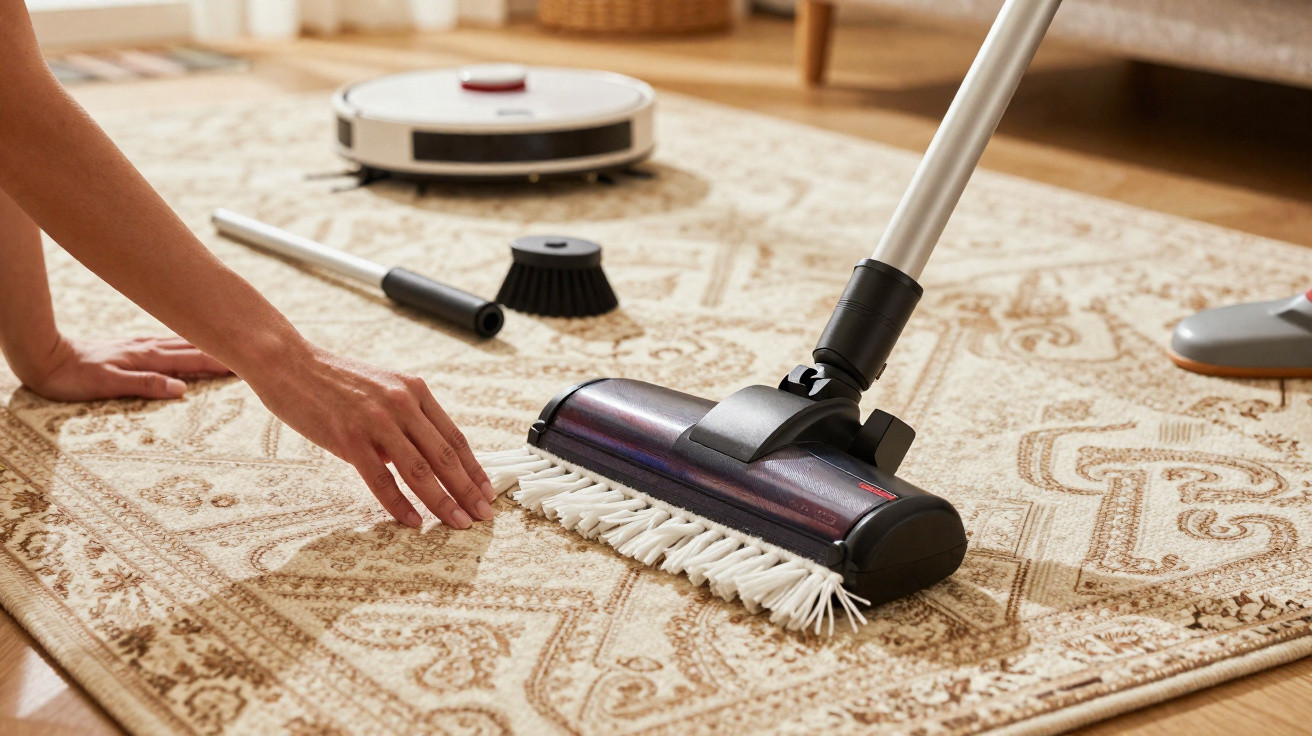
The sound began as a subdued growl before becoming something nobody wants to hear close to an object they cherish: a violent, grinding tear. It is the sort of noise that instantly silences a room. The vacuum cleaner had seized the tassels on the living-room rug and, by the time the power switch was pressed, its tidy fringe had become a tangled mass of thread.
The edge appeared gnawed and almost scorched. It was no longer simply dirty; it looked wounded.
Later, crouched on the floor and using fingers to separate what the beater bar had destroyed, the moment felt unexpectedly personal. This was not merely a rug: children had learnt to crawl on it, late-night films had ended there in sleep, and coffee spills had happened and been forgiven. A cleaning appliance that was supposed to look after the home had torn it apart.
The harsh reality? Technically, the vacuum cleaner was operating exactly as it should.
Why a beater bar and tassels are natural enemies
A beater-bar vacuum cleaner is, in effect, a powerful rotating brush. Its rigid bristles and spinning roller are made to dislodge dust and grime from carpet fibres before suction removes them. On fitted synthetic carpet, this can seem wonderfully effective. On a tasselled rug, however, it acts like an unstoppable, hungry machine.
Tassels sit loose and naturally untidy. To a beater bar, they are simply something to catch - and it will not release them.
Picture tassels as the loose hair at the end of a plait. They are not always decorative pieces attached afterwards; frequently, they are the rug’s actual warp threads, forming the structural backbone that keeps it together. When a rotating bar forces those threads to unravel, the risk extends far beyond the fringe.
Many rug-cleaning specialists quietly offer the same warning: a beater bar is among the quickest ways to turn an otherwise sound rug into a costly repair job.
When a beater bar snags a tassel, two events take place almost instantly. First, the fringe winds around the spinning brush like spaghetti around a fork. Then, as the vacuum cleaner continues forwards, it tugs at the base of the rug’s edge. That force draws threads from the weft and warp, loosens knots and may even snap fibres within the rug itself.
The harm is not always immediately obvious. The fringe may initially seem a little uneven and the edge slightly coarse. After several more supposedly quick vacuuming sessions, though, whole stretches of tassels can vanish, edges can bow outwards and corners can curl up. The rug is not simply ageing; it is being mechanically taken apart.
Real-world damage: the slow unraveling you don’t notice at first
Speak to any professional rug restorer and a familiar, weary account emerges. Someone arrives with a beautiful hand-knotted rug, perhaps inherited from a grandparent or bought during a trip abroad, and cannot understand what has happened. Its centre remains rich and densely woven. The colours are still fine. Yet the borders are shredded, half the tassels are gone, and certain areas are shorter than others, like a poor haircut.
Owners often insist that the rug “just started falling apart”. Usually, the explanation is less mysterious and much more unforgiving: years of beater-bar vacuuming have attacked the very threads that hold the rug together.
A small London workshop keeps a box of vacuum casualties: clumps of tassels ripped away like weeds. Every bundle once came from somebody’s hallway or living room. The restorer says that one pull from a beater bar can remove several tassels at once, particularly from older or handmade rugs.
Social-media home décor groups are full of subdued alarm: “Why are my tassels disappearing?” and “How did my wool rug edge get like this in only two years?” The first post rarely blames the vacuum cleaner - until somebody asks how the rug is cleaned.
Technically, a tasselled rug is constructed like a woven narrative. Its warp threads run from end to end and often become the tassels when they emerge from the body of the rug. Weft threads pass across them and secure the entire structure. When the beater bar pulls a tassel, that strain runs back through the weave.
It can cause damage that remains invisible: tiny breaks, microscopic splits in fibres and a slight slackening of the weft. Eventually, the rug loses tension and starts to ripple or buckle. The edges fray, the pattern close to the border becomes blurred, and restoring the rug costs much more than buying a gentler vacuum cleaner or adopting one straightforward practice: always keep the beater bar away from tassels.
How to vacuum tasselled rugs without destroying them
The safest approach is almost traditional in its simplicity. Switch off the beater bar, or set the vacuum head to hard-floor mode, and use suction alone. If the brush roll cannot be turned off, fit a flat attachment that provides suction only. Treat the tassels themselves as an area the machine must not enter.
Begin by carefully lifting or folding the tassels back over the rug. Vacuum the main surface, stopping just before the edge. Afterwards, shake the tassels by hand or gently run your fingers through them to release dust. It adds only a minute or two, but may preserve the rug for decades.
For a smaller rug, the tassels can be rolled or folded underneath before vacuuming to make a protective border. Some people lay a straight item, such as a ruler or strip of cardboard, over the fringe and hold it in place while vacuuming nearby, keeping the tassels secure and protected.
Let us be honest: hardly anyone truly does that every day. Even so, doing it weekly or fortnightly can greatly reduce visible wear. Dirt will not disappear by magic, but the structure of the rug will remain intact.
The major error is assuming that one quick pass cannot cause damage. You may be in a hurry, guests may be on their way, the rug may look dusty, and the vacuum cleaner may already be plugged in with the beater bar rotating. Those are exactly the circumstances in which tassels get pulled in. Another common mistake is running the vacuum across the edge and then reversing over the fringe with the brush still engaged, which doubles the danger.
One rug expert put it plainly:
“The beater bar doesn’t know the difference between dirt and your rug’s foundation. It beats both.”
Use this short mental checklist for rugs with tassels:
- Switch off the beater bar, or use a suction-only head, around every fringed edge.
- Never run a vacuum directly over tassels; deal with them manually rather than mechanically.
- Vacuum in the direction of the pile, rather than against it, to place less strain on fibres.
- Treat stains gently with a mild solution and blotting, never scrubbing.
- For valuable or hand-knotted rugs, consider professional washing every few years.
Living with rugs you love, not rugs you fear to touch
There is a quiet pleasure in caring for an item that lasts beyond changing trends and furniture. A quality tasselled rug can do precisely that. It can travel from one flat to another, witness different lives unfolding and retain memories in its faded areas and softened fibres.
Once you understand how the damage occurs, the worry about ruining it through cleaning begins to fade. Instead of treating the rug like fragile crystal, you can see it for what it is: a durable handmade textile that simply clashes with one particular tool.
Practically speaking, moving away from the beater bar is a very small change. It is one button, one attachment and one deliberate choice not to drag spinning brushes over loose threads. That’s all. The mental change is larger, though: it is the point at which you stop allowing a machine’s default setting to determine the lifespan of something that matters to you.
That may sound overly dramatic for fabric placed on a floor. Yet homes are largely built from such “small” things, which we pass over every day without a second thought.
On a screen, the connection between tassels and beater bars is easy to miss: a warning scrolled past or a tip only half remembered. In an actual room, it is the suddenly bare edge that was once full, or the fringe that no longer lies flat. It is the small pang of regret when you recognise that the damage was not unavoidable; it was merely a habit.
Some readers will alter the way they vacuum. Others will recall this the next time they stand over a rug with the hose in hand, considering one rapid pass along the edge. That brief pause is where the outcome changes. It is where a rug either starts to unravel or quietly remains whole.
| Key point | Detail | Why it matters to the reader |
|---|---|---|
| Beater bar vs tassels | The rotating brush catches and twists fringe, pulling against the rug’s structure. | Helps explain why rug edges are wearing out quickly. |
| Structure of tasselled rugs | Tassels are often exposed warp threads rather than mere decoration. | Shows the genuine risk: harm to tassels damages the rug’s backbone. |
| Safe cleaning habit | Use suction only near edges and deal with tassels by hand. | Provides an easy routine for protecting rugs without specialist equipment. |
FAQ:
- Can I ever use a beater bar on a rug with tassels? Only on the central area, and even then with caution. Stop several centimetres before the fringe and switch to suction-only near the edges.
- My tassels already look damaged. Is the rug ruined? Not necessarily. A professional rug restorer can often secure the edge, trim uneven fringe, or even reweave parts of the border.
- What’s the safest way to clean tassels themselves? Gently shake them out, then, if needed, lightly vacuum from a distance with a nozzle held above the fringe, or blot by hand with a damp cloth.
- Are synthetic rugs with tassels at risk too? Yes. Even if the rug is machine-made and synthetic, the fringe can still be pulled, broken or detached by a beater bar.
- How often should I vacuum a rug with tassels? Once or twice a week for high-traffic areas is usually enough, using suction-only near the edges and occasional deeper professional cleaning if it’s a valuable rug.


Comments
No comments yet. Be the first to comment!
Leave a Comment