
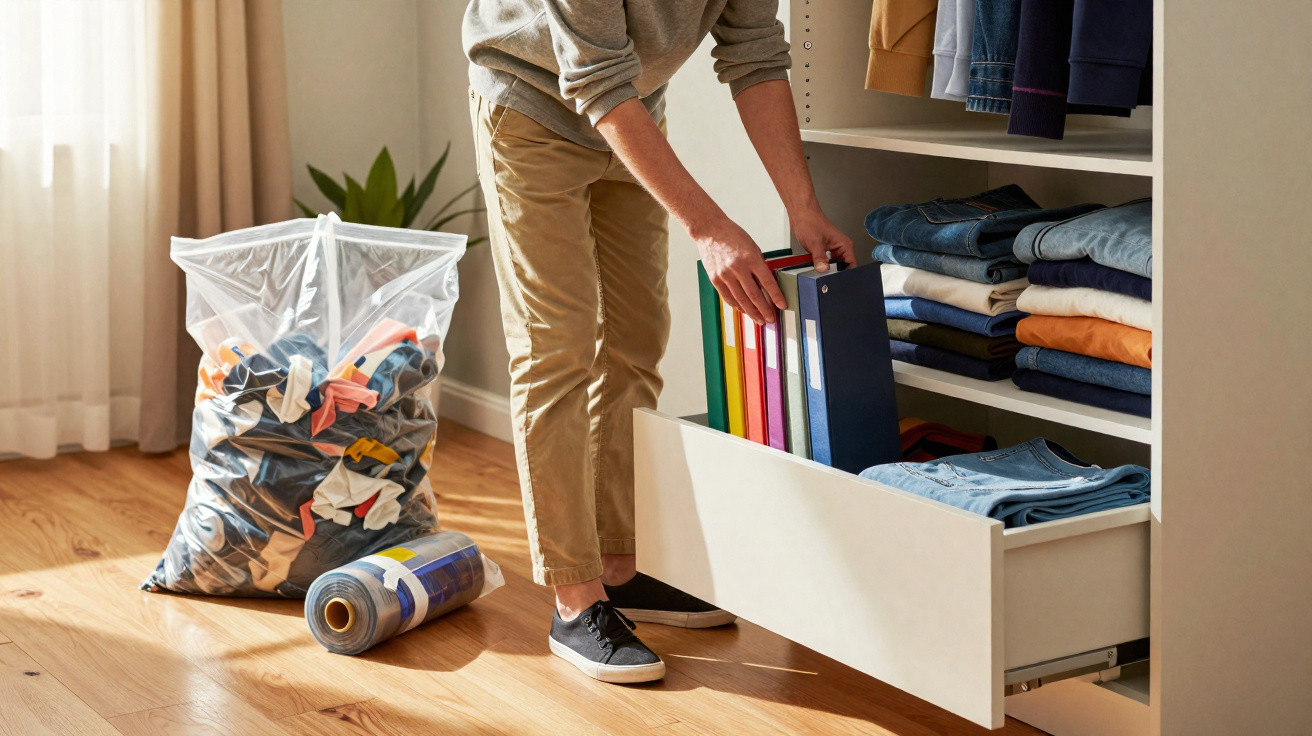
One knee braced against the lid, both hands pushing down, while the zip fought its way angrily around the corners. Two vacuum bags were already swollen like overstuffed pillows: the air had supposedly been removed, but clothes still overflowed at the edges in a rather untidy display.
On the other side of the room, a friend watched briefly before calmly emptying one vacuum bag. She shook out the shirts and began folding them. There were no gadgets and no wheezing pump, only purposeful, almost rhythmic motions. Every T-shirt became a tidy, compact rectangle, standing upright like a file in a cabinet.
Fifteen minutes later, my suitcase closed with two fingers and a soft click. The clothes were identical, as was the available space, but the outcome was completely different. That was the day I understood something surprisingly radical.
How you fold your clothes can outperform high-tech vacuum bags at their own game.
The quiet chaos lurking in your wardrobe
Open almost any wardrobe on a weekday morning and it seems to let out a weary sigh. There are lopsided piles, a jumper trapped beneath six others, and that dress you repeatedly forget exists because it lies flat at the bottom of a stack. It is not merely “a bit messy”; it is wasted space accumulating gradually.
Most of us point the finger at an undersized wardrobe rather than how we use it. We purchase extra rails, fabric storage boxes and even more furniture. But every uneven stack of T-shirts wastes centimetres through unnoticed gaps and sagging layers. Clothing slips, falls over and spreads out, occupying room you never intended to surrender.
Behind closed doors, a subtle daily contest is taking place between the behaviour of fabric and the way we pile it up.
The same pattern appears when people pack for a holiday, only at greater speed. One London couple recorded themselves packing for a city break, using the same 10 items but two separate approaches. He chose a vacuum bag, while she used a “file” folding system and rolled several awkward pieces. Placed side by side on the bed, the contrast was rather embarrassing.
His vacuum bag appeared compressed, yet its plastic casing was stiff and unwieldy. Its shape alone claimed half the suitcase. Her folded clothing fitted tightly into place, following the corners and sides, while leaving spaces for shoes and toiletries. Once measured, her side of the suitcase offered 20% more usable space and much less empty air.
Travel bloggers witness this repeatedly: vacuum bags create an impressive effect, but they do not always deliver the greatest genuinely packable volume. The real answer lies in the folds.
In technical terms, vacuum bags work by extracting air caught between fibres and layers. It sounds impossible to beat. However, clothing within them spreads into broad, thick, solid slabs that cannot bend around corners or occupy irregular spaces. You gain slimness but sacrifice flexibility.
Clever folding takes another route. It makes use of gravity, structure and repetition. Compact folds cut down air pockets without converting clothing into inflexible blocks. Vertical storage makes use of height rather than depth. Rolling harnesses fabric’s natural flexibility to fill small voids between other belongings.
When your wardrobe or suitcase contains shapes that can bend, slide and stack without tumbling down, you reclaim space you did not realise was there.
The folding change that transforms everything
The most important change is not a complicated trick. It is replacing “flat and stacked” with “compact and vertical”. Rather than layering T-shirts on top of one another, fold them into smaller rectangles and stand them upright, as you would files in a drawer. Each item occupies less physical and visual space.
A straightforward starting point is this: place the T-shirt flat, fold both sides inwards to create a long rectangle, then fold it up from the bottom in thirds or quarters. Aim for a compact block that can stand alone. The same principle applies to jumpers and sweatshirts, although thicker fabrics need looser folds. The goal is not perfection, but shapes you can recreate consistently.
Inside a suitcase, the same technique allows clothes to be arranged edge to edge rather than piled up. There is no longer any need to dig for the shirt hidden at the bottom. Every folded piece becomes a building block.
The most difficult element is breaking the habit of making a “quick stack”. Horizontal piles are appealing because they seem speedy and familiar: fold, drop, finished. But when you want the third T-shirt from the bottom, you lift the stack, it wobbles, and by the end of the week half the pile has slumped sideways. The space is lost all over again.
Vertical folding asks for slightly more care at the beginning, but rewards you whenever you open the drawer. You can see everything you own at a glance. Remove one item and the others remain in place. That stability is what enables tighter packing without creating chaos.
In practical terms, vertical folding also suits the shape of drawers. It uses their height and depth, rather than only their surface area. Those persistent spaces at the back of a drawer suddenly stop being wasted room. Your wardrobe begins to work like a series of fitted shelves instead of a collection of unsteady towers.
Let’s be honest: nobody truly does this every day. No one lives in a Pinterest-perfect flat. The key is to choose one or two categories to “switch”: T-shirts, underwear or perhaps jeans. Not your whole life.
Begin with a single drawer. Take everything out, then sort it quickly into keep, donate and seasonal piles. Fold only the items you are keeping using the new approach, and stand them upright. When travelling, spend an additional 10 minutes folding rather than simply cramming things in and hoping for the best. You will notice the benefit as soon as the zip closes without you having to sit on the case.
Common mistakes include making folds too large, so the garments flop over; rolling jumpers too tightly until they become oversized sausages that dominate everything around them; and overlooking differences between fabrics. Silky items require a firmer fold, while knitted pieces benefit from gentler, fewer folds to prevent stretching. Do not be too hard on yourself if it looks untidy at first. Neatness develops through repetition.
“My clients always want new storage,” laughs UK professional organiser Emma Hart, “but nine times out of ten, they gain a whole extra drawer just by changing the way they fold. The furniture never changed. Their habits did.”
That minor adjustment has a subtle emotional benefit as well. When clothes are not crammed in or compressed inside plastic, you treat them differently. You spot your favourite jumper before you forget about it. You stop buying more black T-shirts because you “can’t find any clean ones”. Space is not solely physical; it can make your mornings, packing and mood feel calmer.
- Create consistent rectangles rather than vague shapes.
- Store clothes upright instead of in flat stacks.
- Combine folding and rolling to occupy awkward spaces.
- Reserve vacuum bags for genuinely long-term storage.
- Keep delicate fabrics safe from heavy compression.
More room, the same clothes and a different feeling
After testing both approaches side by side, the contrast is difficult to ignore. A drawer of vertically folded clothes appears lighter, almost airy, even when it is full. Your suitcase becomes less of a struggle and more like a puzzle whose solution you understand. Nothing miraculous has happened to your available floor space; you have simply learnt to work with fabric rather than against it.
There is also a quiet sense of freedom in moving away from endless storage products. You may still retain a few vacuum bags for duvets or genuinely off-season coats. Yet everyday life starts to depend less on plastic fixes and more on small, repeatable actions: folds you can make half-asleep after a long day, as your hands remember the movements.
On a crowded island where homes are expensive and cupboards are shallow, the way we fold can feel almost political. We are negotiating with the boundaries of our lives. The aim is not perfection, nor an Instagram grid of colour-coordinated jumpers, but finding a folding rhythm that gives you space to breathe.
| Key point | Detail | Benefit for the reader |
|---|---|---|
| Vertical folding beats flat stacks | Clothing is folded into compact rectangles and stored upright | Saves space without buying new storage |
| Vacuum bags have a specific role | Better suited to long-term storage than daily use or weekend breaks | Prevents fabric damage and avoids losing flexibility in a suitcase |
| Repeatable habits, not perfection | A simple method that can be maintained even on busy days | Less stress, less searching in the morning and more visual space |
FAQ:
- Do folding methods really save more space than vacuum bags? Yes. For everyday drawers and most suitcases, compact vertical folds and smart rolling often provide more useful, flexible space than a single rigid slab created by a vacuum bag.
- When should I still use a vacuum bag? Use vacuum bags for bulky items that are rarely used, such as duvets, spare pillows, heavy winter coats or clothes being stored for several months.
- Won’t vertical folding take too much time? The initial reset takes slightly longer, but after some practice, folding each item adds only a few seconds and saves minutes of searching later.
- Is rolling or folding better for travel? A combination is most effective: make compact rectangular folds, then roll softer garments such as T-shirts and leggings to fill corners and small gaps between shoes or packing cubes.
- What if my clothes keep toppling over in the drawer? Make the folds smaller and a little firmer, group garments by type and length, then use basic dividers or old shoe boxes to “bookend” each row so that nothing slides.



Comments
No comments yet. Be the first to comment!
Leave a Comment