
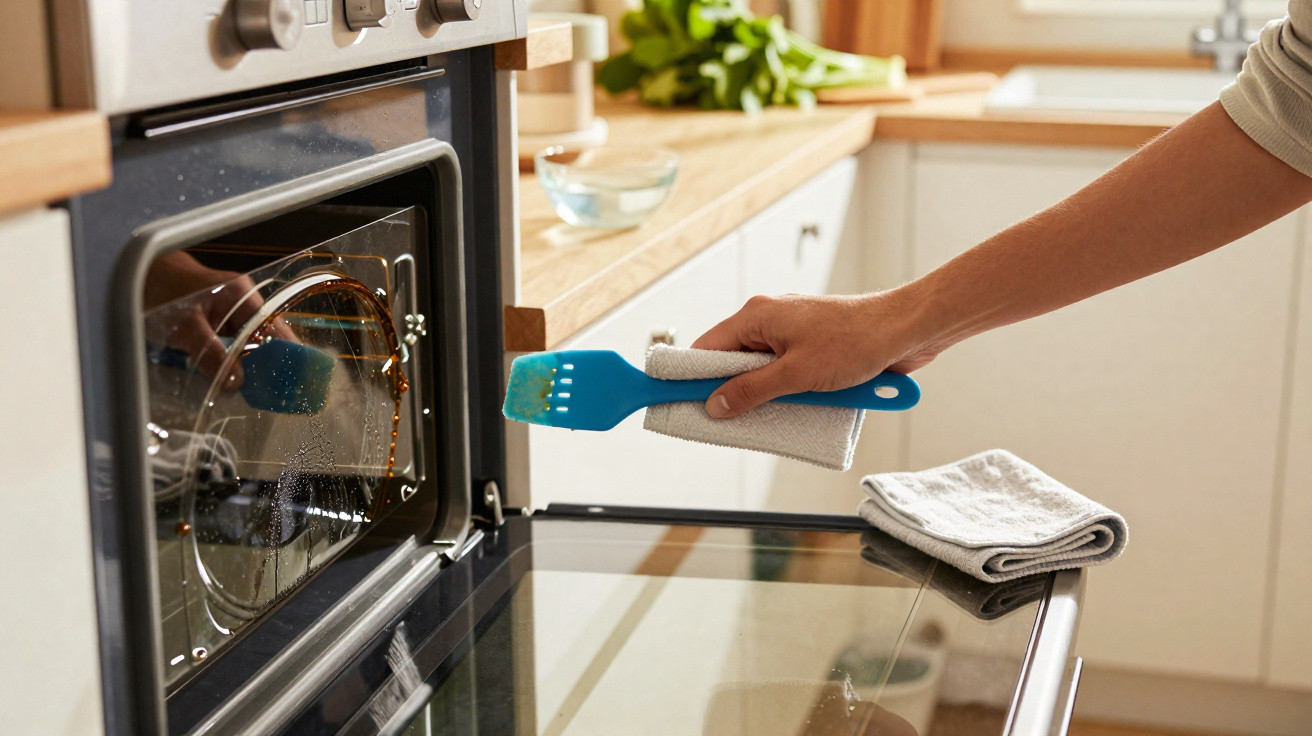
Want your oven glass clear again without removing the door, using bottles that make your nose sting, or risking even one scratch? This calm, effective approach brings back the shine with warmth, cloths and a few well-chosen techniques.
At 7.12 pm in a compact kitchen, with sheet-pan broccoli sizzling away, the oven door glass was revealing months of splashes, baked-on shadows and a comma-shaped thumbprint. The host, tired after a midweek day, with a candle burning and quiet jazz playing, was rubbing circles with a paper towel. It achieved nothing except spreading the dull film. We have all faced that moment: guests are on their way and the oven glass suddenly becomes an unwanted mirror. The solution, as I discovered, is easier than it seems-and far nearer than the cupboard under the sink full of cleaning sprays. It begins with warmth.
Why oven glass becomes grimy-and why harder scrubbing makes it worse
Your oven door is not made from ordinary glass. It is tempered, may have a coating, and sits only a few inches from hot fat that spits and settles on it as a fine mist. Every roast leaves behind a barely visible layer. Trying to wipe it when cold simply buffs that layer into a cloudy surface. Abrasive pads can cut tiny circular marks that only become apparent in the light at 4 pm. That is what creates the appearance of a “permanent haze”. It is not permanent at all; it is a build-up of layers. Those layers need softening, not brute force.
One January evening, I saw a neighbour heat her oven for ten minutes, put in a tray of freshly boiled water and shut the door. Steam gathered on the glass like a tiny sauna. She then turned the oven off, waited until the door was warm rather than hot, and placed a hot, wrung-out microfibre cloth over it. After three minutes, she used a plastic loyalty card to lift away a visible ribbon of greasy film. There was no harsh scraping sound and no nervous hesitation. Google Trends shows that searches for “oven glass clean” rise just after the holidays; this simple routine makes that seasonal pattern understandable.
Glass benefits from a little warmth and a gentle lifting action. Heat loosens polymerised grease, allowing a soft edge to shear it away. Straight passes are better than circular rubbing because they avoid leaving halos. Distilled water is preferable to tap water because tap-water minerals can cause streaks. That is the science behind it. There is no need for foam, fragrance or abrasive grit. Steam handles more of the work than you might expect. Change the sequence to warm, soften, lift and buff, and the glass responds. The shine is created by technique, not products.
A clever, scratch-free oven glass method without chemicals
Heat the oven at 95°C for 8–10 minutes, then turn it off. Set a heatproof bowl or tray containing just-boiled water on the middle shelf, and close the door for 5–10 minutes. Open the door to a 30° angle. Place a hot, thoroughly wrung-out microfibre cloth over the inner glass for 2–3 minutes. Take it away, then hold a plastic scraper or old gift card at a shallow angle and draw it from top to bottom in straight, overlapping strokes. Wipe the edge on a cloth after every pass. Finish with a clean damp microfibre cloth-using distilled water if available-then buff dry. No blades. No aggressive sprays. No fuss.
For stubborn marks, dampen one corner of the cloth and add a pinch of food-safe bicarbonate of soda to the cloth rather than directly to the glass. Work only on the affected spot with two light strokes, then rinse and buff. The glass should be warm, not hot: warmth helps, whereas excessive heat works against you. Choose microfibre instead of paper towels, which shed fibres and may drag grit across the surface. Avoid pressing firmly around the edges where the glass meets the frame. Thin gloves are fine if the warm door makes you uncertain. Let’s be honest: nobody does this every day.
Some oven doors develop a haze between the panes. It is still possible to clean this without taking the door off. Fasten a narrow strip of microfibre to a long cable tie, chopstick or shoelace. Moisten the cloth with hot water, then carefully feed it through the vent slots along the bottom of the door. Move it gently backwards and forwards to sweep the inner surface, shifting the damp section as it collects dirt. Use a dry strip afterwards to prevent streaks. The oven door remains in place, and the glass remains protected.
“Aim for glide, not grind. If you hear scraping, you’re using the wrong tool or the wrong angle,” says home-appliance tech Maya L., who cleans dozens of doors a month.
- What you need: a kettle or saucepan, two microfibre cloths, a heatproof bowl, a plastic scraper or old card, a cable tie or chopstick, a thin cloth strip, and a small towel for the floor.
- Helpful extras: distilled water for the final wipe and thin gloves.
- Avoid: steel wool, razor blades, abrasive powders applied directly to the glass, and vinegar inside the vent.
Keep oven glass clear with small habits
Clear glass stays clear when the upkeep is brief and gentle. After cooking, while the door is still only slightly warm, wipe it once with a damp cloth and once with a dry one. Avoid major cleaning sessions by giving it a “steam minute”: leave a mug of boiled water on the shelf for five minutes, then quickly buff the glass. On the days you do not manage it, give yourself a break and enjoy your meal. The next time you bake, the warmth will help you again.
There is also a strategy for spills. When food threatens to bubble over, place a sheet of baking parchment on a tray beneath the dish to catch splashes before they coat the door. Keep a clean, folded microfibre cloth on a small hook inside a nearby cupboard. It is one easy action with no searching required. Let’s be honest: nobody really does this every day. Having the cloth within reach makes “not today” less likely.
When late-afternoon light falls across your kitchen and the oven glass looks museum-grade, the entire room feels different. You cooked, you lived, and you kept the view. Pass this tip on to the person who always says their glass is “ruined”. It is not. Warmth, patience and the right touch win over drama every time. The door never needed to move.
| Key point | Detail | Benefit for the reader |
|---|---|---|
| Prepare with steam | A tray of boiling water in a warm oven softens the baked-on film | Loosens grime quickly without sprays or odours |
| Glide, do not scrape | Use a plastic card at a shallow angle in straight strokes | No scratches, no halos and clean edges |
| Reach between the panes | Feed damp microfibre through the bottom vent using a cable tie | Cleans “impossible” haze without removing the door |
FAQ:
- Can I use a razor blade on oven glass? Do not use one. Tempered glass and coatings are not suited to steel edges. A plastic card removes film safely without micro-scratches.
- What if I only have paper towels? They can do in an emergency, but they shed fibres and leave streaks. Microfibre captures grease and produces a clearer finish with less work.
- Do I need distilled water? No, although it can minimise mineral streaks. If your tap water leaves marks, use distilled water for the final wipe and buff.
- How do I clean between panes if there is no visible vent? Most doors have slots along either the bottom or top edge, so run your fingers along them to find them. If your door is completely sealed, clean the inner surface only.
- Is bicarbonate of soda safe for glass? Yes, when used sparingly on a damp cloth. Keep the pressure light and do not scrub dry. Rinse and buff well afterwards.


Comments
No comments yet. Be the first to comment!
Leave a Comment