
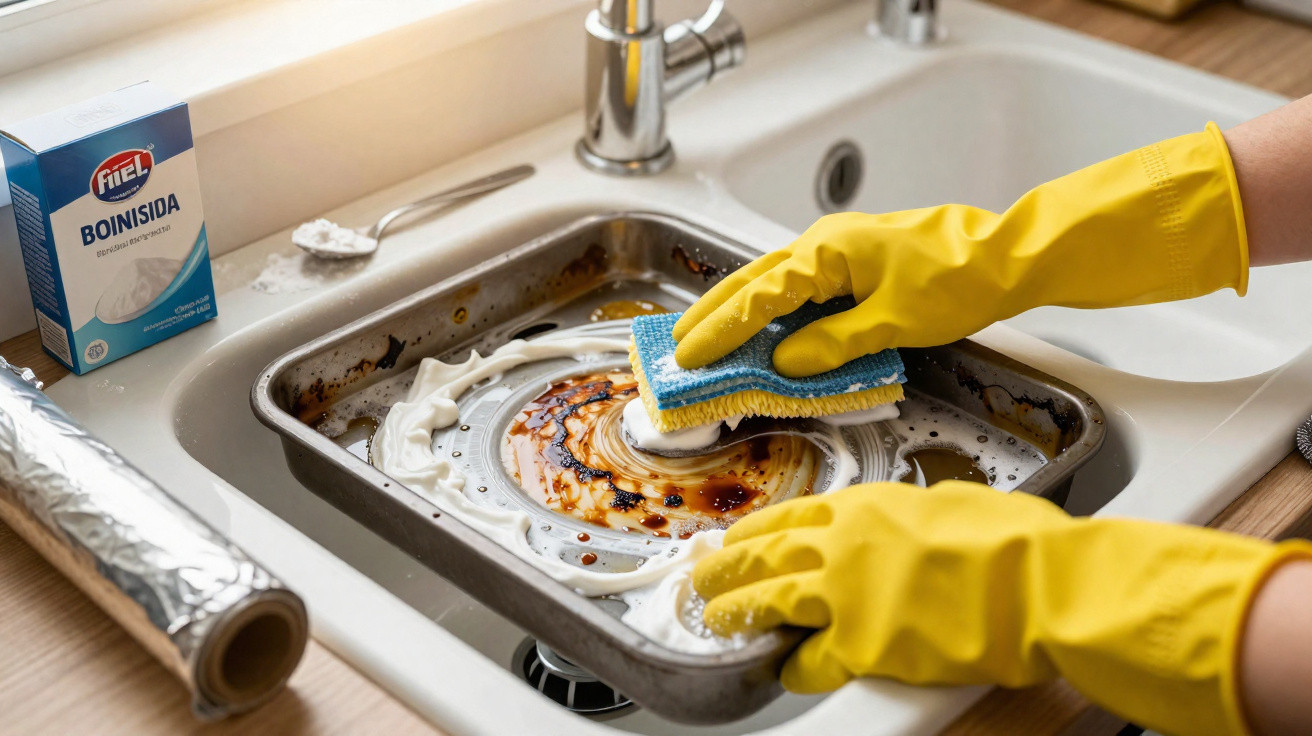
The tray beneath the hob burners collects grease, sauces and small particles that repeatedly scorch, gradually building a stubborn crust that is hard to shift. The most effective approach is to combine a long soak with mild washing-up liquid, bicarbonate of soda and gentle scrubbing - always when the part is completely cold.
Why does grease get so baked on to a hob tray?
Every time you use the hob, splashed grease goes through another heating cycle. Over time it dries out, hardens and bonds to the finish, turning into carbonised residue that a quick wipe with detergent cannot fully lift.
Scrubbing a dry tray aggressively often smears the grease around and increases the chance of scratches or chips. Softening the build-up first cuts down the effort and helps protect the enamel, particularly around the burners.
Before you start, keep these essentials in mind:
- Cooling: wait until the hob and the tray are completely cool.
- Safety: switch off the power and turn off the gas where necessary.
- Manual: check the instructions to confirm whether the tray can be removed for washing.
- Sponge: use only the soft side of a sponge or a nylon brush.
- Abrasives: avoid steel wool, knives and metal scrapers.
Why can steel wool damage an enamel hob tray?
A hob relies on heat to cook food, which is why splatters gradually change and toughen. Before cleaning, power the appliance down, allow it to cool fully and verify in the manual whether the tray is removable.
Enamel trays have a glass-like layer designed to make cleaning easier while shielding the metal underneath. Steel wool, knives and highly abrasive powders can break this coating, create rust-prone spots and leave the surface permanently rough.
How do you soak the tray to loosen the grease?
With the piece cold and removed from the hob, cover it with very hot water, add mild washing-up liquid and sprinkle bicarbonate of soda over the greasiest areas. Leave it for at least thirty minutes so the crust can take on moisture and become easier to remove.
Soaking time means less scrubbing
Hot water and washing-up liquid help soften the baked-on layer. Keep the tray submerged for at least thirty minutes before you begin scrubbing.
If the tray cannot be removed, follow only the manufacturer’s cleaning guidance.
Once it has soaked, pour the water away and use the soft side of a sponge or a nylon brush. Rinse, check any remaining patches and repeat the soak if needed, rather than applying too much force to a finish that may still be warm or weakened.
Clean in this order:
- remove the pan supports, burners and the tray only once they are cold;
- add very hot water, mild washing-up liquid and bicarbonate of soda;
- soak the piece for at least thirty minutes;
- scrub using a soft sponge or a nylon brush;
- rinse and soak again if there is still baked-on grease.
How do you use a bicarbonate of soda paste on the toughest spots?
For stubborn areas, mix bicarbonate of soda with a few drops of water until you get a thick paste. Spread it over the residue, wait a few minutes, then scrub gently. Because bicarbonate of soda is a mild abrasive, keep the pressure moderate to protect the enamel.
After the grease has come away, rinse thoroughly so no washing-up liquid or bicarbonate remains in corners. Dry with a clean cloth and wait until all moisture has gone. Refitting the tray while damp can lead to stains, odours and possible corrosion where the coating is already compromised.
To finish without harming the part:
- try the paste first on a small, less visible area;
- do not allow the bicarbonate to dry out completely on the enamel;
- avoid spatulas, blades and steel wool;
- rinse until every trace of the mixture is removed;
- dry the tray fully before putting it back in the hob.
Is it safe to line a hob tray with aluminium foil?
If you have looked up ways to clean oven racks with minimal effort, you will have noticed the same principle: softening residue before scrubbing helps protect many surfaces. On a hob tray, wiping up splashes once everything has cooled prevents grease from going through further burning cycles.
Lining the tray with aluminium foil is not a universal recommendation: some manufacturers forbid it because it can block airflow, trap heat or cause damage. Only use this kind of protection when the manual explicitly allows it, and never cover burners, outlets or ventilation areas.
Comments
No comments yet. Be the first to comment!
Leave a Comment