
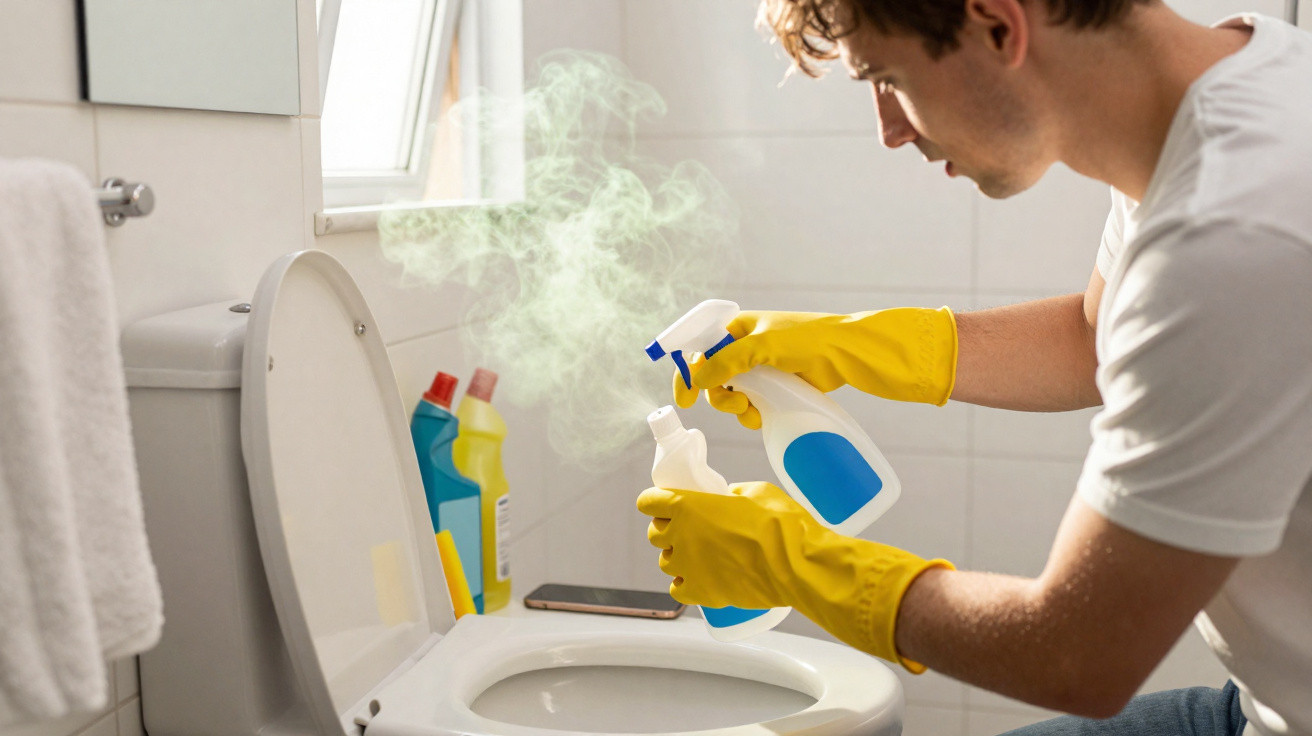
What was meant to be a harmless bit of cleaning turned into a genuine emergency. At home, a 35-year-old combined two everyday cleaning products, sprayed the mixture into a corner of his bathroom, and unknowingly triggered a chemical reaction that released toxic fumes. Moments later he could barely breathe, called the emergency services, and set off a major fire service response.
An ordinary evening that ends in hospital
The incident happened on a Thursday evening in the wider area around the French city of Albi. The man wanted to give his bathroom tiles a deep clean and reached for a product many people keep in the cupboard: bleach. He then added a second, equally common household cleaner-vinegar-based cleaner.
To “boost” the effect, he poured both liquids into a spray bottle. Soon after applying it to the tiles and grout, he noticed a sharp, biting smell. At first the fumes mainly stung his eyes, but a severe coughing fit quickly followed. Within a short time, he developed serious breathing difficulties.
"Mixing chlorine-based bleach with an acidic cleaner can release corrosive gases that can attack the airways within minutes."
He still managed to make an emergency call. On the phone he described his symptoms and explained that he had recently combined cleaning products. The control room immediately dispatched several units, as such reports are treated as a hazardous materials incident.
13 firefighters and three vehicles attend
Within minutes, the first fire crews arrived. They found the 35-year-old coughing heavily and clearly struggling to breathe. Firefighters moved him outside, administered oxygen, and at the same time checked the air in the bathroom.
Because it was initially unclear how much gas had formed and whether dangerous concentrations were still present indoors, a total of 13 firefighters and three vehicles were deployed. Windows and doors were opened wide and the flat was thoroughly ventilated.
Paramedics examined the man on scene and decided he should be taken to hospital. There, doctors were expected to assess whether his mucous membranes, eyes or lungs had been more seriously affected. According to the fire service, depending on the concentration, such gases can lead to:
- severe coughing and shortness of breath,
- burning sensations in the eyes and throat,
- irritation of the bronchial tubes,
- in severe cases, pneumonia or pulmonary oedema.
What happens chemically when these cleaners are mixed?
Bleach that contains chlorine and acidic cleaners-often including vinegar-are simply not compatible from a chemical standpoint. If they are combined in the same container, or used one after the other on the same surface, an aggressive gas can form very quickly.
Many products contain sodium hypochlorite, widely known as the active component in household bleach. When substances like this come into contact with acids such as vinegar, toxic fumes may be produced-fumes that can build up particularly strongly in small rooms.
"It becomes especially dangerous in poorly ventilated spaces such as windowless bathrooms, small WCs or storage cupboards."
In Albi, the man put the cleaner into a spray head and misted it finely-meaning the gas spread straight into the breathing zone around head height. That is precisely what increases exposure for the eyes and respiratory tract.
Why so many people underestimate this risk
Many people assume: “If one product cleans well, two will clean even better.” That idea quickly leads to mixing different cleaners-either directly in a bottle or layered on the same surface. Bathrooms, in particular, encourage this behaviour: limescale, mould and soap residue build up, and people often reach for several strong products at once.
On top of that, everyday household cleaners can seem harmless because they are sold everywhere, come in colourful packaging and smell pleasant. It is easy to overlook that some contain highly reactive chemicals.
There is also the temptation to save time. If you want to finish quickly, you might not rinse before applying the next product, and instead simply spray over the top-an unsafe shortcut.
The most important cleaning rules that can genuinely save lives
To prevent incidents like this, a few straightforward principles are worth following in any household:
- Never mix cleaning products: Whether it is bleach, drain cleaner, toilet cleaner or vinegar, different products do not belong in the same container.
- Rinse thoroughly between products: Wash the surface with plenty of water first, then apply the next cleaner.
- Ventilate properly: Open windows and keep doors open when working with strong cleaners.
- Actually read the instructions: Many bottles clearly state which combinations are prohibited.
- Wear protective gloves and, if in doubt, a mask: With spray cleaners in particular, it is easy for droplets to reach the airways.
Particularly risky combinations in the home
In addition to the dangerous pairing of chlorine-based bleach and vinegar, there are other combinations that are considered hazardous. Mixing products without checking can trigger chemical reactions that produce toxic fumes or caustic solutions.
| Combination | Possible outcomes |
|---|---|
| Bleach + acidic cleaner (e.g. vinegar, toilet cleaner) | Irritant gases, shortness of breath, burning eyes |
| Bleach + ammonia-based cleaner (some glass cleaners) | Caustic fumes, headaches, lung irritation |
| Drain cleaner + other cleaning products | Violent reactions, splashing chemicals, risk of chemical burns |
| Several strong descalers used at the same time | Highly acidic mixture, skin and eye irritation |
How to respond properly in an emergency
If, while cleaning, you suddenly develop a coughing fit, a burning sensation in the nose, or dizziness-especially after using different products-do not waste time. The fire service recommends the following steps:
- Open all windows and doors immediately.
- Leave the room straight away and go outside.
- Do not try to clear up puddles or spray mist without protection.
- Call the emergency services and name the products you used.
- If symptoms are severe, do not experiment-accept medical help.
Only once you are no longer at risk should you try to reduce the concentration of fumes by further ventilation. Direct contact with the liquids or aerosol mist should be avoided unless you have protective goggles and protective gloves.
Why the bathroom is particularly treacherous
Bathrooms are among the places where multiple cleaning products are most often used at the same time: descaler on taps, bleach for discoloured grout, air freshener in the room, glass cleaner for the shower screen-all in a very confined space.
Many bathrooms have only a small window, or none at all. Ventilation often runs briefly and then stops. As a result, fumes can linger and reach far higher concentrations than they would in, for example, a kitchen with a wide-open window.
There is another factor: tiled surfaces are frequently sprayed so the product clings better. Spraying creates fine droplets that can travel deep into the lungs if they contain hazardous substances.
How to keep bathrooms and homes clean safely
With an understanding of the risks, it is still possible to clean thoroughly without putting your health on the line. Many types of dirt can be removed with relatively mild products. In day-to-day use, warm water, washing-up liquid and a good sponge are often enough.
For limescale, simple household options such as diluted vinegar solution or citric acid can help-but only used on their own, not mixed with other strong cleaners. Strong bleach products are best kept as an exception and used only in small areas, for example on stubborn discolouration in grout.
It is also useful to build regular cleaning routines at home. If you clean consistently, you need fewer aggressive products because dirt, limescale and mould are less likely to become heavily ingrained. That protects not only your lungs and eyes, but also surfaces and fittings.
The case involving the 35-year-old from the Albi area shows how quickly a seemingly clever cleaning idea can turn into a medical emergency. Paying attention to simple rules not only avoids a response involving 13 firefighters-it can also protect your own health and that of the people you live with.


Comments
No comments yet. Be the first to comment!
Leave a Comment