
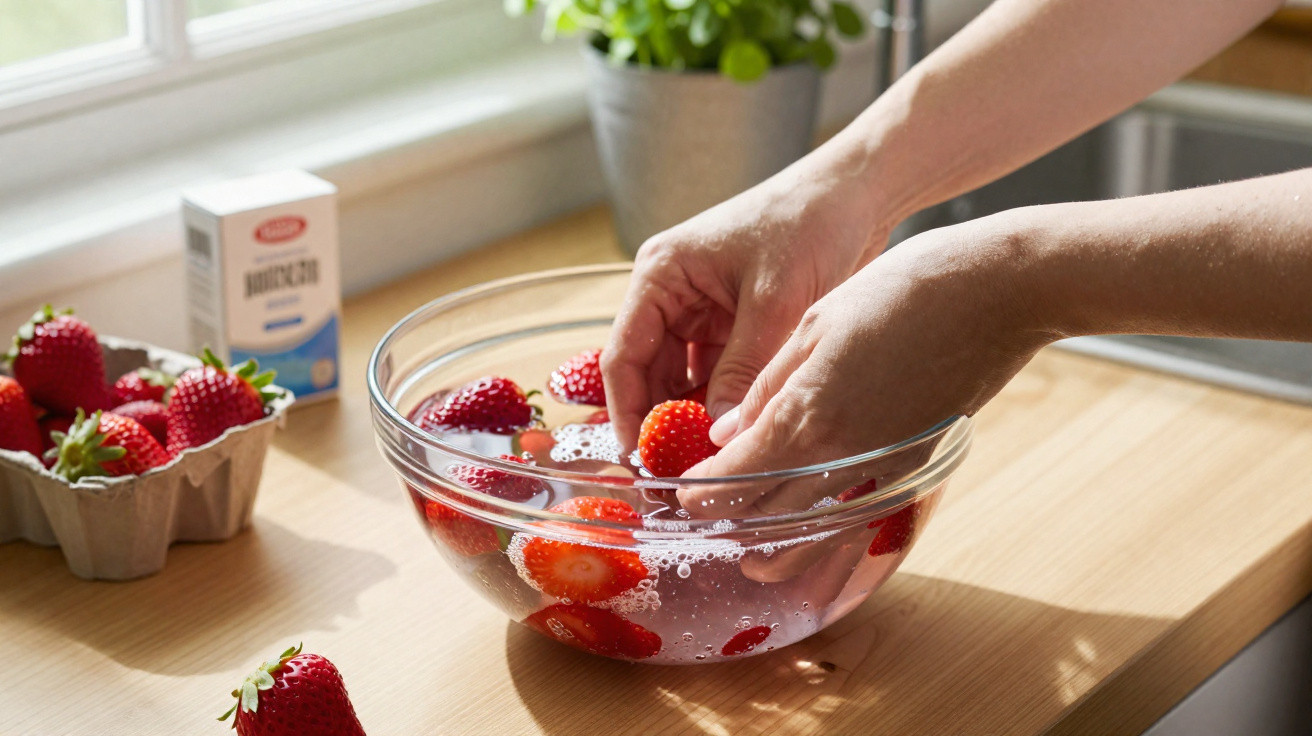
Fresh, sweet and bright red, strawberries sit right at the top of the popularity charts in the UK. When it comes to washing them, most people rely on the same routine: a quick rinse, let them drain, and that’s it. That instinct, however, often leaves a large share of what’s on the skin right where it started. New analyses from the United States show just how heavily strawberries can be contaminated - and which straightforward method genuinely reduces the chemical cocktail.
Strawberries are among the most heavily contaminated fruits
Official testing in the United States paints a consistent picture: strawberries regularly appear near the top of lists for fruit with the highest pesticide residues. Data from the USDA and the environmental group EWG indicate that almost all conventionally grown strawberries carry measurable traces.
In sample testing, inspectors found:
- in around 99% of tested strawberries, at least one detectable residue
- in about 30%, as many as ten or more different substances on a single sample
- in individual cases, up to 23 different active ingredients in one sample
Across the datasets, more than 80 different molecules appeared in various combinations. These included agents such as carbendazim or bifenthrin, used mainly to control fungal disease and pests. That may protect crops in the field - but it also means a colourful chemical mix can end up in the fruit bowl.
"Strawberries can look spotless after a quick blast of water, yet often still carry a whole cocktail of residues on the skin."
Why plain tap water removes very little residue
The obvious move is to hold fruit under running water, rub briefly and tip it into a bowl. Dust, soil and grains of sand wash away easily - and that’s largely where the benefit stops. Modern pesticides are designed so rain does not simply rinse them off.
Many commonly used active ingredients are:
- lipophilic (fat-loving), meaning they embed into the fruit’s waxy surface
- formulated to be “rainfast”, so they do not become useless after the first shower
- designed to adhere tightly to the skin
For these molecules, tap water effectively beads and runs off. Research from the University of Massachusetts suggests that washing with water alone removes about 10–20% of residues on average - mainly those that are easily dislodged. Anything more deeply lodged in the surface tends to remain largely untouched.
The mistake that can contaminate strawberries even more
A second common kitchen habit can actually make the situation worse: removing the stems before washing. When you cut off the leafy cap with a knife, you open the fruit. If water then reaches that cut surface, dirt particles and dissolved residues can seep directly into the flesh. What began as a surface issue can become an internal one.
For that reason, the order should always be the same: wash first, then trim and remove the stems.
The most effective method: cleaning strawberries in a bicarbonate of soda bath
A bath made with bicarbonate of soda (food-grade bicarbonate of soda, often sold simply as “bicarb” or “bicarbonate of soda”) performs far better than water alone. It is mildly alkaline, which changes the conditions on the fruit’s surface for certain substances.
The higher pH can help destabilise some molecules chemically, or at least shift them out of their “comfortable” position in the wax layer. Studies on apples have measured reductions in surface residues of up to around 90% after a bicarbonate of soda bath - far more than with water alone.
"Bicarbonate of soda loosens and lifts many residues without damaging strawberries - as long as the soaking time is right."
Step-by-step guide to the bicarbonate of soda bath
A simple bowl mixture is enough for everyday use. Do it like this:
- Fill a large, clean container or bowl with 1 litre of cold water.
- Dissolve 1 heaped tablespoon of food-grade bicarbonate of soda completely.
- Add untrimmed, intact strawberries carefully - leave the leafy tops on.
- Move the fruit very gently so every side contacts the solution.
- Leave for 10 to 15 minutes, without stirring aggressively.
- Lift the strawberries out in a sieve and rinse under running tap water for about 30 seconds.
- Lay them on a clean tea towel or kitchen paper and pat dry.
With a brief rinse alone, up to 80% of residues can remain lodged in the tiny seed dimples (the so-called achenes). After a correctly done bicarbonate of soda bath, this proportion drops markedly - and the surface is usually left with only trace remnants.
What about vinegar, salt, or warm water?
Online, countless home “hacks” circulate for washing fruit and berries. Testing suggests some do help - but results can vary, and some methods bring unpleasant side effects.
| Method | Typical reduction in residues | Notes |
|---|---|---|
| Tap water only | approx. 10–20% | Mainly removes dirt; little effect on chemical residues |
| Water with vinegar | approx. 60–70% | Effective, but can alter the strawberries’ taste and smell |
| Salt water (lukewarm) | approx. 40–60% | Moderate effect; fruit can soften |
| Bicarbonate of soda solution | up to about 90% (on the surface) | Effective and gentle when used correctly |
What should never go into the bowl: washing-up liquid, soap, or other household cleaners. They can leave their own residues behind - substances not intended for eating and with no place in your mouth or stomach.
What changes with organic strawberries?
Choosing organic usually reduces exposure to synthetic pesticides significantly. However, it does not automatically mean completely residue-free fruit. Organic production still permits certain approved treatments, and contamination can also occur through drift from nearby fields or shared transport routes.
So the cleaning routine remains the same:
- treat organic and conventional strawberries alike with a bicarbonate of soda bath first
- then rinse briefly with tap water
- dry thoroughly before putting them in the fridge
The US investigation data show the benefit is not merely theoretical. Even where official limits are met, an effective washing routine can substantially reduce overall exposure.
Freshness, shelf life and hygiene: how to store strawberries correctly
A frequent household mistake is washing whole punnets “in advance” and returning them wet to the fridge. Moisture is mould’s best friend. After just a day, white patches can appear on individual berries and then spread quickly.
A practical approach for day-to-day use:
- wash strawberries only if you will eat or use them within a few hours
- for longer storage, keep them unwashed, dry and well-ventilated in the fridge
- place delicate berries on top so they are not crushed
- remove any damaged or mushy fruit immediately so it does not spoil the rest
If you regularly buy larger quantities, you can process part of the batch straight into purée, compote or jam. In those cases, minor quality changes from soaking are less important, while the flavour gain from fully ripe fruit matters far more.
How dangerous are residues really?
Pesticides are subject to strict approval processes and legal limits. Even so, many people feel uneasy when they think about chemical mixtures on food. Individual residues are often well below the relevant thresholds. The concern increases when many different substances accumulate, each potentially affecting the body in different ways.
Long-term effects from combined exposure are difficult to replicate reliably in laboratory settings. That is why nutrition-focused clinicians often recommend a practical approach: variety on the plate, a focus on seasonal produce, and lowering exposure where it is easy to do so through sensible kitchen habits. The bicarbonate of soda bath fits exactly into that category - minimal extra effort, noticeable impact.
Practical tips for your next strawberry shop
A few straightforward strategies can reduce day-to-day risk further:
- Choose seasonal fruit: in peak season from local growing areas, pressure from long storage and transport is often lower.
- Buy fruit that is ripe but not overripe: very pale berries are often picked too early.
- Opt for loose fruit rather than tightly sealed punnets if you can see and select individual berries.
- For children, pregnant people and those with sensitive health, be especially consistent with thorough cleaning.
Handled this way, strawberries offer a threefold win: less contaminated fruit, better keeping quality, and a more mindful approach to a food many people snack on almost without thinking. 1 litre of water, a little bicarbonate of soda and 15 minutes of patience are enough to outperform the “looks clean” tap-water rinse by a clear margin.

Comments
No comments yet. Be the first to comment!
Leave a Comment