
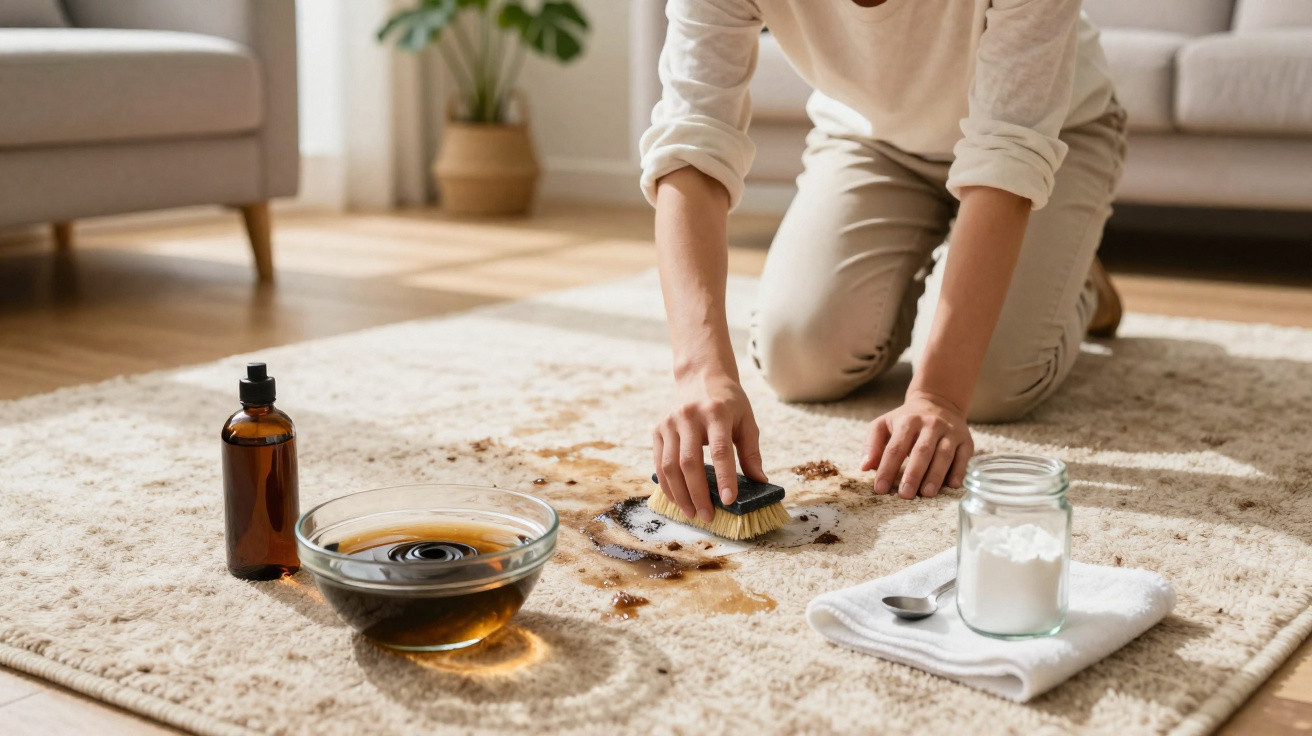
For months, a stubborn mark on my light-coloured carpet seemed to stare back at me - until two basic cupboard staples changed everything.
A reddish-brown blend of coffee and sauce had worked its way deep into the pile. Specialist cleaners, hot water, vigorous scrubbing - nothing shifted it. If anything, the stain spread and the fibres looked duller. The turning point only came when I deliberately questioned my usual “clean it harder” instinct and tried a much gentler approach.
Why scrubbing makes stubborn carpet stains far worse
When coffee, red wine or sauce lands on a carpet, most people instinctively grab a sponge and start rubbing. That was exactly my mistake - and from the perspective of the fibres, it’s a disaster.
A carpet behaves like a tiny, tightly packed landscape of stems and leaves. If you scrub back and forth with force, several things happen at once:
- The liquid gets driven deeper between the fibres.
- The dirt spreads outwards, so the stain grows.
- Friction creates heat and effectively “sets” colourants and sugary residues.
- Fibres flatten or felt together, leaving the surface permanently dull.
Even when the patch looks a bit lighter at first glance, a kind of “shadow” often remains that’s very noticeable depending on the light. That’s how I ended up with the classic grubby ring - a lasting tide mark from the original spill.
A second common mistake makes everything worse: using too much water. Once a carpet is properly soaked, the material holds moisture like a sponge. That leads to:
- very long drying times
- ugly edges that end up larger than the original stain
- an ideal breeding ground for lingering odours
And then there are the surprisingly widespread no-gos: rubbing in circles, blasting the area with a hairdryer on the hottest setting, or mixing a random cocktail of chemicals. It can feel like you’re “doing something”, but it reduces the chances of the stain disappearing completely.
The key difference: professionals don’t rub - they work in layers, with minimal moisture, lots of patience and a clear order.
The simple two-product method that saved my carpet
The fix came down to two things many homes already have: a liquid black soap product and bicarbonate of soda (sodium hydrogen carbonate). You’ll also need clean cloths (ideally white) and a small bowl.
Step 1: Clean with lukewarm water and black soap
In a small bowl, I mixed about 250 millilitres of lukewarm water with 1 teaspoon of liquid black soap. This combination lifts grime gently without roughing up the fibres.
This is what I did:
- Dip a clean white cloth lightly into the solution, then wring it out well. It should be damp, not wet.
- Dab the stain from the outside in, using only gentle pressure.
- Keep folding the cloth to a clean section so the dirt transfers into the fabric rather than being pressed back into the carpet.
- Let the mixture sit for a few minutes, then repeat.
With older stains in particular, it’s worth doing several passes. Better to dab carefully five times than scrub aggressively once. The trick is controlling moisture: too little and the dirt stays put; too much and the liquid migrates further through the carpet.
To avoid fresh tide marks, I finished by lightly dabbing a soft ring around the treated spot with the damp cloth. That creates a gradual transition that won’t catch your eye later.
Step 2: Dry out and neutralise with bicarbonate of soda
Once I’d lifted any soap residue with a fresh cloth that was only slightly damp, I moved on to the second - and crucial - stage: bicarbonate of soda.
First, I pressed a dry cloth onto the area to draw out as much moisture as possible (again, no rubbing). Then I sprinkled an even layer of bicarbonate of soda over the spot - around 2 to 3 tablespoons. Don’t pack it down; just scatter it loosely.
What the bicarbonate of soda does:
- pulls remaining moisture from the fibres
- traps odours
- absorbs tiny residues still lodged in the carpet
I left the powder in place for several hours - for me, from mid-afternoon into the evening. Airflow matters, so I kept a window slightly open. Only when the carpet felt genuinely dry did I vacuum slowly and carefully, in different directions, so the pile lifted again.
After this pass, the area that had looked ruined matched the rest of the carpet - no dull shadow, no edge, no smell.
How to adapt the method depending on the type of stain
It became even more interesting once I tried it on other marks, because not every stain responds in the same way. Depending on the cause, I made small adjustments while keeping the same basic technique.
Greasy stains (oil, sauce, butter)
Here, the grime clings stubbornly to the fibres. Grease rarely comes out in one go, so I worked in repeated cycles:
- gentle dabbing with the black soap solution
- sprinkling bicarbonate of soda again and letting it dry
With each round, more grease migrated towards the surface and ended up in the powder or on the cloth. Patience pays off, especially with dark sauces or roasting fat.
Sugary stains (fizzy drinks, syrup, ketchup)
The problem here is sugar. If sticky residue remains in the pile, it attracts dust again and soon looks dirty. What mattered most was a thorough “mini rinse”:
- use the black soap solution sparingly
- wipe over with a clean cloth that’s only slightly damp until no residue can be felt
- then use bicarbonate of soda to dry the area
Coloured stains (red wine, juice, spices)
With strongly coloured liquids, the rule is: never drown the carpet. Every extra dose of water can pull colour deeper and spread it wider. Short, controlled cycles worked far better for me: dab briefly, let it sit briefly, dab again, then dry quickly.
Pet accidents
Anyone with children or animals at home knows the issue: odour can linger even when discolouration is barely visible. Speed is everything. Right after the mishap, I:
- blotted up as much liquid as possible with kitchen paper
- then dabbed briefly with the black soap solution
- scattered bicarbonate of soda generously and let the area dry out completely
The smell only stayed away for good when the carpet truly dried all the way through the layers. If it didn’t, that musty note crept back after a few days.
How to protect carpets in advance and avoid common mistakes
If you value your carpet, a few basics can save a lot of work. Some of them sound obvious, but they make a huge difference to how well stains lift.
- Act immediately: the fresher the stain, the higher the chance of an invisible rescue.
- Blot only - never rub: even when you’re flustered, try to remember this.
- Use little water, but use it deliberately: drenched cloths and bucketfuls do more harm than good.
- Plan regular care: vacuuming in multiple directions lifts the pile and helps prevent dirt build-up.
- Test in a discreet spot: try any new product in a corner first.
Many people underestimate how much carpet quality matters. A deep pile behaves differently from a flat-woven rug, and natural fibres respond differently from synthetics. With delicate materials, it’s better to use less soap and do an extra mild pass instead.
Bicarbonate of soda isn’t only useful for spot cleaning - it also works for the occasional refresh: sprinkle lightly over the whole carpet, leave it for a few hours, then vacuum thoroughly. That neutralises odours without harsh chemicals or wet shampoos.
If you reach for aggressive all-purpose cleaners, you risk discolouration or brittle fibres. Coloured carpets in particular can fade if strongly alkaline products are used. Compared with that, the combination of lukewarm water, a small amount of black soap and bicarbonate of soda is very mild and easy to control - and it left my living-room carpet, which I’d basically written off, looking almost new again.
Comments
No comments yet. Be the first to comment!
Leave a Comment