
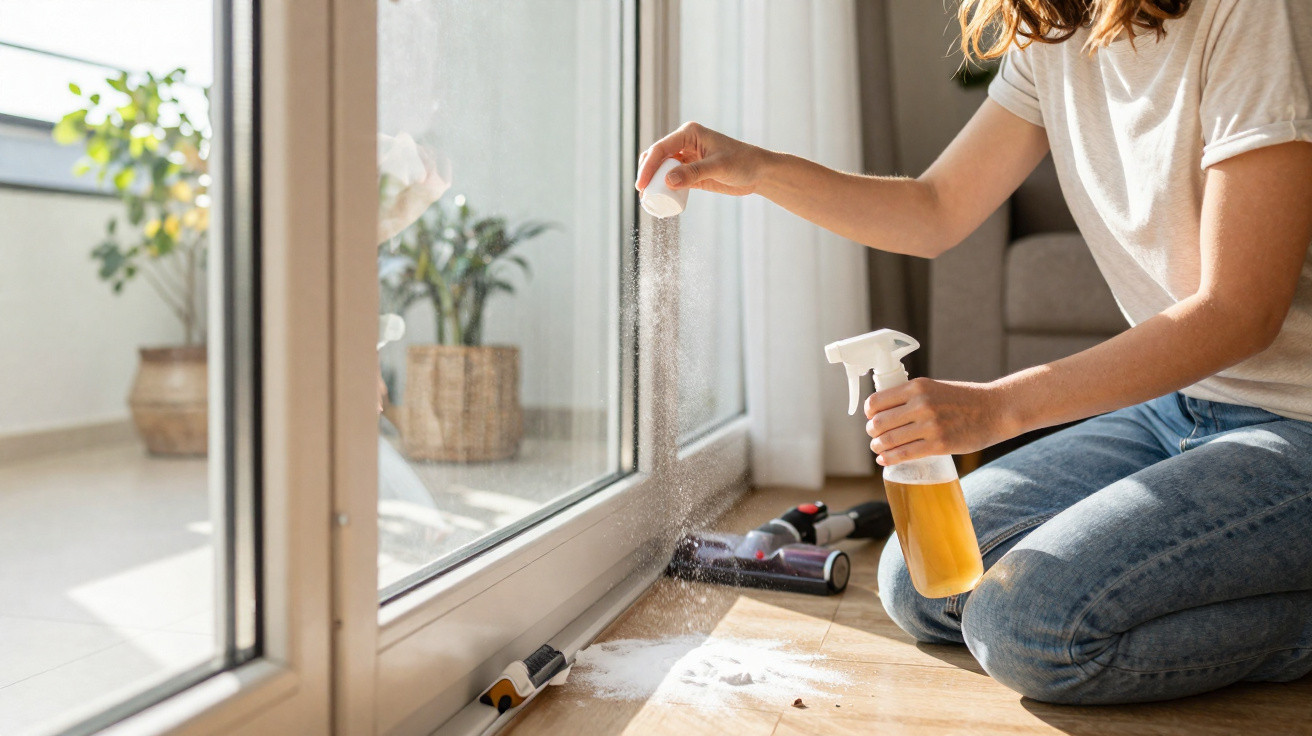
You tug, push and yank until your wrists ache - and your mind immediately jumps to “the window must be broken”. In reality, the culprit is almost always right at the bottom of the frame: a dirty running track. With a simple cupboard-staple mix, most sliding windows can be made smooth again in minutes, with no dismantling and no pricey specialist cleaners.
Why sliding windows suddenly start sticking
When a sliding window becomes hard to move from one day to the next, it’s usually not a failed fitting, but grime lodged in the track.
Over time, a surprising amount of mess builds up along the lower section:
- fine layers of dust
- grains of sand brought in on shoes or from the balcony
- hair, pet hair and crumbs
- residue from cleaning products and kitchen grease
All of this turns into a sticky paste that packs into the grooves. The window’s small rollers can no longer run freely, the pane sits slightly out of true, and resistance increases every time you open it.
The cardinal mistake: pulling harder only forces the dirt deeper into the track - and, over time, damages the rollers.
Many people also reach for an oil bottle or a spray “to make it glide”. It may feel better briefly, but in the long run it makes things worse: oil traps dust, the mixture becomes tacky, and it forms a kind of brake lining inside the track. A quick wipe with a cloth then isn’t enough, because the critical corners remain dirty.
A simple kitchen duo that loosens the dirt
The good news: for most sticking windows, a straightforward household pair is enough - bicarbonate of soda (baking soda) and ordinary clear white vinegar.
Used together, they do exactly what the track needs:
- They break down stubborn dirt and grease.
- The fizzing reaction lifts particles up out of narrow grooves.
- The powder’s mild grain helps release grime without scratching aluminium or plastic.
This isn’t about sterile disinfection, but about a gentle yet effective mechanical assist. The mixture won’t replace a repair if the track is bent or a roller carriage is broken. It does, however, make it very clear whether the issue is simply dirt or whether you need a professional.
A smooth-gliding sliding window in five minutes
You only need a few items that most households already have:
- approx. 20 g bicarbonate of soda / baking soda
- approx. 50 ml clear household vinegar
- an old, clean toothbrush
- a microfibre cloth, slightly damp
- optional: a vacuum cleaner with a narrow nozzle
Step 1: Vacuum up loose debris
Before you use the cleaning mix, it’s worth a quick pass with the vacuum. With a narrow nozzle you can remove crumbs, sand and spider remains. That way, the mixture doesn’t have to work around large particles first and can get straight into the key grooves.
Step 2: Sprinkle the powder into the track with purpose
Now it’s time for the bicarbonate of soda. Sprinkle it directly into the running track, but do it methodically:
- concentrate it in the darker, heavily soiled areas
Comments
No comments yet. Be the first to comment!
Leave a Comment