
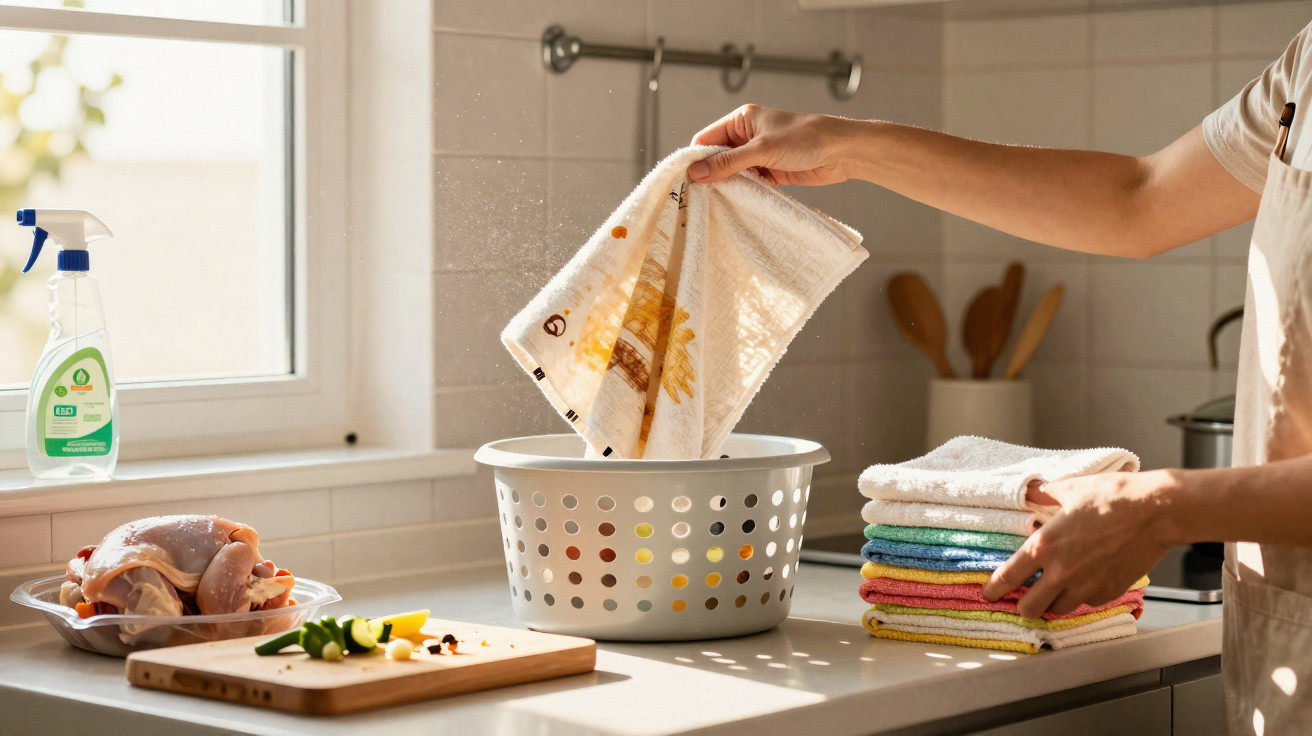
In many kitchens the worktop shines, the floor has just been mopped and the dishes are neatly put away. At a glance, everything looks clean. Yet one everyday item quietly collects moisture, food residue and germs – right where we handle food. Few people realise how much this object can affect hygiene across the whole household.
The most underestimated hygiene problem: the kitchen towel
We are talking about ordinary kitchen towels – the ones hanging on hooks or draped over a chair back. They are used constantly: drying hands, polishing glasses, wiping the worktop, dabbing up a splash of sauce, quickly running over cutlery after washing up. Very often, a single towel ends up doing all of these jobs.
That is exactly the issue. Over the course of a day, the same piece of fabric can go from hands to chopping board, on to a child’s plate and then across the dining table. What feels convenient becomes an ideal motorway for bacteria in the kitchen.
“A kitchen towel is rarely properly dry, is constantly in contact with food, and therefore offers germs perfect conditions to grow.”
Researchers at a university examined household kitchen towels – and the results are surprising: almost half of the towels tested were demonstrably contaminated with bacteria. Among the microbes found were gut bacteria, resistant enterococci and staphylococci, which under unfavourable conditions can contribute to stomach upsets or skin infections.
Why a towel so quickly becomes a germ spreader
For bacteria to multiply, they mainly need three things: moisture, warmth and nutrients. A frequently used kitchen towel provides all three in an almost perfect combination.
- Moisture: After handwashing, drying up dishes or wiping damp surfaces, the towel stays clammy for a long time.
- Warmth: In heated kitchens, the ambient temperature is usually comfortable – ideal for germs.
- Nutrients: Food remnants, greasy traces, crumbs and splashes of sauce get trapped in the fibres.
If you then use the same towel to mop up raw meat juices, dry your hands and later polish a clean plate, you spread germs widely. For healthy adults this often has no consequences. In households with children, pregnant people, older adults or anyone with a weakened immune system, the risk of gastrointestinal infections rises noticeably.
Hygiene specialists also point out that kitchen towels and sponges are among the most important transmitters of so-called cross-contamination. This means germs are transferred from a dirty area – for example raw meat – to foods or surfaces that should be clean.
How often should you really wash kitchen towels?
The guidance is clear: in a normally used household, a damp all-purpose kitchen towel should go in the wash after two to three days at the latest. Many experts view three days as the absolute maximum; in some situations, changing daily is the better option.
Guide values for different households
- Single person or couple with a dishwasher: towel mainly used for drying hands → changing about once a week can be fine, as long as the towel stays dry and does not come into contact with raw foods.
- Household that often washes up by hand: towel is regularly wet, lots of contact with crockery and work surfaces → change every two to three days.
- Families with children, pregnant people or older adults: higher infection risk → change closer to every two days, and more often if in doubt.
- After contact with high-risk material: raw meat, raw poultry, eggs, food that has been on the floor, vomit or diarrhoea in the household → replace the towel immediately and wash it hot.
Many people underestimate how quickly a “slightly damp” towel can turn into a full-blown bacteria farm. Getting into the habit of swapping kitchen towels regularly can noticeably reduce the risk of stomach upsets – with very little effort.
How to get kitchen towels properly clean
Simply rinsing a towel in water and hanging it over a radiator is not enough. It may seem fresh, but a large proportion of germs remain deep in the fabric.
Professionals recommend a consistent washing routine:
- Choose a wash temperature of at least 60°C.
- Use a cotton cycle, ideally with a longer main wash.
- Use a biological heavy-duty detergent; if odours are strong, add a little household vinegar to the fabric softener compartment.
- At regular intervals, run a 90°C wash to reduce stubborn germs and smells.
Drying afterwards matters just as much. Kitchen towels should come out well spun and then dry out completely – ideally hung up with plenty of airflow. If you scrunch them up damp or put them into a drawer, you recreate a warm, moist environment where bacteria can multiply quickly.
“Only a truly dry and freshly washed kitchen towel provides real hygiene – everything else is just smoke and mirrors.”
More order, fewer germs: separate towels by task
One simple change can improve matters immediately: introduce different kitchen towels for different jobs. This reduces the chance of transferring grime from one area to another.
| Area of use | Recommended use | Change interval |
|---|---|---|
| Drying hands | Only clean hands after washing | every two to three days |
| Dishes and cutlery | Only clean dishes, not work surfaces | every two to three days |
| Work surfaces | Only for wiping surfaces, never for hands | depending on use, usually every one to two days |
| Contact with raw foods | Avoid if possible; otherwise single use | immediately after use |
This works well if you set up a small system: different colours or patterns for different purposes. For example, blue for dishes, red for surfaces, white for hands. Children will also reach for the right towel more instinctively.
Warning signs you should not ignore
Sometimes a kitchen towel tells you visually or by smell that it has reached the end of its run. At the latest, it should go straight into the washing machine when:
- the towel smells musty or sour;
- stains do not properly come out even after rinsing;
- the fabric feels persistently damp or greasy;
- it has been in contact with raw meat or eggs;
- someone in the household has recently had a stomach bug.
Many people keep towels in use until they look truly unpleasant. From a hygiene point of view, that is too late. It is better to wash or replace more often than to work for days with a germ-catcher.
How kitchen towels differ from other cleaning helpers
Sponges and dishcloths often get the spotlight when people talk about germ hotspots in the kitchen. That is fair – they are frequently heavily contaminated. Kitchen towels, by contrast, are easily overlooked because they are made of “clean” cotton and tend to smell less offensive.
That is precisely the trap: while an old sponge will eventually smell unmistakably bad, textile towels can seem fine for longer. You cannot see bacterial load with the naked eye. If you rely on your sense of smell, you often react far too late.
Practical everyday tips for better kitchen safety
With a few simple routines, you can significantly reduce the risk from kitchen towels without turning housework into a full-time job:
- Straight after washing up: wring towels out, hang them up neatly, do not scrunch them into a ball.
- Keep a laundry basket near the kitchen or bathroom so used towels quickly end up where they belong.
- Build a small запас of kitchen towels so frequent changes are easy.
- For raw meat and raw eggs, use kitchen roll instead, then throw it away.
- Teach children early on not to use the hand towel for spilled milk or sauce.
If you make these points second nature, you reduce the germ load in the kitchen and protect yourself and your family from unpleasant infections. Especially when many people are paying closer attention to hygiene, it is worth looking at small everyday habits.
A lot of illnesses are not caused by dramatic hygiene failures, but by inconspicuous everyday items. The kitchen towel clearly belongs in that category – a tiny change with a big impact once the washing machine is used a little more often.

Comments
No comments yet. Be the first to comment!
Leave a Comment