
Sticky orange-brown grease fused to your favourite pot. Fingers wrinkling in the washing-up bowl. A sponge that squeals across the surface yet barely makes a mark. It’s easy to assume the pan is ruined - or that you’re about to lose your entire evening. The good news is the fix is simpler than it looks.
A mate once made a glossy, tomato-rich stew that set on the sides like lacquer. We filled the sink, did the usual soak, and still the crust wouldn’t shift. He just grinned, shook his head, and grabbed two items I wouldn’t have thought to pair.
After that, the pan stopped resisting. The residue released in soft, curling sheets. A touch of chemistry, a little warmth, and then that satisfying sense of bare metal again. The whole method felt almost cheeky.
Why grease clings, and why brute force usually fails
Grease thrives on heat. When oils, proteins and sugars hit a lively boil, they don’t merely brown - they bond. Stainless steel and enamel both have tiny, invisible scratches that give burnt-on grime somewhere to anchor. Scrubbing harder can smooth the high points while leaving the low points packed with residue. The pan seems better, but the shadow of last week’s sauce is still there.
Most of us have left a pan to soak overnight, watching the water turn cloudy with hope. Then, in the morning, someone rubs the same stubborn patch, sighs, and reaches for something more abrasive. A bit more of the surface gets worn away. The mark remains. In that deadlock, you can almost feel the quiet defeat of cookware you’ve spent years learning to love.
Here’s the uncomfortable reality: what you’re fighting is cooking and chemistry at once. Fats oxidise and thicken, sugars caramelise, proteins denature, and together they create a thin film that grips tightly. If you simply push harder, you can press it further into the texture. What breaks it isn’t strength - it’s giving the fat something familiar, shifting the pH slightly, and letting heat do the slow, unseen work.
The magical trick that lifts grease like a decal
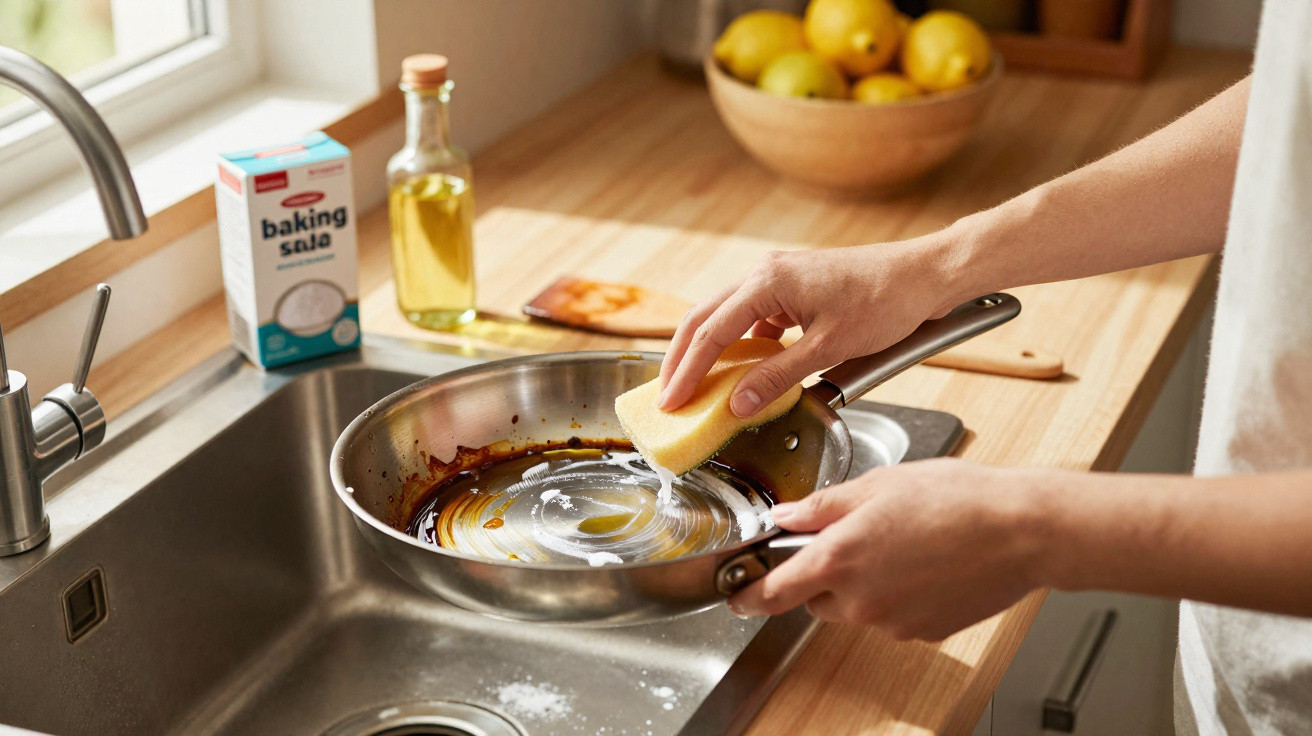
Begin with a dry pan. Wipe off any loose bits so you’re focusing on the glossy, properly stuck layer. Drizzle about a teaspoon of neutral oil over the worst area and rub it in gently with kitchen roll - like dissolves like. Then add a generous spoonful of bicarbonate of soda over the oiled patch, plus a pinch of fine salt. Follow with a single drop of washing-up liquid, and pour in just-boiled water until it covers the mess by about 1 cm. If the pot can handle it, put it on a very gentle simmer for 5–10 minutes.
Remove it from the heat and give it a short pause. The mix becomes silky, the shine turns dull, and you’ll notice the edges starting to lift. Use a wooden spoon or silicone spatula to coax the film; it should come away in soft rolls. With non-stick, miss out the simmer and stick to very hot water - the paste still does the job and the coating stays protected. For enamel, keep the simmer low. For cast iron, use as little water as you can, then dry and oil immediately afterwards. That first peel is oddly satisfying.
Keep your pressure light. Let the reaction do the work. The bicarb nudges the pH, the oil loosens oil, the heat softens the bond, and the fine salt adds the faintest abrasion without scratching. No harsh chemicals. Two minutes of prep, ten minutes of waiting. If the stain has been there for ages, run the process a second time instead of scrubbing yourself into a rage.
“Grease is just stubborn fat - give it something it likes, then lift it away.”
- Step 1: Oil the stuck patch.
- Step 2: Sprinkle bicarb and a pinch of salt.
- Step 3: Add a drop of washing-up liquid and hot water.
- Step 4: Gentle simmer if the pot allows.
- Step 5: Nudge and lift, then rinse.
Small tweaks, fewer scrapes, happier pans
When you’re tired at the sink, it’s easy to make things worse: steel wool on non-stick, vinegar on bare aluminium, or long soaks for cast iron that encourage rust. Aim for soft tools, warm water, and short bursts of effort. If you do use vinegar, keep it well away from aluminium and unlined cast iron; it can dull the finish. A dishwasher tablet can replace bicarb on stainless steel, but it’s far too aggressive for delicate coatings - and, frankly, nobody wants to do that every day.
Timing matters as well. Tackle the pan while it’s still warm (not scorching) and the paste works its way in faster. Don’t flood sticky sugar sauces for hours - they love a long bath. Wipe, paste, heat, lift. If a ring won’t budge, leave the paste in place and come back after a cup of tea. Your pan isn’t ruined. It just needs a smarter approach.
This small routine brings back the feeling of a kitchen that behaves: the scent of clean metal, the shine on a lid that looked hopeless the night before, the quiet confidence of tools that last. You may even find yourself cooking bolder meals because the clean-up no longer feels intimidating. Pass it on to the friend who always apologises for the state of their pots - the same way someone once passed it on to you. It isn’t magic; it just looks like it when the film finally slides.
There’s a pleasant knock-on effect, too. When washing up is low-drama, you cook more often and reach for the good pan without hesitation. You start to notice the difference between stuck-on flavour and stuck-on failure. The trick doesn’t replace patience - it simply rewards it. There’s a quiet satisfaction in rescuing a pan from the bin, and it’s worth leaning into. What if the answer to kitchen fatigue really is this small and this ordinary?
| Key point | Detail | Benefit to the reader |
|---|---|---|
| - | - | - |
| - | - | - |
| - | - | - |
FAQs:
- Can I use the trick on non-stick pans? Yes, with one adjustment: don’t simmer it. Use very hot water, the oil + bicarb paste, and a soft sponge. Keep anything metal well away.
- What if I don’t have bicarbonate of soda? Use fine salt with a little washing-up liquid and hot water. A dishwasher tablet can work on stainless steel. Baking powder will do in a pinch, just with less bite.
- Is it safe for cast iron? Keep the water minimal and avoid long soaks. Work in the oil + bicarb paste, lift the residue, dry over a low flame, then wipe on a whisper of oil to re-season.
- Does cola or vinegar work better? Vinegar is useful on mineral marks, but it’s not brilliant on greasy films. Cola is sticky and makes a mess. For grease alone, oil + bicarb + heat is neater and calmer.
- How do I stop the build-up next time? Warm the pan gently, use enough oil for sticky sauces, and wipe the pot while it’s still warm. If sugars have caramelised on the sides, paste them straight away before they fully set.

Comments
No comments yet. Be the first to comment!
Leave a Comment