
A quiet kind of damp settles into a lot of wardrobes: the jumper that feels slightly clammy, the scarf with that faint cellar note, the shoes you were sure had dried out days ago. Moisture creeps in without fuss, and musty smells tend to follow. It’s easy to assume you need a gadget or a strongly scented spray to sort it out. In most cases, you don’t.
“The window had been cracked for weeks, and the closet backs onto a chilly exterior wall. I tried a fabric spray, shut the door, and pretended it was fine. The next morning, it wasn’t.”
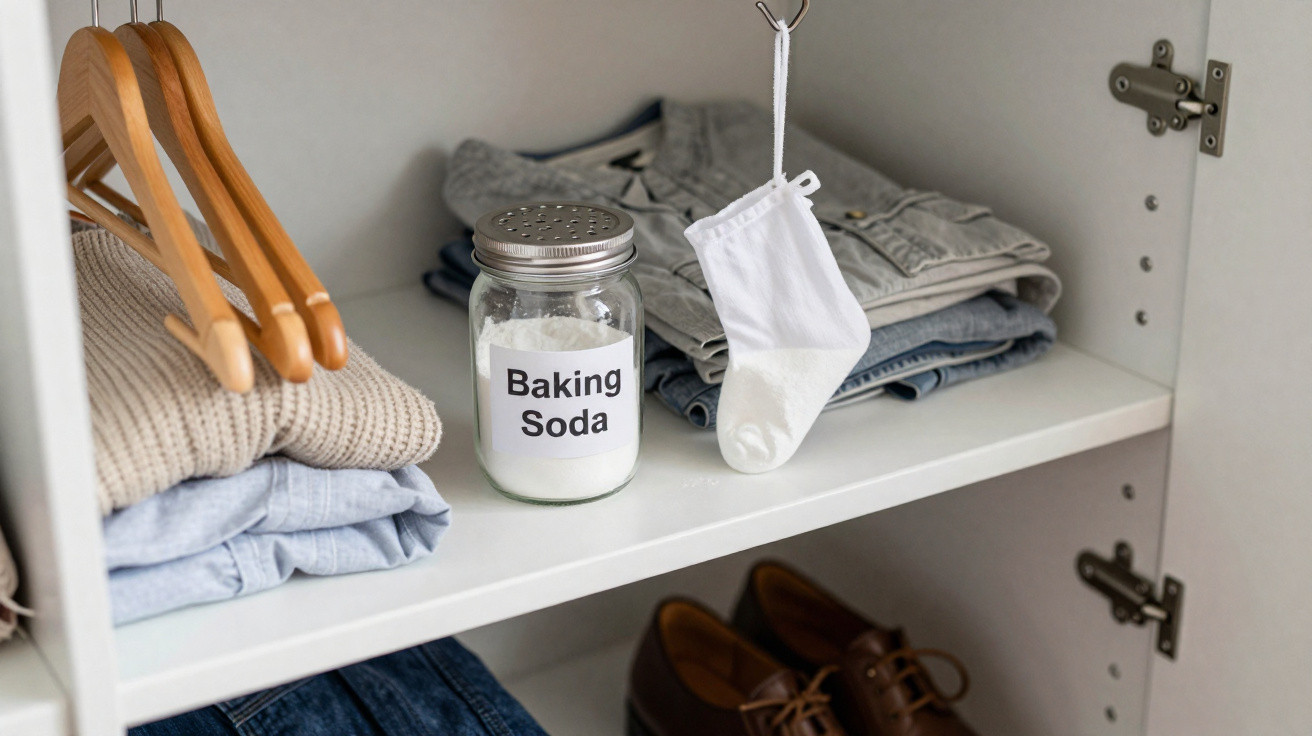
What changed things wasn’t a smart dehumidifier or a fashionable sachet. It was something already in the cupboard, sat beside the cinnamon, looking thoroughly unremarkable. I tipped some into a jar, pierced holes in the lid, and slid it onto the top shelf. Within a few hours, the air felt noticeably fresher.
We’ve all experienced that oddly satisfying moment when one small household fix makes the whole place feel manageable again. This was exactly that sort of win-the answer tucked away in a £1 box.
The pantry staple that sips humidity and erases musty smells
The “mystery” powder is baking soda. Often labelled bicarbonate of soda, it’s mildly alkaline and works like a low-key odour magnet. Unlike perfumed sprays, it doesn’t try to cover smells; it neutralises the acidic compounds that make “musty” smell musty. For such a plain-looking powder, it also takes up a surprising amount of moisture from the air.
In my case, one jar took the sting out of a wardrobe that sat near 65% relative humidity on rainy days. A friend renting by the coast scaled it up: two cotton socks filled with baking soda-one down by the shoes, another higher up near the shelf. By the weekend her linen shirts stopped feeling tacky, and the stale smell clinging to the cuffs had disappeared.
This is the basic science of it. Baking soda has a porous structure, and it’s good at trapping volatile molecules that create unpleasant odours. Because it’s a base, it can help balance the acidic compounds that read as “stale”. It won’t solve a leak, repair building damp, or kill mould. But for everyday wardrobe funk, it acts as a buffer-softening humidity spikes and pulling the smell down with them. It just gets on with the job in the background.
How to use baking soda to keep closets dry (without making a mess)
Keep it tidy by using a contained method. Put 1/2 cup of baking soda into a clean jar or tin, make 8–10 small holes in the lid, and set it on a high shelf. If the space is bigger, use two containers. Replace it-or “recharge” it-every 30–45 days, or sooner if it starts clumping.
Another option is to spoon baking soda into a cotton sock, tie it off, and hang it up like a sachet.
Be restrained with added fragrance. If you want, mix in a teaspoon of dried lavender, but heavy scent blends can make the powder cake. Don’t scatter baking soda directly onto wool, silk, or leather-keep it inside a container. If your jar feels damp quickly, add a second one closer to the floor to deal with shoe moisture. And realistically, most of us won’t remember on an exact timetable-set a calendar reminder and move on.
Treat it like a no-tech humidity sponge that doesn’t demand attention. Swap containers with the seasons, and give the wardrobe a quick airing now and then.
“Baking soda won’t replace a dehumidifier in a wet basement, but in typical closets it’s a small, consistent win,” says a home-restoration tech I spoke with. “It’s cheap, safe, and it keeps must from building up.”
- Begin with 1/2 cup per container; only increase if smells linger.
- Position one container high and one low to work with airflow.
- Change it every 30–45 days, or when it’s clumpy, dull, or grey.
- Keep it away from children and pets; lidded containers make this easier.
- Combine with five minutes of airing (door open) on dry days.
What baking soda can and can’t do for your wardrobe
If your wardrobe has a light “old” smell, baking soda can make a difference within a day or two. If it smells like a genuine leak, you’ll need proper ventilation and potentially a professional. Where this powder shines is the middle ground: routine humidity spikes, stale air, and trainers that got caught in the rain once. It tackles the little issues before they turn into bigger ones.
Several small jars in different corners beat one big bowl in the centre. Spreading it out helps the air even up. If you dry clothes indoors, add an extra jar for that period. If your doors are solid, leave them slightly ajar for an hour after doing laundry. And don’t combine baking soda with vinegar inside the wardrobe-together they create carbon dioxide and water, which adds the very humidity you’re trying to reduce.
There’s also a side to this people rarely mention. Smells aren’t only smells; they’re a quiet signal that something at home is slightly off. Swapping out a jar each month isn’t a major task, yet the effect can feel disproportionately calming. It’s a small ritual busy people can keep up without resenting it. Dry wardrobes protect your clothes and your mood.
| Key point | Detail | Why it matters for you |
|---|---|---|
| Baking soda neutralises musty odours | Mildly alkaline; binds acidic odour molecules | Clothes smell clean without heavy perfumes |
| Helps absorb everyday humidity | Porous powder reduces small moisture spikes | Keeps wardrobes drier between laundry and rainy spells |
| Simple, low-cost setup | Jars or cotton socks, refreshed monthly | Quick to set up, easy to maintain |
FAQ:
- What’s the powder we’re talking about? Baking soda, also known as bicarbonate of soda. Not baking powder, and not washing soda.
- How much should I use for a standard wardrobe? Start with 1/2 cup in a ventilated jar; use two jars for a walk-in or if shoes live inside.
- How often do I replace or recharge it? Every 30–45 days, or sooner if it clumps or starts smelling “tired”. You can dry it by baking at a low heat, but replacing it is simplest.
- Is it safe around clothes, leather, and wood? Yes, when contained. Keep the powder off silk, leather, and unfinished wood; use lidded jars with holes.
- Is it as strong as silica gel or a dehumidifier? No. Baking soda is best for everyday odours and minor humidity. For ongoing damp, use silica gel, calcium chloride, or a small dehumidifier.

Comments
No comments yet. Be the first to comment!
Leave a Comment