
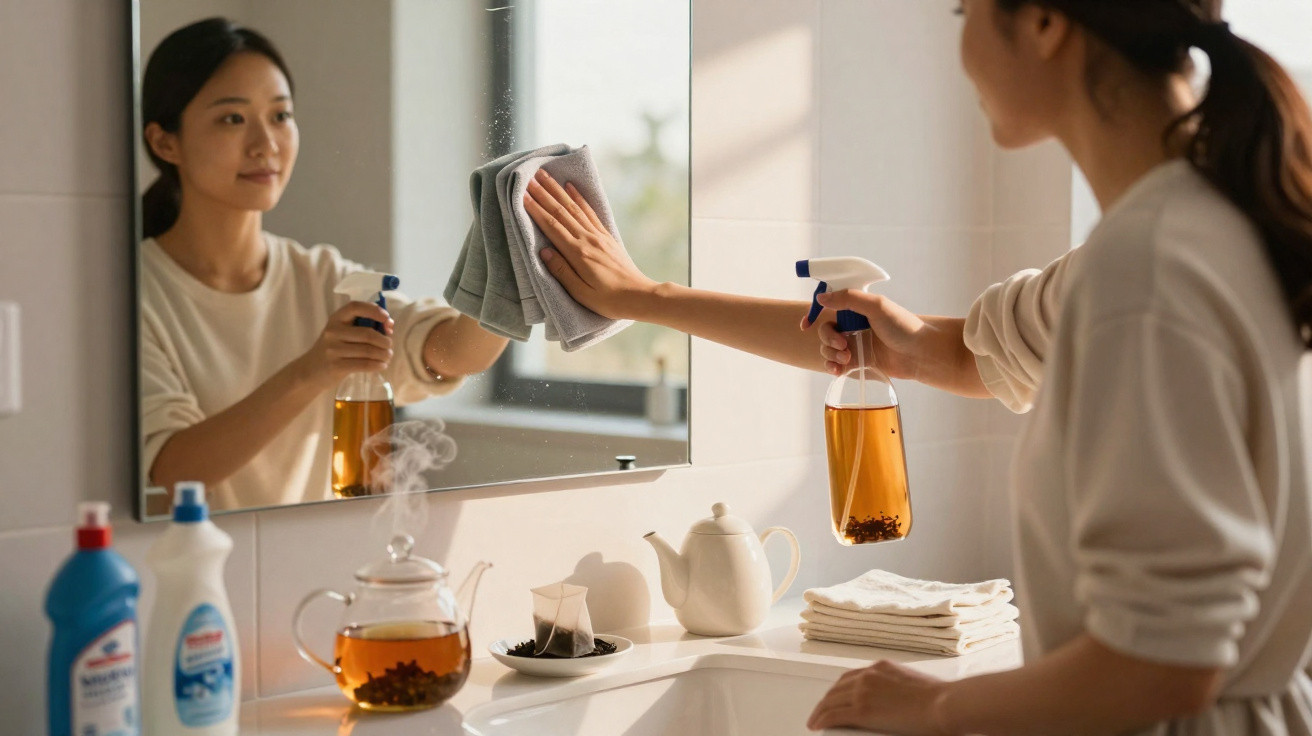
You wipe the mirror, it clouds over again, and somehow the smears only get worse. A domestic cleaner I met once took a teabag from her apron and gave me the smile of someone sharing a well-kept secret. What she showed me was straightforward, slightly unusual and remarkably inexpensive. It leaves glass so clear that it almost vanishes. The surprise ingredient? Black tea.
Steam rolled out of the bathroom in a slow cloud, coating the glass until the mirror looked as though it had been painted. Lila, a house cleaner with understated confidence and a bag full of worn cloths, placed a mug beside the sink. Its scent was instantly familiar: malty and tannic, with a suggestion of breakfast. She soaked a cloth in the amber tea, squeezed it out and laid it flat against the mirror. One measured S-shaped sweep, followed by another, and the misty film gave way as if it had simply been waiting to be removed. Tea on glass?
Why black tea beats streaks
In a bright room, every mirror exposes the mess. There is toothpaste spray, hairspray and fingerprints that apparently appeared overnight. Black tea will not solve every problem in your day, but it can deal with this one. Its tannins cut through the thin mix of soap residue and oils that builds up in present-day bathrooms. At first, you barely register the change; then the glass suddenly looks sharply clear. In my tests, black tea clears bathroom haze more quickly than most shop-bought sprays. It is not magic, merely polite chemistry.
Most of us have experienced the moment when a dirty mirror makes the entire morning routine feel untidy. The evening before a property inspection, a tenant in my building sent me a message: “My mirror looks like a crime scene.” I steeped two plain black tea bags in a mug, let it cool and tipped it into a spray bottle. Within ten minutes, the cloudiness, drag lines and odd rainbow curves had disappeared. A single teabag costs pennies, whereas a bottle of premium glass cleaner can cost as much as lunch at a café. Better still, tea leaves no synthetic fragrance behind, only the faint impression of cleanliness.
The explanation lies in the tea leaves. Black tea is mildly acidic and packed with tannins-polyphenols that attach to oils and release surface film. That gentle acidity also helps dissolve the mineral marks that make glass look cloudy. The liquid is light enough to moisten the surface rather than soak it, allowing it to dry without a thick residue. Microfibre makes the result even better by holding onto lint and grit instead of pushing them across the glass. Tea does not react with glass, so it delivers clarity without etching it. Streaks form when residue remains behind. Tea removes that residue, leaving the glass to reflect only what is before it: you.
The method: from kettle to mirror
Bring water to the boil, then pour roughly one cup (250 ml) over two black tea bags. Leave them to steep for five minutes, until the liquid becomes a rich copper colour. Allow it to cool to room temperature and, for an even smoother result, strain it through a coffee filter. Lightly mist the mirror or dampen a clean microfibre cloth with the tea. Clean from top to bottom using overlapping S-shaped strokes. Turn the cloth to a dry section, or use the second cloth, and polish with brisk, gentle movements. The two-cloth method is the make-or-break move. The damp cloth cleans, while the dry one polishes. As the final moisture evaporates, the shine appears almost unnoticed.
Avoid flavoured or sweetened teas, teas containing oils, and green or herbal blends for this task. If you live in a hard-water area, make the tea with distilled water for a crisper finish. Take care around untreated wooden frames, gilded borders and natural-stone splashbacks: keep the tea on the glass rather than the surrounding trim. Never apply hot tea to a cold mirror; wait several minutes to prevent thermal stress. Paper towels release lint, so use microfibre or a folded cotton flour-sack cloth instead. Realistically, no one does this every day. Yet whenever you do, the result is quickly worthwhile.
The usual mistakes come from hurrying or applying too much liquid. Over-spraying can cause drips, which dry into a fresh set of streaks. Work in light passes, and swap to a clean cloth before the one you are using becomes overly damp and ineffective. Lila has another useful trick: once you have finished, breathe onto the glass. Because your breath creates an even mist, any overlooked swirls become obvious. Buff those patches with a dry corner of the cloth and they disappear.
“People think glass is fussy,” Lila told me, wringing out her tea cloth. “It’s the opposite. Keep it simple, keep it dry at the end, and the mirror does the rest.”
- Use: plain black tea, brewed strongly and cooled to room temperature.
- Tools: 2 clean microfibre cloths, one damp and one dry.
- Motion: S-shaped strokes from top to bottom, followed by a quick dry buff.
- Extras: distilled water in hard-water areas and a coffee filter for added clarity.
Beyond the mirror
This black tea method is more than a cleaning trick; it changes the way we approach household cleaning. There are no fluorescent blue liquids, no aerosol mist and no cupboard crowded with duplicate products. You simply boil water, steep tea leaves and restore clear glass with two cloths and a steady hand. It can make an everyday chore feel like a small ritual-almost meditative. One mug cleans the mirror, while another can warm your morning. There is also a quiet pleasure in leaving less behind: fewer perfumes, fewer bottles and fewer unexplained films that gather dust. If a habit is easy and cheap, it sticks. Try it once, see that it works and share it with someone else; that is how the best household solutions endure.
| Key point | Detail | Benefit for the reader |
|---|---|---|
| Why black tea works | Tannins and mild acidity lift oils and film without leaving residue | Delivers a streak-free finish using cupboard staples |
| Two-cloth method | One damp cloth cleans, while one dry cloth provides a quick buff | Stops new streaks and reduces cleaning time |
| Water and tools matter | Distilled water, microfibre cloths and light S-shaped strokes | A sharper shine, less lint and fewer repeat attempts |
FAQ:
- Can I use any tea? Use plain black tea only. Avoid flavoured, oily or herbal blends, as they can leave a film or an unwanted scent on the glass.
- Will tea stain grout or frames? Not on sealed surfaces. Keep the cloth damp rather than dripping, and avoid untreated wood, fabric-covered frames and unsealed stone.
- What if I can still see streaks? Use less liquid and change to a clean, dry microfibre cloth for the final polish. Straining the tea through a coffee filter can help as well.
- Can I prepare a batch in advance? Yes. Keep cooled tea in a clean spray bottle for up to two days. After that, make a fresh brew for the clearest result.
- Is it safe for tinted or antique mirrors? Yes, on the face of the glass. Do not wet the back edge or any damaged silvering, and keep your strokes light and targeted.




Comments
No comments yet. Be the first to comment!
Leave a Comment