
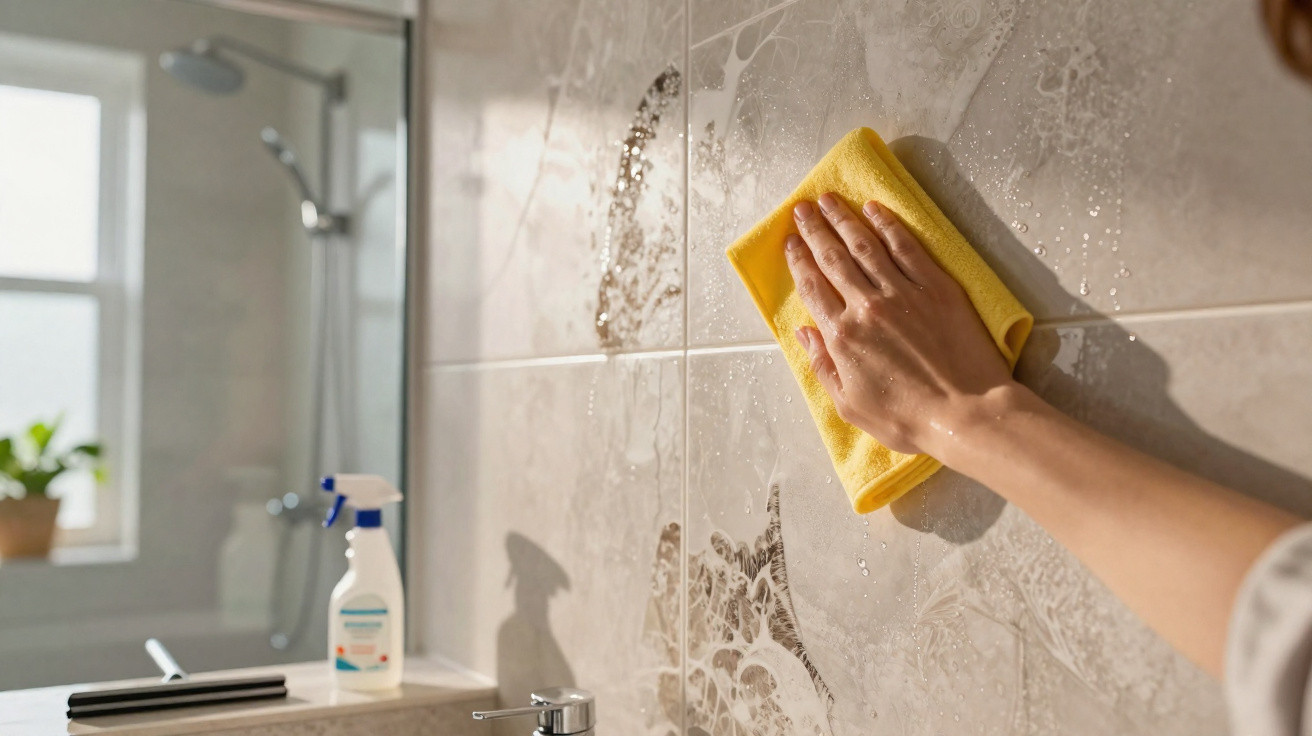
The first thing that hits you is the scent of “clean”.
Bleach, citrus, perhaps a trace of eucalyptus from that influencer-approved spray. You stand back to take in your bathroom: the floor is still wet, your shoulders ache slightly, and your sponge is battered. But something seems… wrong. The corners around the toilet never look properly white. The sink base feels coarse. The shower screen is spotted once more, as though you had never cleaned it at all.
You have put in an hour, perhaps longer, yet it still lacks that satisfying hotel-bathroom finish. Your cleaners are powerful. You have genuinely made the effort. So why does the grime return so quickly? There is a quiet offender in the room, right in front of you.
And chances are, you touch it every day without giving it a thought.
The detail sabotaging your bathroom cleaning
Take a look around the bathroom, but ignore the dirt for a moment. Notice the edges, joins, trims and small decorative decisions that appeared harmless when you moved in. This is where the real struggle lies. The unseen culprit making bathroom cleaning far more difficult than necessary is often texture: rough, ridged and overly elaborate surfaces that hold on to every splash and fleck of dust.
Grouted mosaic flooring, strongly patterned vinyl, porous faux-stone basins and ornate tap bases with grooves all fit the bill. These small design features may look stylish on Instagram, but they are dreadful to tackle with a sponge. They collect limescale, soap residue and hair, making what should be a five-minute wipe-down feel like a full-body workout.
Once you notice these tiny traps, it is impossible not to spot them everywhere.
Consider shower doors with frames. The narrow metal channels at the bottom act like little gutters for grime. Water gathers there and slowly evaporates, leaving behind a light-coloured crust. Add shampoo residue, tiny flakes of skin and dust from towels, and you end up with the sticky grey paste that never seems to go away entirely. You wipe it clean, it improves briefly, and then it is back a week later, staring at you with passive-aggressive vibes.
Textured floor tiles are another example. They may have been marketed as “non-slip” and “spa-like”. In practice, each small groove becomes somewhere for dirt to settle. One UK cleaning survey found that homeowners spend almost twice as long scrubbing textured bathroom floors as smooth ones for precisely the same visual result. Same bathroom size, same person, same products. Only the surface has changed.
We seldom make this connection because our first instinct is to blame ourselves or the products we use. We tell ourselves, “I must not be scrubbing hard enough” or “Maybe I need a more powerful cleaner”. Naturally, brands benefit from that thinking. Yet the actual problem is one of design. Dirt follows physics, not guilt. Water takes longer to dry when it is trapped. Soap attaches itself to rough surfaces. Minerals stick to microscopic imperfections. On a glossy surface with a slight slope, grime can slide away. A coarse, overly detailed edge grips it like Velcro.
The more features, grooves and joins there are in your bathroom, the more points at which dirt can collect. Often, you have accepted them without even knowing it.
How to create an easy-clean bathroom
The encouraging part is that you do not need to renovate the whole room to tackle this detail. Begin by “smoothing” the bathroom through small, purposeful changes. Start with anything that has ridges or difficult joins: a framed shower door, ageing silicone seals, worn grout or fussy tap bases. The objective is straightforward: fewer areas where water can pool, and fewer textured spots where dirt can cling.
Replacing a framed shower screen with a frameless version can make a huge difference. The same applies when selecting a toilet with a concealed rim, or a basin with a flat, sleek underside rather than a shaped pedestal full of curves and angles. Even replacing a pleated fabric shower curtain with a plain, smooth alternative can speed up cleaning. Make one understated change at a time and your bathroom will start to behave differently.
In day-to-day life, small routines help your new “easy-clean” arrangement deliver more. Wiping a flat shower screen can become a 30-second job rather than a wrestling match.
Realistically, we all know how it goes. You buy the impressive descaler, scrub enthusiastically one Sunday, then promise yourself that you will “do a quick wipe every day from now on”. Let us be honest: nobody really does that every day. Life intervenes. Children, work, tiredness and the inevitable doomscroll at 11 pm. This is why you need surfaces that are forgiving when your routine slips.
Picture a wall-mounted vanity instead of one resting on the floor. Suddenly, there are no awkward corners beside the skirting boards where dust can gather. Your mop simply moves underneath. Choose stainless-steel hooks instead of a towel rail with baroque spirals. One evening, while doing a quick clean before guests arrive, you may realise that you have finished in 15 minutes. Same person. Same level of laziness. Simply fewer traps.
We have all experienced the moment of getting on our hands and knees to clean behind the toilet, followed by a small wave of despair. That feeling is not evidence that you are “messy”; it means your bathroom design is quietly working against you.
“The easiest bathrooms to keep clean aren’t the ones with the strongest products,” says an interior designer who specialises in rental flats. “They’re the ones with the least places for dirt to hold on.”
Keep that quote in mind the next time you are scrolling through bathroom inspiration. Fluted glass, black-framed showers and detailed encaustic tiles may look beautiful on day one, but they can be exhausting on day 365. If those features are staying for now, you can still “hack” them. Keep a soft toothbrush specifically for the shower frame, hang a small squeegee inside the shower enclosure, and choose pale, simple textiles that do not highlight every water mark.
For a more practical guide, here is a quick reference to check before buying anything new:
- Select flat, frameless or wall-mounted fittings whenever possible.
- Steer clear of ridges, grooves and faux-stone finishes in areas that get heavily splashed.
- Consider how quickly an item can be wiped with one cloth.
- Favour fewer joins: choose large tiles instead of small mosaics.
- Use your finger as a test: if it feels rough or overly fussy, it will trap dirt.
Small changes for bathrooms that are liveable, not merely Instagrammable
When you recognise that texture and fussy features are the real problem, you begin to assess bathrooms in a new way. Hotel bathrooms suddenly seem clever rather than simply luxurious. Their large tiles, floating vanities and plain chrome taps are not dull decisions. They are low-friction choices made by people who pay cleaners by the hour. They understand exactly which corners demand extra time and effort.
This shift in perspective is surprisingly liberating. Instead of criticising yourself for not maintaining a “perfect routine”, you start asking more useful questions. What if the aim were not a bathroom that photographs well in one moment, but a room that quietly supports your real life for years?
Cleaning products still have their place, as do your habits to some extent. However, this one factor - the texture and design complexity of your bathroom surfaces - quietly determines how burdensome the task feels each week. Discuss it with your partner before buying that ornate mirror or Instagram-famous terrazzo basin. Ask your landlord whether it would be possible to replace the shower screen with a simpler one. When one small change suddenly halves your cleaning time, share before-and-after photographs with friends.
Because after living with a bathroom that almost cleans itself, it is difficult to return to anything else.
| Key point | Details | Why it matters to readers |
|---|---|---|
| Framed vs. frameless shower screens | Framed doors feature metal channels and rubber seals that collect water, soap and limescale. Frameless glass has minimal hardware and smooth, flat areas that can be wiped in seconds using a cloth or squeegee. | Moving to a frameless screen often halves the time spent cleaning the shower each week and limits mould growth along the base, meaning less scrubbing on your knees. |
| Tile size and grout lines | Small tiles produce a tight grid of grout lines that can stain and deteriorate over time. Large-format tiles have fewer joins, so walls and floors become closer to one continuous, wipeable surface. | With fewer grout lines, there are fewer yellowing edges and dark corners, allowing a quick mop or sponge to achieve a “hotel clean” appearance without monthly deep cleaning. |
| Toilet and sink shapes | Conventional toilets with visible pipework and sculpted pedestals create concealed ledges where dust and splashes accumulate. Wall-hung toilets and simple, straight-sided basins leave open floor space and smooth edges. | These forms make it possible to clean the floor in seconds and avoid the “gross zone” behind the toilet, making everyday upkeep less tiring and more achievable. |
FAQ
What single change makes the biggest difference to bathroom cleaning? For most people, changing a framed shower screen for a frameless one makes the greatest difference. It immediately removes grimy lower channels and awkward corners, meaning a swift daily - or even weekly - wipe is enough to keep the glass and seals clear.
My bathroom is rented. How can I deal with textured surfaces? Concentrate on temporary additions: use a squeegee after showering, keep an old toothbrush solely for frames and seals, and replace cluttered accessories with straightforward, flat items such as smooth soap dishes and wall hooks. Small routines, alongside fewer objects, can counteract many design shortcomings.
Are non-slip textured tiles always a bad idea? No, they can be helpful in homes with children, older adults or people with mobility needs. The important thing is to balance safety with easy cleaning: select tiles with a light, consistent texture rather than deep grooves, then use a suitable scrub brush and a mild cleaner once a week.
Is strong chemical cleaner the answer if surfaces are badly designed? Powerful products may provide short-term help, but they cannot alter the fact that grime continues to become trapped. Gentler cleaners on carefully selected, smooth surfaces will generally outperform harsh chemicals used on overly complicated designs.
How often should I realistically clean a bathroom designed for “easy clean”? With an easy-clean arrangement, one quick 10–15 minute clean each week is generally sufficient for most households, plus a fast wipe of the basin and toilet midway through the week when necessary. The point is that no military schedule is required, because the surfaces are doing half the work for you.


Comments
No comments yet. Be the first to comment!
Leave a Comment