
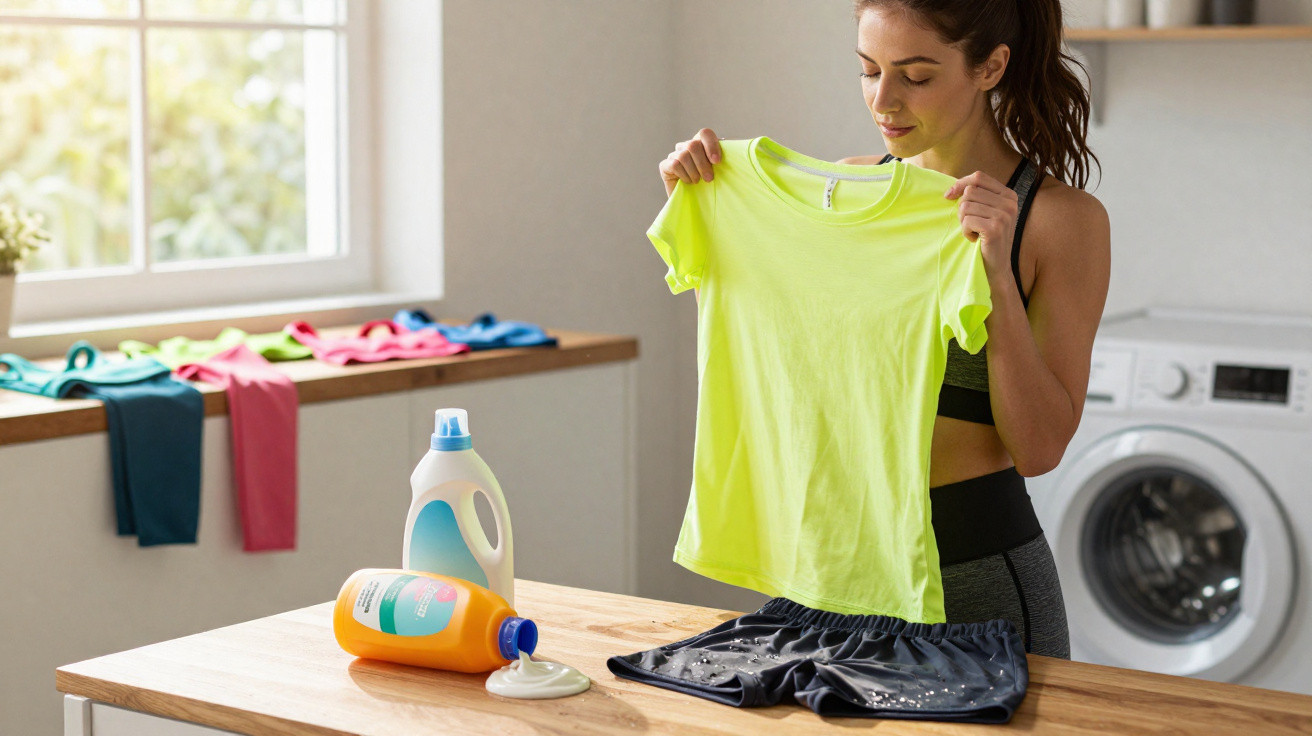
The spin cycle ended, but something about the gym kit smelled… off.
You know that combination of artificial flowers and stale sweat that hangs in the air? The leggings were supposedly clean, warm from the tumble dryer and unbelievably soft in the hand. Still, the slight sour odour-the one the lavender fabric softener was meant to banish-lingered. If anything, it seemed stronger.
The colours looked unchanged and there were no visible marks. But the fabric had a tacky, almost wax-like texture where it ought to have felt breathable. On TikTok, people insisted on using three times the detergent and extra softener. Her sense of smell suggested otherwise.
When she put on her “fresh” sports bra for a morning run, it stuck to her rather than stretching with her, holding in warmth within seconds. Just 0.8 km into the run, it felt as though she were wearing a damp plastic bag. That was when she understood that part of her washing routine had been quietly undermining her exercise.
The cause was sitting in that attractive blue bottle on the shelf.
What fabric softener actually does to workout clothes
For many people, fabric softener feels like a small indulgence: add it, start the machine and enjoy soft, pleasantly scented washing. With cotton towels and old T-shirts, it may seem harmless enough. Athletic wear is different. The smooth, flexible fibres in leggings and running tops are made to draw sweat away from the skin. Think of them as miniature routes for moisture and air.
Fabric softener covers those routes with a slick, waxy layer. It coats every fibre in oily ingredients intended to limit friction and create a “silky” finish. That can be pleasant to touch. Within the material, however, the coating blocks the channels intended to let your body breathe.
After this coating has formed, clothing stops functioning as performance kit and begins acting more like cling film. Sweat cannot escape as quickly, so it collects in the material. Heat remains against your skin, leaving you hotter and damper. Warm, trapped moisture also gives bacteria somewhere to settle. That is why supposedly “clean” leggings can smell sweaty within five minutes of a workout.
Most of us have had a favourite pair of black leggings turn into the pair we wear only as a last resort. Initially, they were brilliant: dry within minutes, close-fitting like a second skin and able to withstand punishing spin classes. Gradually, though, they let you down. They remained wet long after class and developed a faint sour smell, even when freshly taken from the drawer.
Consider Mark, a weekend runner who washed his compression tops alongside the rest of his laundry, including fabric softener. His kit still looked immaculate, with no fading or apparent damage. Yet on every 10K run, he encountered the same issues: chafing beneath his arms, overheating by the halfway mark and a persistent stale-sweat odour. He changed deodorants, tested different detergents and even blamed the gym changing room. Nothing helped.
A friend advised him to stop using fabric softener on his sportswear for a month, and he was doubtful. At first, the difference was harsh: his tops felt slightly rougher after washing. Then the benefits emerged. They dried more quickly, no longer smelled between runs and lost their sticky texture. He had not replaced his kit; he had simply stopped smothering the kit he owned.
There is a straightforward reason for this. Athletic materials-polyester, nylon and elastane blends-do not behave like cotton bedding. They are engineered surfaces with microscopic grooves and channels that transport moisture away from the body. This is known as moisture-wicking, and it relies on sweat making contact with uncoated fibres. Fabric softener is designed to create a more slippery layer over those fibres. Excellent for softness, but poor for performance.
As that layer accumulates, washing becomes progressively less effective. Detergent cannot properly reach the fibres. Additional sweat and body oils remain trapped, while bacteria feeding on them produce the stubborn “gym funk” that seems impossible to remove. Moisture held against rubbing skin can also raise the likelihood of irritation and rashes. Your garments are attempting to perform their role, while softener works against them at every stage.
So, although the floral fragrance may appeal to your nose on laundry day, your skin and muscles bear the consequences on the treadmill.
How to wash athletic wear so it genuinely stays fresh
The first rule could hardly be simpler: do not use fabric softener on sports kit. This means no liquid softener, sheets or “2-in-1” pods. None at all. Handle athletic wear as its own category, much as you would baby clothes or delicate lingerie. Give it a separate cycle and its own washing rules. It may sound overly particular, but it usually requires no more than pressing one extra button.
Turn leggings, sports bras and tops inside out. Choose cool or warm water rather than hot water, which can damage elastane. Select a brief, gentle programme and use a small quantity of detergent-roughly half the amount used for heavily soiled cotton loads. Excess detergent also leaves residue behind. Dry the items flat in the air or place them on a hanger. A tumble dryer is convenient, but high temperatures gradually damage stretch and shape, whatever the care label may say.
If your current sports kit already has an unpleasant smell, approach it as a “reset”. A thorough wash with a specialist sports detergent, or pre-soaking in cool water with a small splash of white vinegar, can help break down old deposits. One carefully handled wash may reverse months of unnoticed damage.
People generally wash gym kit far too frequently-or nowhere near often enough. Following an easy walk, allowing an item to air may be adequate. After a HIIT class that leaves your top soaked, however, it belongs in the laundry basket rather than screwed up in a bag. The real problem is throwing everything into one mixed load “to save time”. That is how softener finds its way back in: it is already in the drawer and built into your routine.
Let’s be honest: nobody studies every care label before every wash. You are tired, you throw in the clothes and press start. That is precisely why one small change-using a dedicated sportswear wash without softener-can deliver such a substantial benefit. It requires no further research, just one non-negotiable part of your routine.
If you share a home with others, discuss it clearly. Your flatmate will then be less likely to “helpfully” wash your costly running tights with a full cap of blue softener. Brief conversations around the washing machine can prevent considerable expense and frustration later.
There is another aspect to consider: how you feel about your body when the clothes you wear are quietly letting you down. Poorly washed kit that stays damp for longer can make you feel self-conscious in a busy gym or crowded yoga studio. You may start to wonder whether other people can smell your top from across the room. You move with less freedom, and exercise becomes more about concealing yourself than feeling strong.
“Once I stopped using softener on my leggings, they smelled less, dried faster, and I stopped thinking about my clothes mid-workout,” says Emma, a crossfit regular. “It sounds silly, but it made me feel more at home in my own body.”
You can make the process easier by deliberately setting yourself up to succeed.
- Keep a small basket or bag marked “sports only” beside the washing machine.
- Put fabric softener on a separate shelf, away from immediate reach.
- Attach a note to the machine saying: “No softener on gym clothes.”
- Choose a mild, fragrance-free activewear detergent to avoid adding scents on top of sweat.
- Air-dry kit somewhere with good ventilation, rather than on a damp bathroom hook.
These small visual reminders take away the uncertainty and safeguard your clothes, including on rushed days.
Rethinking what “clean” feels like on your skin
Stopping the habit of coating everything in fragrance and softness involves a subtle change in mindset. Initially, athletic wear washed without softener may feel different in your hands: less slippery and slightly more “technical”. Some mistake this for roughness. In fact, it is exactly how these fabrics are intended to feel: practical, ready to move sweat away from you instead of retaining it.
With time, the difference becomes noticeable in your body as well as in the laundry basket. Your tops dry more rapidly between sets. During hot yoga, your leggings do not cling in the same way. That strange swampy area around the lower back after a long run gradually disappears. You no longer rewash the same sports bra twice in pursuit of a smell that never completely went away. Your kit starts working with you again rather than against you.
There is also something unexpectedly grounding about it. Cleanliness becomes less about smelling like a perfume advert and more about remaining light, dry and comfortable while moving. You may even begin discussing it with friends, as people exchange advice about running shoes or water bottles. Laundry becomes part of the performance discussion rather than a dull background chore.
The softener bottle will remain there, still promising comfort and clouds. For towels and bedding, it may retain its place. But for the clothing in which you sweat and breathe, a different rule takes over quietly. You begin sorting laundry not merely by colour but also by purpose: what helps you rest, what helps you move and what shields you from your own exertion.
That modest change in how you care for clothes may alter how you approach training too. There is less hiding and less concern about odours, with greater focus on whether you feel strong, quick or calm. Sometimes the most worthwhile improvements do not begin with new trainers, but with what you stop adding to the wash.
| Key point | Detail | Benefit for the reader |
|---|---|---|
| Stop using fabric softener on athletic wear | Softener coats fibres, preventing moisture-wicking and trapping sweat and bacteria | Fewer odours, less irritation and clothes that perform like new for longer |
| Adopt a dedicated washing routine | Cool or warm water, mild detergent, a gentle cycle and air-drying | Prolongs garment life, preserves stretch and comfort, and saves money on replacement kit |
| “Reset” already smelly gear | Deep-clean with sports detergent or use a vinegar pre-soak to remove build-up | Saves favourite leggings and bras instead of throwing them away |
FAQ:
- Can I ever use fabric softener on any sportswear? Avoid it on anything labelled moisture-wicking, quick-dry, compression or technical. If an item is 100% cotton and is worn only for gentle walks, softener is less problematic, though it is still not ideal.
- What if my washing machine auto-doses fabric softener? Empty and clean the softener compartment, then run a rinse cycle. For sports loads, keep that compartment dry and add detergent only.
- How do I get rid of stubborn sweat smell already in my clothes? Soak the garments in cool water with a small amount of white vinegar for 30–60 minutes, then wash them with a sports-specific or enzyme detergent and air-dry.
- Are dryer sheets as bad as liquid softener? Yes. Tumble dryer sheets leave a similar coating on fibres, reducing breathability and moisture-wicking. Do not use them on activewear.
- My gear feels rough without softener. Is that normal? A slightly less silky texture is normal and generally indicates that the fibres are no longer coated. If an item feels genuinely scratchy, look for fabric damage or use less detergent and a gentler cycle.


Comments
No comments yet. Be the first to comment!
Leave a Comment