
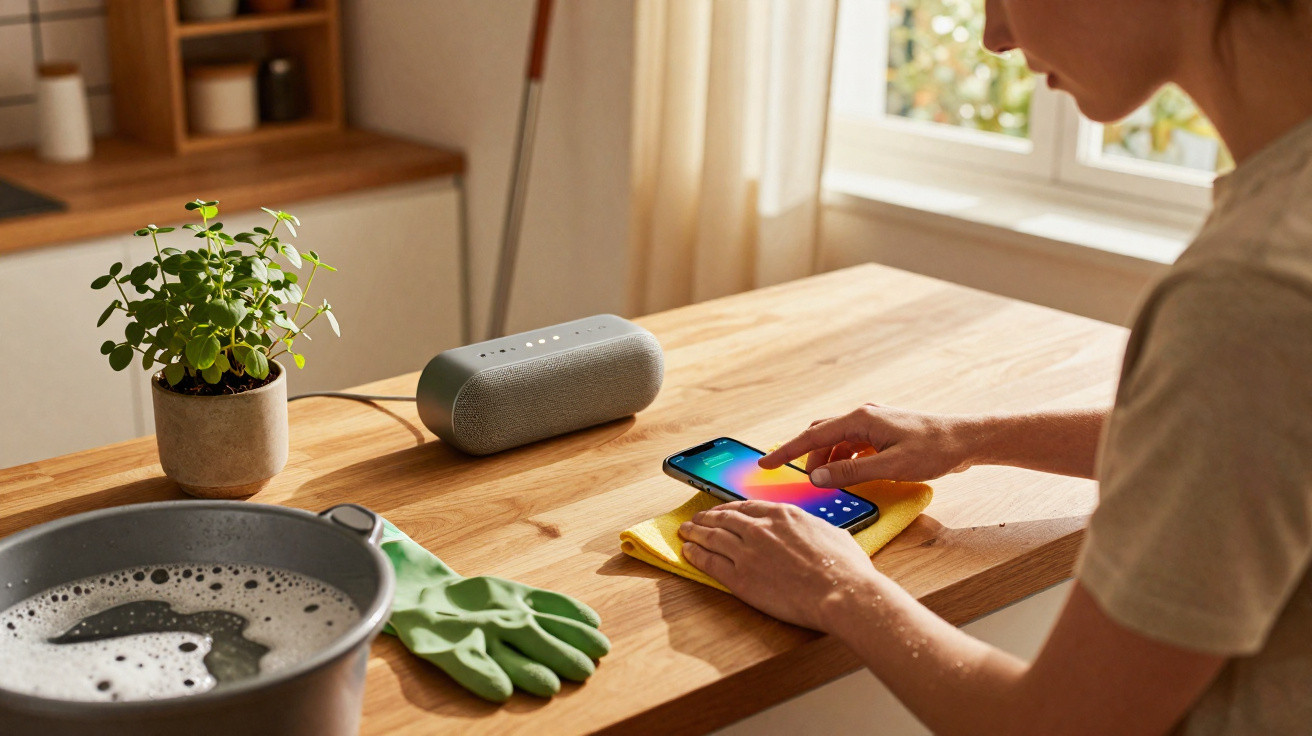
Your mind keeps circling the unpaid bill stuck to the fridge, the email left unanswered and the message still waiting for a reply. Your hands are working, yet your thoughts are reluctant to follow. Then you press play. A bass line hits your chest, the tempo takes hold of your shoulders, and wiping down the counter suddenly has a pulse. As you walk across the room, your feet fall into time with the beat. The cloth moves more quickly, seemingly without effort. When the chorus arrives, you finally deal with the mess in the corner that has been there for weeks. By the third song, the job no longer feels quite so awful. The sink is gleaming, the bin has been emptied and your mood has lifted. Something has changed quietly - and it is not only the dust.
Why your brain cleans better with a soundtrack
Watch somebody clean without any sound and boredom almost seems to settle over them. They move more slowly, sigh more often, and pause to check their phone “just for a second”. Put music on and the pace of the whole room shifts. Their arms move with greater intent, the vacuum becomes a dance partner, and even the laundry pile feels slightly less daunting. Rather than measuring every passing minute, your brain begins to follow the rhythm. You notice your dislike of scrubbing less, because you are waiting for the next chorus instead. The chore itself is unchanged, but the way it feels is not.
A small cleaning firm in Manchester tested this idea without much fuss. Fed up with unfinished work and lengthy breaks, its owner allowed staff to take portable speakers to jobs. For one month, three teams cleaned identical types of homes using the same products and timetable. The sole variation was the sound: one team worked in silence, another listened to the radio, and the third used collaborative playlists. Once the trial ended, the playlist team was completing each house around twenty minutes sooner. One cleaner said she had stopped watching the clock and began “cleaning to the end of the album” instead. Client feedback repeatedly used the same descriptions: “thorough”, “energetic”, “fresh vibe”. Dust may not understand statistics, but the outcome did.
The reasoning behind this change is straightforward. Your brain has only so much energy available for willpower. Cleaning is repetitive, offers little immediate reward and requires countless minor choices: start with this corner or that one, keep it or bin it, tackle the drawer or the shelf. Music removes part of that mental burden. A beat structures your movements, meaning you need not consciously plan every action. Meanwhile, the melody occupies the part of your brain looking for distraction, leaving more attention for the work itself. You enter a gentle, near-automatic way of getting things done. You’re not suddenly someone who loves scrubbing grout. Your mind is simply occupied enough that it stops pushing back.
Turning chores into a personal playlist ritual
The key is to use a cleaning playlist as a practical tool rather than mere background sound. First, make its length fit the time you intend to clean for: 30, 45 or 60 minutes. Choose songs with a consistent pace, avoiding anything that turns into a sleepy ballad halfway through. Familiar tracks tend to be most effective because your brain does not need to process something new. The moment you press play, your body recognises the routine and gets moving. Open with a single “launch track” that always marks the beginning of cleaning - your own theme tune, in effect. After several weeks, that opening riff becomes a mental cue: hear it, and your hands reach for the sponge or laundry basket almost automatically.
Many people make the mistake of putting random music on loudly and expecting it to cure procrastination. That is like tossing spices into a pan and assuming dinner will make itself. Instead, build a few small rituals. Make one playlist for quick resets, such as the kitchen, bathroom sink and surfaces. Create another for bigger jobs, including windows, the oven and cupboards. Leave out songs you strongly connect with a breakup, a funeral or the holiday you miss too much. They pull your attention in another direction. If a song makes you pause and gaze through the window, it has no place in your “cleaning engine”. Let’s be honest: nobody really does this every day. Your playlist should suit your actual habits, rather than some idealised version of yourself.
Your emotional state matters just as much as the cleaning products in the cupboard. On certain days, lively pop is what you need to outrun the nagging voice in your head. On others, gentle lo-fi can ease you into action without becoming overwhelming. One professional organiser I spoke to put it simply:
“Music is the only colleague that makes cleaning feel less lonely and never complains about the mess.”
A few straightforward rules can keep the approach easy.
- Keep your “cleaning playlist” visible and easy to access, whether pinned or favourited.
- Wear headphones only when using shared speakers would bother someone else.
- Keep the volume low enough that you can still hear the doorbell or children calling.
- Leave out songs that cause you to stop moving, however much you enjoy them.
- Finish with one dedicated “closing song” to signal that the work is over.
The quiet benefits you only notice once the music stops
There is something striking about returning to a room you have just cleaned while the memory of its music remains. Your body still carries an echo of the earlier rhythm, and the room itself seems to feel different. On a difficult day, cleaning with music can be a small way of reclaiming control. You select the soundtrack, set the pace and decide when it finishes. Most of us know the feeling of a home mirroring our minds: cluttered, weighed down and slightly beyond control. Starting a playlist and clearing even one small area can interrupt that cycle. What you gain is not merely a sparkling sink, but a mind with a little more room to breathe.
| Key point | Detail | Benefit for the reader |
|---|---|---|
| Rhythm and motivation | Music gives repetitive movements a framework | Less mental resistance and an easier start |
| Attention management | Songs occupy the part of the brain that becomes bored | Fewer distractions and jobs completed sooner |
| Personal ritual | Playlists are connected to particular durations and rooms | A simple routine that can be repeated without relying on willpower |
FAQ:
- Does any kind of music work for cleaning? Not really. Tracks with a steady mid- to fast tempo usually help most people, whereas very slow or emotionally intense songs can often distract you or reduce your pace.
- Is it better to use headphones or a speaker? If you live by yourself, a speaker can feel more liberating. In shared areas, headphones work well, provided you can still hear what is going on around you and move safely.
- Can listening to music while cleaning be bad for focus? Yes, if the lyrics are too engaging or the volume is excessive. When you find yourself stopping to sing rather than wipe, the music is taking up too much attention.
- What if I don’t usually like music? Experiment with understated instrumental music, ambient sounds or film scores. You do not have to be a “music person”; you simply need something gentle to shape the time.
- How do I stop relying on music for every chore? There is no need to. Save it for the tasks you resist most, and do some chores quietly when you genuinely enjoy the silence. The aim is not dependence, but leverage.


Comments
No comments yet. Be the first to comment!
Leave a Comment