
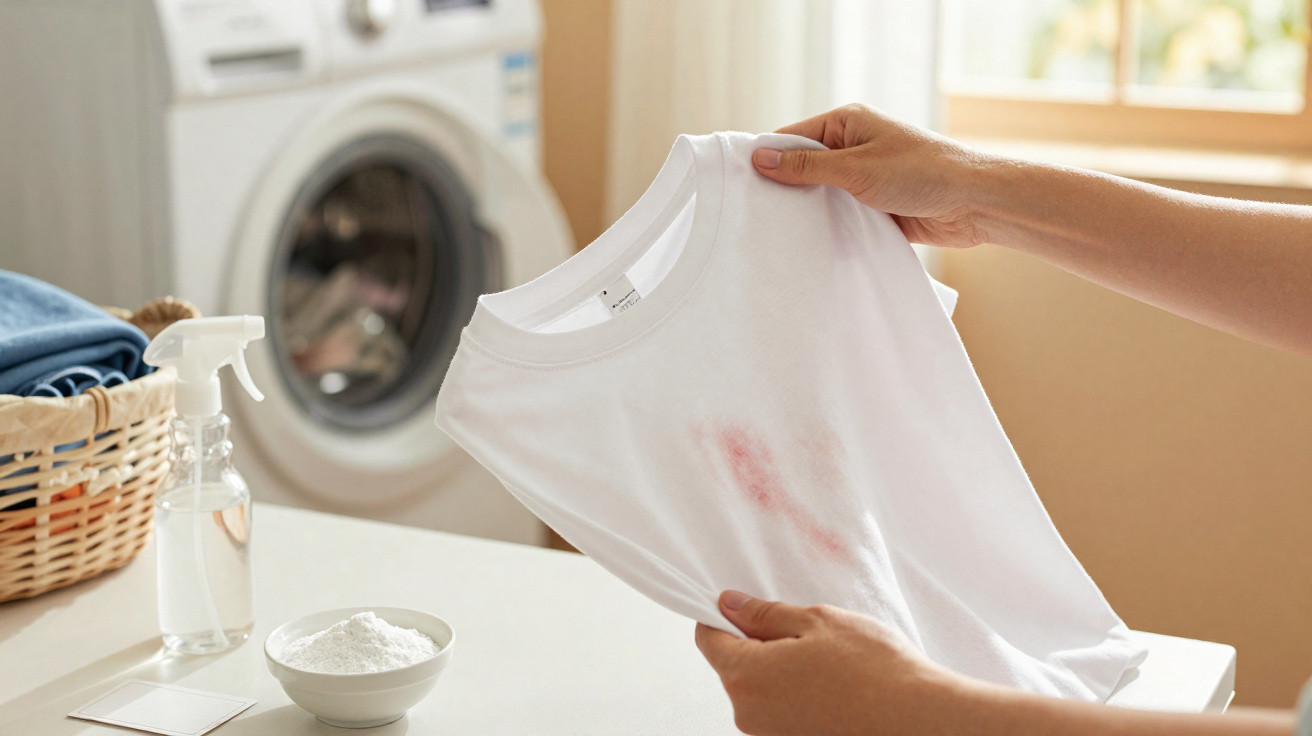
The shirt appears spotless when it comes out of the washing machine.
It has that “cotton fresh” smell and feels warm, almost reassuring. You lift it towards the light, about to fold it, and spot it: a shadow in the material. A pale ring where last week’s tomato sauce landed. It is no longer vivid red, only a lingering ghost stain that will not disappear.
You run the fabric through your fingers, confused. It has been washed twice, put through the “intensive” programme, and even treated with that costly detergent advert featuring the cheerful family. Yet the mark remains. It is subtle, but noticeable enough to make the shirt unsuitable for work or dinner.
You start asking whether you made a mistake, or whether the stain has somehow become embedded in the material. Then an uneasy thought quietly takes hold. Perhaps it has.
Why some stains cling to clothes like a bad memory
Certain stains do not simply rest on the surface of clothing. They settle in. They work their way between the fibres, latch on and begin to alter the fabric itself. Oils, dyes, and proteins from food or perspiration mix with cotton, polyester or wool. It is not so much like a splash on a wall as ink sinking into paper.
This is why a wash cycle that removes mud immediately may do little for red wine, curry or coffee. The machine turns, the drum fills and the suds circulate. It may look forceful from the outside, but within the fibres the chemistry is much more subtle - and often works against you.
The most frustrating part is that heat can “set” a stain once it has been through a hot wash or tumble dryer. Think of baking a cake: something that could once have been removed can suddenly become fixed, almost like a new shade in the fabric.
Picture the familiar white shirt at a Sunday family lunch. Someone reaches across the table and a drop of gravy falls directly onto the front. There is a brief silence, followed by anxious laughter, napkins dabbed at the mark and the reassurance that “it’ll come out in the wash”. The shirt is placed in the laundry basket, left there for two days, then added to a 40°C mixed wash with everything else.
When it comes out, the obvious brown mark has disappeared, yet it has been replaced by a yellowish halo. It is not dramatic enough for social media, but it is enough to make the shirt seem “not quite right” beside a sharp jacket. Many people continue wearing it around the house before gradually abandoning it altogether. A favourite shirt slowly becomes a pyjama top, then a cleaning cloth.
Laundry-industry surveys suggest that up to a quarter of clothes discarded by people are still wearable, apart from supposedly “unfixable” stains or discolouration. That amounts to a great many shirts, trousers and dresses lost because of what happened during the first ten minutes after a spill.
The science behind this is far less glamorous than advertising suggests. Many difficult stains contain fats, proteins or tannins that attach themselves to fibres. Perspiration and deodorant may react with aluminium salts and cotton, producing the familiar yellow patches under the arms. Red wine and tea contain complex tannins that grip fibres like magnets. Tomato and curry bring powerful pigments that are particularly drawn to synthetic materials.
Standard detergent is made for everyday grime rather than intense molecular adhesion. As water warms inside the drum, proteins in food stains may denature and solidify, much as an egg firms up in a frying pan. Once this occurs within the fabric, you are dealing with something more like a chemical tattoo than an ordinary mark.
That is why people can insist they “did everything right” while the stain remains. In most cases, they followed the usual instinct: wash first and ask questions afterwards.
Stain-removal steps that help before the mark becomes permanent
The most important change is remarkably straightforward: deal with a stain before washing, rather than hoping the wash will deal with it. That does not mean reaching for a specialist treatment whenever you drop a noodle. It means rinsing in cold water, blotting carefully and paying the mark a little focused attention before the garment joins the normal laundry pile.
Cold water helps stop proteins from cooking into the fibres. For oily marks, a small amount of washing-up liquid can break down grease more effectively than certain expensive powders. Leave it for ten minutes, gently rub the material between your fingers, then rinse once more. Only after that should it go into the machine. This 30-second “mini ritual” can completely change the outcome for a stain.
For coloured stains such as wine or berries, rapid dilution is your friend. Hold the reverse side of the fabric beneath the tap so that the stain is forced outwards instead of being driven deeper in. With many marks, the crucial work happens before the drum begins to turn.
Most people make the same understandable error: they delay. They intend to “deal with it properly later”, then life intervenes, the basket fills up and the stained garment is automatically swept into a full load. By the time it emerges, time and heat have fixed the mark. Treatment may still be possible, but the chances of success are reduced.
We also tend to respond by adding more product. More detergent, a higher temperature and a longer programme. It feels as though greater effort should bring better results. Yet on some fabrics and with certain stains, that forceful combination simply pushes the molecules further into the weave. The faded ring that develops later does not always mean the stain has gone; it can indicate that it has spread.
There is also a laundry myth many of us live by: “one detergent suits everything, one cycle suits everything”. Let’s be honest: hardly anyone really reads the tiny care symbols on every label before pressing start. However, those small icons can reveal which stain treatments will avoid damaging the fabric too.
“A stain is a story between the fabric and the moment it was made. Your job isn’t to erase the story, it’s to interrupt the chemistry before it becomes permanent,” says a London-based textile restorer who spends her days rescuing wedding dresses and vintage shirts.
Small errors can accumulate. Scrubbing a fresh stain vigorously may roughen the fibres, leaving them more likely to catch and retain colour. Hot water can lock blood or egg into place. Applying perfume or deodorant to areas that are already stained can trigger additional reactions you did not expect.
- Blot rather than scrub: dabbing with a clean cloth lifts the stain away instead of working it further in.
- Start with cold water: particularly for blood, milk, eggs and sweat.
- Test products first: trying a small hidden section of a seam can protect an entire blouse.
- Treat, wash, then air-dry: heat from a tumble dryer should be the final step, not the first.
- Pause if you are unsure: it is better to leave the item damp with a little soap than rush it into a hot cycle.
Living with stains, learning from them and knowing when to let go
Once you begin noticing how stains behave, you cannot easily ignore them. You recognise the faint old-sweat ring on a much-loved T-shirt or the light coffee shadow on the sleeve of a jumper worn every Sunday. Some marks become part of a garment’s history. Others remain interruptions you still want to put right.
Oddly, this minor domestic struggle has significant consequences. Clothing is thrown away or relegated to homewear not because it is worn out, but because of one persistent blotch near the collar. Understanding how stains set - and how to interrupt the process - is one of those unglamorous skills that quietly saves time, money and frustration.
A small, kinder change in perspective can help as well. Rather than thinking, “this is ruined”, try thinking, “this is a chemistry puzzle I perhaps mishandled the first time”. That does not mean every garment can be saved. Sometimes the best result is to accept a faint mark, rethink how the item is used or dye it entirely. The difference is that you are making a choice rather than simply losing something.
| Key point | Detail | Why it matters to the reader |
|---|---|---|
| Timing beats temperature | Fast, cold pre-treatment often performs better than a hotter, longer wash later on | Helps save more clothes without harsh wash cycles |
| Stains are chemistry, not magic | Oils, proteins and dyes attach to fibres in particular ways | Helps you choose the right action instead of hoping for a miracle |
| Heat can “bake in” stains | Tumble dryers and hot cycles can permanently set untreated marks | Prevents reactions that turn a small mishap into a permanent stain |
FAQ:
- Why do underarm stains stay even after washing? They are usually caused by sweat, deodorant and the fabric reacting together, rather than surface dirt alone. Applying a paste of bicarbonate of soda and water to the area before washing may help break down the build-up.
- Is it true hot water always sets stains? Not in every case, but for protein-based stains such as blood, milk or egg, hot water can make removal far more difficult. Warmer water may actually help with greasy or oily marks - after a cold pre-rinse.
- Can I fix a stain that survived the dryer? You can try, although the chances fall after heat has set it. Enzyme-based stain removers left to work for 15–20 minutes, followed by a gentle wash, can sometimes fade “baked-in” marks, especially on cotton.
- Do I really need separate products for each type of stain? Not necessarily. A simple kit containing mild detergent, washing-up liquid, white vinegar and bicarbonate of soda can handle a surprising range of everyday mishaps, provided you act quickly.
- When should I give up and stop treating a stain? If several careful attempts have made no difference, or if the fabric begins to look thin or worn, it is often kinder to the garment to stop. At that stage, using it as loungewear, layering it or dyeing it can offer it a second life.


Comments
No comments yet. Be the first to comment!
Leave a Comment