
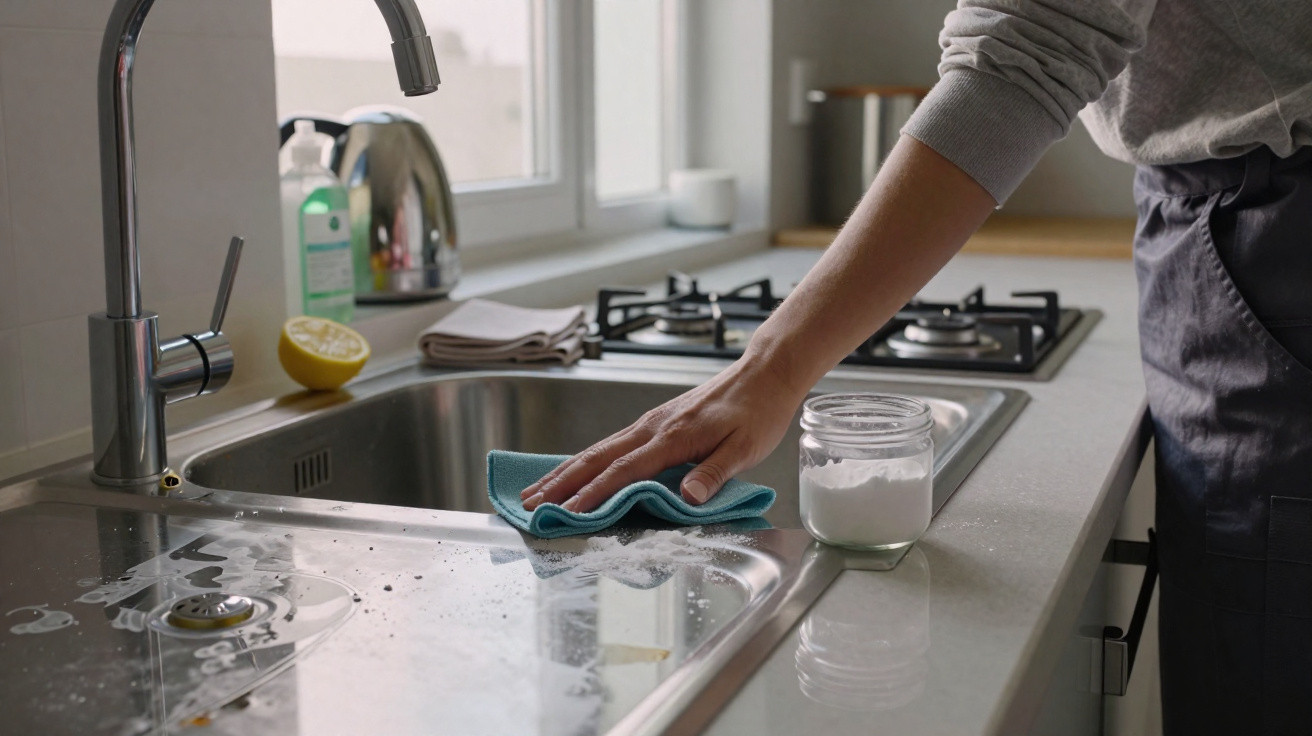
The kitchen light was unforgiving.
It was late afternoon, with a low winter sun exposing every mark across the stainless-steel hob. The flat’s owner, a busy GP, watched a professional cleaner arrive carrying a small caddy rather than a cumbersome trolley. There were no expensive sprays or fluorescent bottles in sight: only two cloths, a sponge and a simple glass jar containing what looked remarkably like porridge oats.
Within five minutes, the sink, hob and previously dull chrome tap were mirroring the window. There were no scratches and no chemical smell hanging in the room. The cleaner smiled, rinsed her hands at the sink and said, “It’s from the kitchen cupboard, you probably have it already.”
She then replaced the lid on the jar, and I finally understood what was inside.
The pantry staple that revives lifeless surfaces
The hidden ingredient is neither an obscure powder nor a viral American cleaning spray. Professional cleaners around the UK are discreetly relying on something your nan may well have used: everyday bicarbonate of soda. It is not soda crystals or anything caustic, but the mild, chalky powder used in baking or left at the back of the fridge to absorb odours.
When applied properly, bicarb acts like a miniature force of micro-sponges. It loosens grease, shifts stains and polishes surfaces without creating swirl marks. There is no fragrance and no aggressive vapour – only the satisfying sight of a weary, matt worktop seeming to breathe again after a long day.
After seeing a professional scatter it as though seasoning food, then restore a seemingly scratched sink in less than five minutes, you will never view the contents of your cupboard in quite the same way.
One Tuesday morning in south London, professional cleaner Lena pours half a teaspoon of bicarbonate of soda into her hand. She sets a timer on her phone, almost treating it as a challenge. According to the tenant, the stainless-steel sink before her is beyond saving: tea marks circle the plughole, cloudy water stains cover the surface and the tap is blurred from too many limescale treatments.
Lena dampens a microfibre cloth, touches it to the powder and begins with the area around the drain. She uses small circles and no pressure. “People scrub too hard,” she mutters, hardly glancing down. Within two minutes, the brown ring of grime has vanished. By the fourth minute, her fingers are visible in the tap’s reflection. She takes a quick photograph, removes the final residue and looks at the timer: 4 minutes 36 seconds.
She later tells me that 7 out of 10 of her regular clients now ask what is in “the magic jar”. Most have it sitting in their baking drawer already.
There is a straightforward reason bicarb is so effective on tired-looking surfaces. Every particle is a mild abrasive: firm enough to lift ingrained build-up but gentle enough not to score metal or ceramic. With a few drops of water, it forms a paste that remains on taps, hobs and sinks long enough to work.
From a chemical perspective, sodium bicarbonate is mildly alkaline. This slight alkalinity helps release oily residues from the material beneath them. Grease, tea tannins and dried sauce – the substances that leave a coating on worktops – start to lose their hold. Rather than merely sitting on the dirt, the powder interacts with it, so it can be wiped away more easily.
This blend of gentle grit and understated chemistry is what makes bicarb so popular with professionals paid to work quickly. While someone is still debating which supermarket trigger spray to use, they have rinsed, wiped and moved on.
How professional cleaners use bicarb in everyday kitchens
The technique is remarkably uncomplicated. Professionals describe it much like making a fast sauce: use a little of one thing, add a splash of another, then know when to stop. For a dull hob or sink, they begin with a surface that is damp rather than dripping wet. They scatter a small amount of bicarbonate of soda over it – closer to dusting a cake with icing sugar than gritting a road in January.
Next comes the movement. Using a soft microfibre cloth or non-scratch sponge, they work in tight circles. There is no frantic rubbing or arm-aching scrubbing. After one or two minutes, the white powder becomes a cloudy paste as it gathers grime. Everything is removed with a clean damp cloth, then quickly buffed with a dry towel or old cotton T-shirt. Chrome regains its shine and enamel looks less like a “rental flat” and more like something from a “Sunday magazine”.
For more persistent marks, many cleaners add one small extra step: acid. A few drops of white vinegar or lemon juice over the bicarb will create fizzing. On a clouded chrome tap, this mild reaction can help release mineral deposits without the severity of a dedicated limescale remover. A Bristol cleaner showed me how she places dots of bicarb around a tap base, adds vinegar, leaves it for 60 seconds and wipes it away. Once the fizzing stops, the chalky ring has gone and the tap reflects the light again.
For greasy splashbacks, some professionals do the process the other way around. They first use a tiny amount of washing-up liquid to remove the top layer of grease, before treating any remaining dull areas with a fingertip of bicarb paste. It is not glamorous; it simply works.
Problems generally arise when people rush. They hear “scrubbing powder” and treat the job as if they were sanding floorboards. That is when surfaces can be damaged. Force is unnecessary: what matters is contact and repeated light movement. Think of it as polishing rather than attacking. Another common error is applying it dry to unsuitable materials. Marble, certain granites and high-gloss acrylic can be sensitive. A professional tests a small concealed area before proceeding, and that is the sensible approach at home too.
Let’s be honest: nobody really does this every day. Most of us only notice the grey tap when guests are arriving in an hour. That is precisely when bicarb comes into its own. There is no need to soak a surface, wait, then wait again. You can enter the kitchen, notice a cloudy sink, give it a 90-second massage with bicarb paste and get on with your day.
There is an emotional element too. During a difficult week, a five-minute improvement can be surprisingly calming. One moment the hob appears neglected and worn; the next, it catches the light like a show home. At a small domestic level, it is evidence that certain things really can be fixed quickly.
“I bring bicarb to every single job,” says Martin, a professional cleaner from Leeds with 18 years on the job. “My clients think I have some trade-only miracle spray. Half the time it’s a 60p supermarket tub doing the heavy lifting.”
- Use it on a damp surface, not a soaking one – water helps it adhere rather than slide away.
- Make circular motions with a soft cloth, rather than using a scouring pad.
- Try it on a concealed patch of expensive stone or glossy finishes before tackling the full surface.
- Rinse thoroughly and dry well, so no powdery residue remains.
From a rapid solution to a quiet routine
Once you have seen what ordinary bicarbonate of soda can achieve in under five minutes, it becomes difficult not to notice other apparent lost causes. A dull kettle lid, a stainless-steel bin pedal or worn-looking enamel around hob controls: all those small, faintly embarrassing details that make a kitchen seem older than it is. On a wet Sunday, you may find yourself walking around with a damp cloth and a sprinkle of white powder, lifting smears like a magician.
At a deeper level, this small practice encourages a different view of cleaning: a collection of speedy resets rather than a monthly punishment. One professional I spoke to follows the “one surface a day” rule: the tap on Monday, the hob on Tuesday and the sink on Wednesday. There is no guilt and no enormous scrub at the end of the week. The five-minute bicarb method becomes a brief, nearly meditative ritual alongside making tea or waiting for pasta water to boil.
In a world of screens packed with miracle detergents and celebrity-backed sprays, there is something reassuringly grounded about the battered orange tub at the rear of the pantry. It makes no claim to transform your life. It simply restores the things you own, changing dullness into shine with one uncomplicated human gesture.
| Key point | Detail | Benefit for the reader |
|---|---|---|
| Bicarbonate as a gentle abrasive | Each grain polishes most stainless steel, enamel and ceramics without scratching them | Revive dull surfaces without damaging or replacing them |
| Method in under 5 minutes | Dampen, sprinkle, massage in circles, rinse and dry | Fast visible results, ideal before guests arrive or at the end of the day |
| Bicarb + mild acid combination | Add vinegar or lemon to bicarb for stubborn marks | Increase effectiveness against limescale and rings without harsh products |
FAQ:
- Can I use bicarbonate of soda on every surface? Not quite. It is safe for most stainless steel, enamel, ceramic and many laminates, but may be risky on marble, some natural stones and highly glossy plastics. Always test a hidden patch first.
- Will bicarb scratch my stainless-steel sink or hob? When used with light pressure and a soft cloth, it is generally gentle enough. Scratches usually result from scouring pads or gritty debris rather than the bicarb itself.
- Is bicarbonate of soda the same as baking powder? No. Baking powder includes bicarbonate, acids and starches. For cleaning, choose pure bicarbonate of soda, which may also be labelled “baking soda”.
- How much bicarbonate of soda do I actually need? Very little. Half a teaspoon to a teaspoon will usually do for a hob or sink. A light dusting is more effective than a thick covering.
- What if the dullness doesn’t go away? If gentle polishing with bicarb does not work, the surface could be etched, worn or covered with a specialist finish. In that case, it is damage rather than dirt, and professional advice or refinishing may be required.
Comments
No comments yet. Be the first to comment!
Leave a Comment