
You spot it halfway through the morning meeting.
A faint, disloyal wobble from a shirt button that was perfectly secure when you left home. You touch it once, then again, and can already feel the thread working loose. Immediately, you picture the disaster: the button coming off during your presentation, your shirt falling open, and you spending the rest of the day with one hand pressed to your chest.
Someone nearby says casually, “You know you can fix that with clear nail polish, right?”
It seems almost absurdly straightforward. That is probably why the suggestion stays with you.
Why your buttons keep betraying you
Once you begin noticing, it becomes clear just how many shirts are surviving by a thread. There is the favourite white office shirt, whose button is held on by a soft, fuzzy ring of thread. Then there is the denim shirt you have owned for years, where the second button always seems to fail first.
Thread rarely breaks in a single moment. Instead, it gradually wears away with every wash, every change of clothes made in a rush before leaving the house. By the time you notice it, it is usually close to being too late.
Think back to the last occasion a button came off while you were out. Perhaps you were on a date, trying to manage your jacket. Or maybe you were hurrying to collect your luggage from the overhead locker on a flight.
You heard the quiet “ping” as it landed on the floor, and everything briefly seemed to slow down. Next came the uncomfortable improvisation: using your bag as cover, shifting how you stand, and trying not to appear as though your outfit is actively coming apart. That small plastic disc had far more control over your day than it should have done.
The cause is simply wear and physics. Thread continually rubs against the cloth and the edges of the button. Washing adds heat, movement and detergent, all of which can weaken the fibres.
Eventually, the knot keeping it all together starts to loosen. As soon as one small strand breaks, the button is essentially on a countdown. The fastening is only as resilient as its weakest loop of thread. That vulnerable point is where clear nail polish subtly changes the outcome.
The clear nail polish trick that quietly saves your shirts
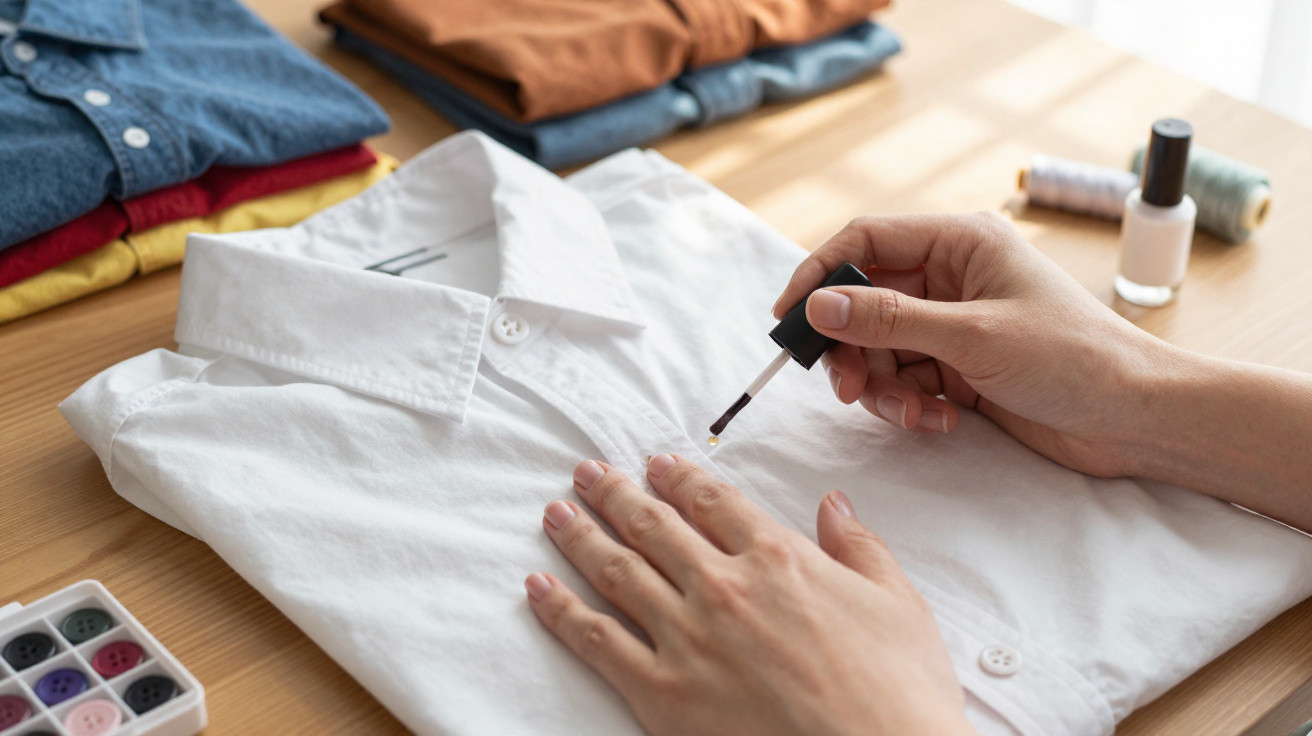
This is the technique trusted by wardrobe professionals, flight attendants and detail-oriented grandmothers. Place your shirt flat and inspect every button carefully. Any button with fluffy, loose thread or a knot that looks slightly weak is a good candidate.
Take a bottle of clear nail polish: not coloured or glittery, simply standard transparent polish. Dip in the brush, remove any excess, then lightly dab a small amount onto the knot and the threads that cross beneath the button. Leave the shirt flat for a few minutes until the polish has dried fully.
Drying is the stage people often rush. Put the shirt on too soon and the polish may stick to your skin or another button, leaving you frustrated rather than relieved.
Consider it a tiny layer of armour. As the polish dries, it hardens around the thread, sealing the fibres and holding the knot in position. It does not glue the button to the shirt. Instead, it transforms soft, delicate thread into something more like a small transparent coating. Once you’ve done it once, you start spotting “rescue candidates” in your closet without even trying.
There is a subtle change in mindset, too. Applying clear nail polish this way is a modest form of future-proofing for your clothes.
You’re saying to yourself: “I like this shirt enough to give it a bit of extra life.”
- Apply it sparingly: a fine layer of polish is more effective than a thick blob.
- Target the knot and the threads crossing the button rather than coating the entire button.
- Leave the shirt flat to dry for at least 10–15 minutes so nothing sticks together.
- If the fabric is delicate, test the method on a concealed button first.
- Reapply every few months to the shirts you wear most often, rather than treating every item you own.
A small gesture that changes how you treat your clothes
After learning this clear nail polish trick, you may begin looking at your wardrobe in another way. A slightly loose button stops being an approaching emergency and becomes a 30-second maintenance task for a calm moment.
You may even put a small bottle of clear polish beside the laundry basket or in the bathroom, rather than keeping it only with your make-up. It can become part of a quiet routine of looking after what you already own, rather than endlessly replacing it.
To be honest, no one really carries this out every day. Most people only remember when a button is already one wash away from disappearing.
Even so, using it now and again on favourite shirts, or on the clothes you depend on for interviews, meetings and travel, shifts the relationship. You are no longer merely responding to minor clothing crises; you are gently and quietly stopping them before they happen. That feels very different when you are halfway across town without a spare shirt.
You may mention to a friend, almost casually, “Try clear nail polish on that button before it goes.” They might laugh initially, then message you a week later to say, “Okay, that actually worked.”
These small, almost private habits are the sort once shared in kitchens, between generations, over coffee and half-sewn hems. They are not glamorous, and they do not become viral in the way dramatic makeovers do, but they endure. They last because they address a small, genuine problem in a surprisingly satisfying way. Once they become part of your routine, your clothes can feel a little less disposable and a little more like your own.
| Key point | Detail | Value for the reader |
|---|---|---|
| Strengthen button threads | Dab clear nail polish on knots and crossing threads | Buttons last longer, with fewer wardrobe mishaps |
| Avoid future damage | Use it on new or slightly loose buttons before they fail | Reduces time, stress and replacement costs |
| An easy routine | A quick 30-second repair using items you already have | A simple, low-effort way to care for favourite clothes |
FAQ:
- Can clear nail polish damage my shirt fabric? On most ordinary cotton or polyester shirts, no. Keep the polish on the thread and knot, avoid putting it directly on delicate materials such as silk, and test it on a hidden button first if you are unsure.
- How long does the nail polish protection last? It will normally last for several months of regular wearing and washing. Once the threads begin to look fluffy again, carefully apply another small amount.
- Does this work on all types of buttons? It works for most standard plastic, resin and metal buttons. Do not use it on highly porous or fabric-covered buttons, as the polish may stain them or make the surface excessively stiff.
- Can I use a top coat or gel polish instead? Any standard clear nail polish is suitable. Gel polish requires curing under a lamp, which is unnecessary for this purpose and may be awkward to use on fabric.
- What if the button thread is already almost broken? Where only one or two strands remain, the polish may give you a little extra time but will not work miracles. Sew the button back on first, then seal the new knot with polish.

Comments
No comments yet. Be the first to comment!
Leave a Comment