
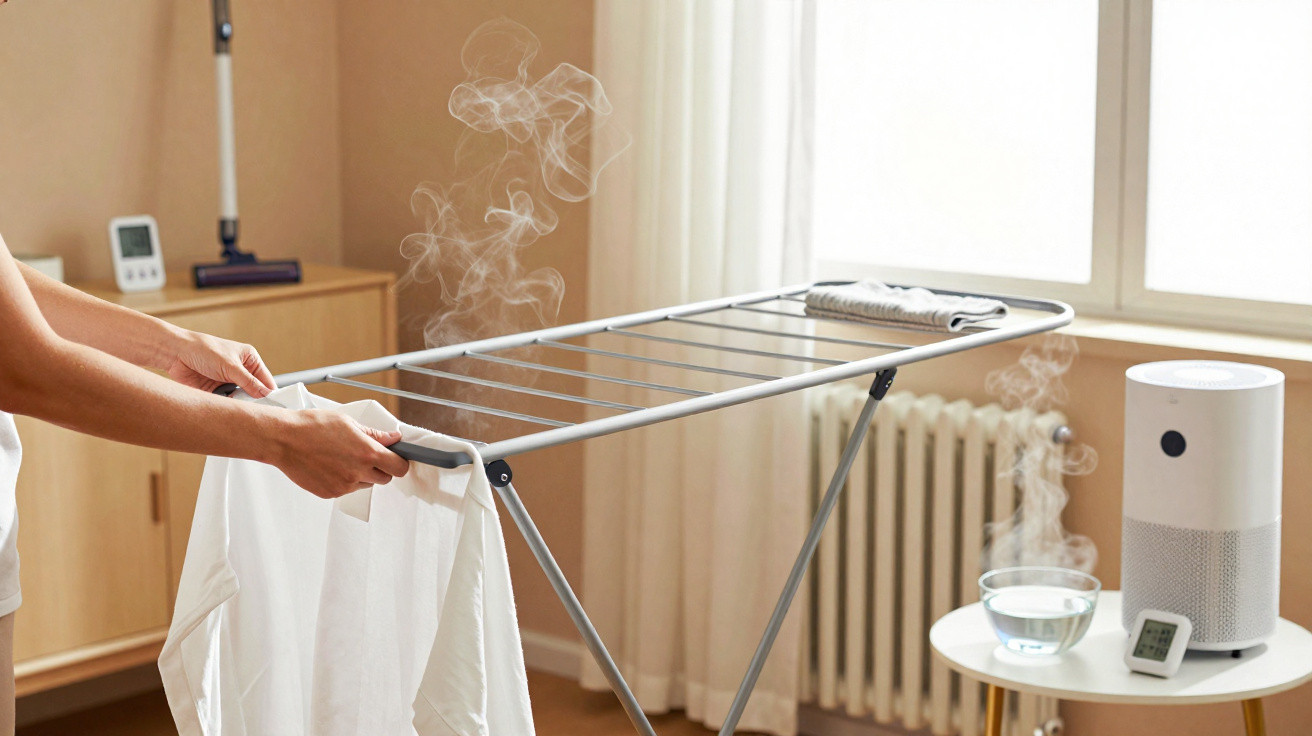
The drying rack is pressed up against the living-room radiator, with socks hanging down like weary flags and a line of damp T-shirts gradually sending steam into the room.
The space feels warm, slightly misty and almost soothing. Beyond the windows, the sky is dark and grey-the sort of day when washing would not dry outdoors anyway. Indoors, the radiators have two jobs: heating the home and doing their best to dry your jeans before the morning. You tell yourself you will wipe the coffee table “one of these days”.
Two days later, the same table appears to have been sprinkled with flour. The TV stand looks even worse. A thin grey coating has formed along the skirting board behind the radiator, while the air has a faintly… stale smell. You open the window for five minutes before shutting it again, because heating costs money and the children are cold. The laundry certainly dries more quickly here. Yet something else is gradually accumulating in the room’s corners.
You cannot watch it happen, but you do inhale it.
Why your “clever” drying trick is quietly feeding the dust monster
Drying clothes beside radiators can initially seem like a handy household shortcut. There is no tumble dryer and no energy-hungry appliance humming away all evening. Instead, there is a warm radiator, a folding drying rack and tomorrow’s work shirts hanging obediently in a row. You can hear the gentle sound of evaporation and feel the humid warmth against your skin. It looks like domestic efficiency at work.
The drawbacks emerge only over time. The air becomes more oppressive. Windows steam up more regularly. Shelves need another wipe sooner than they did the previous week. None of the additional moisture drifting around the room simply disappears; it attaches itself to microscopic particles that are already present. Skin cells, fabric fibres, pollen, cooking soot and pet dander all become more adhesive, gather into clumps and settle across surfaces. That is your “mystery dust”.
Picture the air as a packed train carriage. Turning up the radiator while placing an entire load of washing beside it adds invisible passengers in large numbers: water vapour and tiny fibres released from the material as it heats up. Clothing continually sheds fibres, particularly synthetic fabrics. Because garments dry more rapidly beside a radiator, more fibres can come loose in a shorter period, rising on the warm air currents that radiators naturally produce.
These currents travel in cycles: heated air rises above the radiator, moves across the room, cools and then drops back down along the walls and furniture. Every cycle works like a conveyor belt, transporting fibres and household particles wherever the air travels. Increased humidity makes the particles more likely to bind together and adhere to surfaces, leaving thicker and more noticeable layers of dust. More concerningly, some particles remain airborne and can travel deep into your lungs.
Small changes to reduce dust while keeping your radiator routine
There is no need to get rid of the drying rack or buy a smart dehumidifier costing half a month’s rent. Begin with one straightforward rule: reduce the “wet zone” around radiators. Position the rack at least 50 cm from the radiator. This modest distance interrupts the strongest flow of hot air, meaning fewer fibres and moisture droplets are propelled directly into the room. Your clothes will still dry, albeit a little more slowly, and the air will be far cleaner.
Next, approach ventilation as you would brushing your teeth: brief, frequent and essential. While washing is drying, open two windows on opposite sides for 5–10 minutes, preferably twice daily. This rapid exchange of air removes moisture and airborne fluff without allowing the walls to become cold. During especially cold or polluted weather, leave one window slightly open in its vent setting and run the bathroom extractor fan or kitchen hood on low for 10–15 minutes to maintain air circulation.
Where possible, designate one “sacrificial” room for drying clothes. Keep its door shut, leave the window slightly open, lower the radiator by one setting and allow the rest of the home to remain quieter and less dusty. In that space, hang shirts and dresses on hangers so that the fabric falls open and long rather than folding over drying rails. They will dry faster and shed fewer tangled fibres in one area. A small, quiet desk fan placed on the floor and directed away from the clothes can keep air circulating without blowing lint into your face.
Let’s be honest: nobody genuinely does all of this every day. You are unlikely to monitor humidity like a laboratory technician or use a tape measure to check the precise gap from the radiator every time. Instead, focus on routines that remain manageable when you are exhausted and balancing everything else. Try to maintain a small space between the rack and the radiator every time. When washing is drying, try to give the room a quick 5-minute “air reset” once a day.
Do not make the familiar error of cramming the rack so full that clothes overlap into a thick wall of fabric. If air cannot move between garments, they remain damp for longer, giving fibres and musty odours more time to develop. Divide heavier items between two drying sessions, or combine them with lighter garments so the load has more room to breathe. If you have a tumble dryer, even a brief 10–15 minute pre-dry cycle before using the rack can capture substantial lint in the filter rather than leaving it on your shelves.
Be gentle with yourself when it comes to cleaning. A fast weekly wipe using a microfibre cloth over radiator tops, window sills and TV stands takes only a few minutes, but significantly reduces the worst dust accumulation. In a difficult week, even doing it once every two weeks is better than not doing it at all. The aim is not a perfectly spotless house; it is reducing the number of particles circulating in the air you breathe.
“Indoor dust isn’t just dirt,” explains one environmental health researcher I spoke to. “It’s a moving archive of your home life: what you wear, how you heat, how you cook. When you dry clothes on radiators all winter, you’re quietly rewriting that archive to include more fibres and moisture.”
That “archive” is especially important for people living with asthma, allergies or recurring coughs. Your lungs encounter these particles every day, particularly in bedrooms, where radiators and drying racks often occupy the same limited few square metres. Minor routines can have a meaningful effect over an entire season. An inexpensive hygrometer can be revealing: when humidity rises above 60–65%, it quickly becomes clear why dust and that subtle damp odour tend to appear together.
- Keep drying racks at least 50 cm away from radiators
- Ventilate for 5–10 minutes twice daily while laundry is drying
- If possible, use a separate drying room with the door closed
- Maintain humidity at roughly between 40% and 60%
- Wipe important surfaces weekly with a microfibre cloth
The overlooked comfort compromise - and why “never dry indoors” is not the solution
There is an unspoken compromise involved. In winter, radiators provide dependable heat that is already running, while many households have neither outdoor drying space nor a tumble dryer. On a rainy November evening, the decision can feel like a choice between clothes that stay damp indefinitely and dry washing with more dust. It is hardly a glamorous concern, but it affects how your home feels and smells, and even how easily you get to sleep.
The emotional side of this is rarely acknowledged. After a long weekday evening, carrying washing into another room or opening chilly windows can feel like one task too many. With a limited budget, paying for a dehumidifier or extending heating hours may sound unachievable. Most people therefore make do: a drying rack in the living room, a towel placed straight over the radiator, or a window opened only once condensation becomes worrying. It works “well enough” until the coughing season arrives and the dust abruptly becomes obvious.
The meaningful change happens when dust is no longer viewed purely as a cleaning problem, but as an air problem. Air cannot be seen, yet its quality forms the background music of life at home. Adjusting how and where you dry clothes is not about pursuing perfection. It is about gently changing the pattern: slightly fewer fibres, slightly less moisture and less of that odd winter heaviness in the air. Small actions repeated for months can create a different sort of comfort.
You could send this to the friend constantly battling condensation on their windows, or to the neighbour whose child’s asthma worsens every October. Or you could simply move the rack away from the radiator tonight, open a window for ten minutes and see how the room smells the following morning. These are quiet, modest steps. Nevertheless, they can gradually change how your home breathes.
| Key point | Detail | Why it matters to the reader |
|---|---|---|
| Radiators increase dust formation | Heat from radiators lifts textile fibres and combines them with particles already in the air | Helps explain why rooms seem dustier during the heating and laundry season |
| Humidity is the hidden accomplice | Moisture from wet clothes causes particles to clump and settle on surfaces and in lungs | Explains why controlling moisture reduces both dust and that “stale” smell |
| Small habits alter the air | Moving racks, ventilating briefly and light weekly dusting limit build-up | Offers realistic measures for busy everyday lives without major spending |
FAQ:
- Does drying clothes on radiators really create more dust, or is it just a myth? It generally does increase dust, as heated air currents lift fibres from clothing and distribute them around the room, while extra humidity helps particles join together and settle.
- Is it dangerous for my health to dry clothes indoors? For most healthy people, it is chiefly a matter of comfort, but for anyone with asthma, allergies or vulnerable lungs, added moisture and particles may aggravate symptoms over time.
- What’s better: a tumble dryer or a rack near the radiator? A tumble dryer with a clean lint filter generally sends fewer fibres into your living area, though it uses more energy; a drying rack is cheaper but may raise dust levels unless you ventilate and leave sufficient space.
- How far should I keep my clothes from the radiator? Leaving around 50 cm allows clothes to benefit from warmth without placing them in the strongest hot airflow, reducing fibre and moisture bursts into the room.
- Will a dehumidifier solve the dust problem on its own? It can help by managing moisture, but you still need simple measures such as avoiding overloaded racks, wiping important surfaces and bringing in fresh air whenever possible.






Comments
No comments yet. Be the first to comment!
Leave a Comment