
The washing machine droned in the low light of a winter afternoon, on one of those days when the sky resembles an old grey blanket.
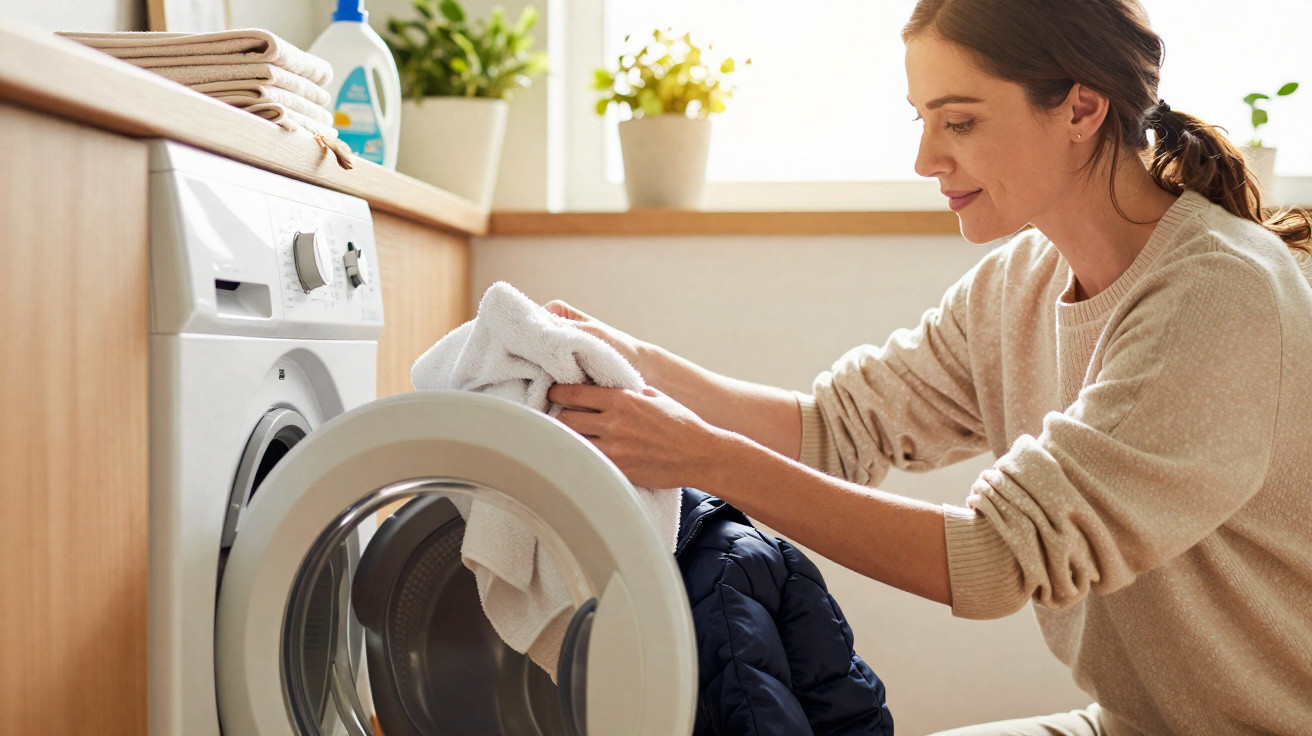
In a compact kitchen, a woman wearing thick socks bent over her front-loading machine and carefully tucked a bulky, sagging down jacket inside. She then did something that would make plenty of people pause: she added one bath towel, loosely folded in two, as though it were a final secret ingredient.
Her daughter, watching from the doorway, looked puzzled. “Why the towel, mom? Isn’t the jacket enough?”
Her mother gave a small shrug and smiled with the calm assurance of someone who has ruined a few coats and learnt the hard way. After pressing start and hearing the first rush of water, she said: “The towel will do what the machine can’t.”
What that towel actually achieves is more unexpected than it first appears.
Why a simple towel changes everything for a down jacket
If you have ever taken a down jacket from the washing machine and felt your stomach sink, you are far from alone. The material is twisted, the feather filling has shifted into strange lumps, and the coat feels heavy and soaked, rather like an injured animal. In that moment, it is easy to wonder whether you have just destroyed the warmest item you own.
Many homemakers - along with an increasing number of detail-oriented dads - have quietly created their own washing rituals. One of the most intriguing is the “towel trick”: placing a large cotton towel in the drum alongside the jacket. It may seem arbitrary, but it is anything but. The towel alters the way water circulates, how the jacket rubs against surfaces and how the load behaves during spinning.
Amid the unseen chaos inside a washing machine, the towel acts as a sort of bodyguard for your coat.
Consider Claire, 42, who says she has “killed” at least two costly down jackets in her twenties. She recalls washing a new white parka while following the care label exactly, like a conscientious pupil: cold water, a delicate setting and mild detergent. When she opened the machine, the feathers had collected into wet balls at the sleeve ends and around the pockets. The outer material was undamaged, but the jacket had lost roughly half of its volume.
Years afterwards, after speaking to a neighbour who had once worked in a launderette, she tested the towel trick. She used the same machine, detergent and programme. The sole change was an old, thick bath towel in the drum. This time, the jacket emerged noticeably less crushed and tangled. The down still required gentle shaking and slow tumble drying, but the filling was distributed more evenly and the coat looked much more like its former self.
She also began to spot other benefits: fewer persistently wet areas, a reduced drying time and less dread whenever she pressed “start”. That minor adjustment made laundry day feel less stressful and more reassuring.
The explanation is rooted more in physics than magic. A down jacket may be light and lofty, but when drenched it turns into a limp, dense bundle that can easily cling to the drum. Water and detergent may collect inside broad areas of fabric. The garment strikes the metal more forcefully and twists around itself, while the down gathers in pockets where moisture remains trapped.
The towel interrupts this cycle. Early in the wash, it takes in a substantial amount of water, meaning the jacket is not sitting in its own saturation. It creates soft friction that encourages the coat to move rather than stick flat against the drum. In the spin cycle, it helps balance the load and draw moisture from the filling. With less water, there is less weight pressing on the feathers, less compression and fewer large clumps.
It is a modest intervention in a powerful mix of water and movement, but it can be enough to alter the outcome for a favourite winter coat.
How to use the towel trick without ruining everything
The technique is remarkably straightforward. First, close every zip on the down jacket and fasten any poppers or buttons. If the outer fabric is delicate or glossy, turn the garment inside out. Pick a large, clean cotton towel that does not shed fluff and is about the same size as the jacket, or slightly larger, when both are laid flat.
Put the jacket into the drum, spreading it out as far as you can rather than scrunching it into a ball. Next, add the towel loosely folded or rolled, allowing it enough room to move. Use a small amount of liquid detergent - preferably one designed for delicates or down - and avoid fabric conditioner. Select a gentle or delicate cycle with cold or lukewarm water and a moderate spin speed. Let the machine run, even if the combination of towel and jacket looks unusual through the door.
The towel absorbs some of the water while cushioning the impacts during tumbling, much like a large cotton buffer.
There are several mistakes people make, usually while trying to be extra careful. Adding two or three towels, for example, creates an overly heavy load. The appliance can struggle to balance it, causing poor spinning or preventing it from spinning altogether. Choosing a very hot wash “to disinfect better” is another common instinct. Heat can weaken some synthetic outer shells and distort seams or protective coatings around the down.
Others cram the machine full: jeans, bath mats, children’s clothes and the unfortunate down jacket squashed beneath it all. In that situation, the towel cannot do its job. The jacket genuinely needs enough room to move and breathe. Then there is drying. Taking out a damp coat and leaving it on a hanger in a dark hallway, in the hope that it will be dry by morning, often leads to stubborn clumps and sometimes a slight musty odour.
Let’s be honest: nobody really does this every day. No one is washing down jackets every week with military precision. These washes are infrequent, which is precisely why it is important to get them right.
“Think of the towel as a dance partner for your jacket,” laughs Anna, a former laundromat worker. “On its own, the jacket either sticks to the wall or gets slammed like a rag doll. With the towel, the movements are softer, more even. The drum becomes less brutal, more like a guided tumble.”
For drying, Anna follows the same principle. She lightly presses out excess water by hand without wringing the jacket. She then puts it in the tumble dryer on a low heat with two or three clean tennis balls or dryer balls, stopping the machine now and then to shake the coat and separate clumps with her fingers. Combined with the towel trick during washing, this method brings back much of the jacket’s original loft.
- Use one large cotton towel, rather than several heavy towels
- Pick a gentle programme with cool or lukewarm water
- Avoid fabric conditioner and aggressive detergents
- Leave sufficient space for the jacket to move around the drum
- Dry gradually, pausing to shake and fluff the down
The emotional side of a “simple” laundry trick
This towel ritual involves more than looking after fabric. It also addresses the low-level worry that comes with washing an expensive item that is not easy to replace: the coat that has seen you through three winters, the parka bought in a sale after weeks of deliberation, or the jacket that keeps your child warm at the bus stop while you try not to remember its price.
In practical terms, the towel trick is about making what you already own last longer. It puts less strain on seams, reduces harsh movement in the drum and limits the water compressing the feathers with every spin. Over time, that can mean a jacket that retains its shape, continues to insulate properly and does not become lumpy after two seasons. It is maintenance as quiet resistance to the idea of “buy, use, replace”.
On a human level, washing a down jacket is often one of those mildly daunting tasks that lingers on the weekly list. You know it needs doing before the next cold snap. You know the coat carries a faint smell of city air and the previous year’s rain. You also know it may not emerge unchanged. We have all had that moment when the machine door opens and a quiet “please” slips out under our breath.
The towel cannot promise a perfect result, but it improves the odds. It is a small, almost caring gesture towards something that protects you quietly throughout winter. Like so many household tips handed from one person to another, it comes with a story: advice from a neighbour, a mother’s habit or a tip found online at 11 pm in a panic before the first snowstorm.
The next time you hear your winter coat thudding during the spin cycle, you may imagine that towel working quietly in the background - absorbing, cushioning and guiding. It is a small character in the story of your laundry, yet one that can mean the difference between relief and regret. An ordinary bath towel, unexpectedly promoted to guardian of your warmest days in cold weather.
| Key point | Detail | Benefit for the reader |
|---|---|---|
| The role of the towel | The towel absorbs excess water and cushions impacts inside the drum | Reduces the risk of clumped feathers and a misshapen jacket |
| Programme selection | Delicate cycle, cold or lukewarm water, and a small dose of liquid detergent | Protects the outer fabric and the structure of the filling |
| Controlled drying | Slow drying, gentle heat and pauses to shake and aerate the down | Preserves the coat’s loft and thermal comfort |
FAQ:
- Can I wash a down jacket without a towel? You can, but the risk of clumping and uneven drying is higher. The towel adds absorption and gentle friction, which usually leads to a better result and less stress on the jacket.
- Does the towel trick replace tennis balls in the dryer? No, they work at different stages. The towel helps during washing and spinning. Tennis balls or dryer balls help in the drying phase to break up clumps and restore loft.
- What type of towel should I use? A large, clean, cotton bath towel that doesn’t shed lint is ideal. Avoid very small towels, microfibre cloths that stick to fabric, or very heavy, saturated towels that overload the drum.
- How often should I wash a down jacket? Most people wash a down jacket once or twice a season, sometimes less. As long as it doesn’t smell, isn’t visibly dirty and still insulates well, there’s no need to wash it frequently.
- Is it safer to use professional dry cleaning instead? Some labels recommend professional care, especially for technical or very high-end jackets. Yet many everyday down coats handle home washing fine when you follow gentle settings, the towel trick, and proper drying.


Comments
No comments yet. Be the first to comment!
Leave a Comment