
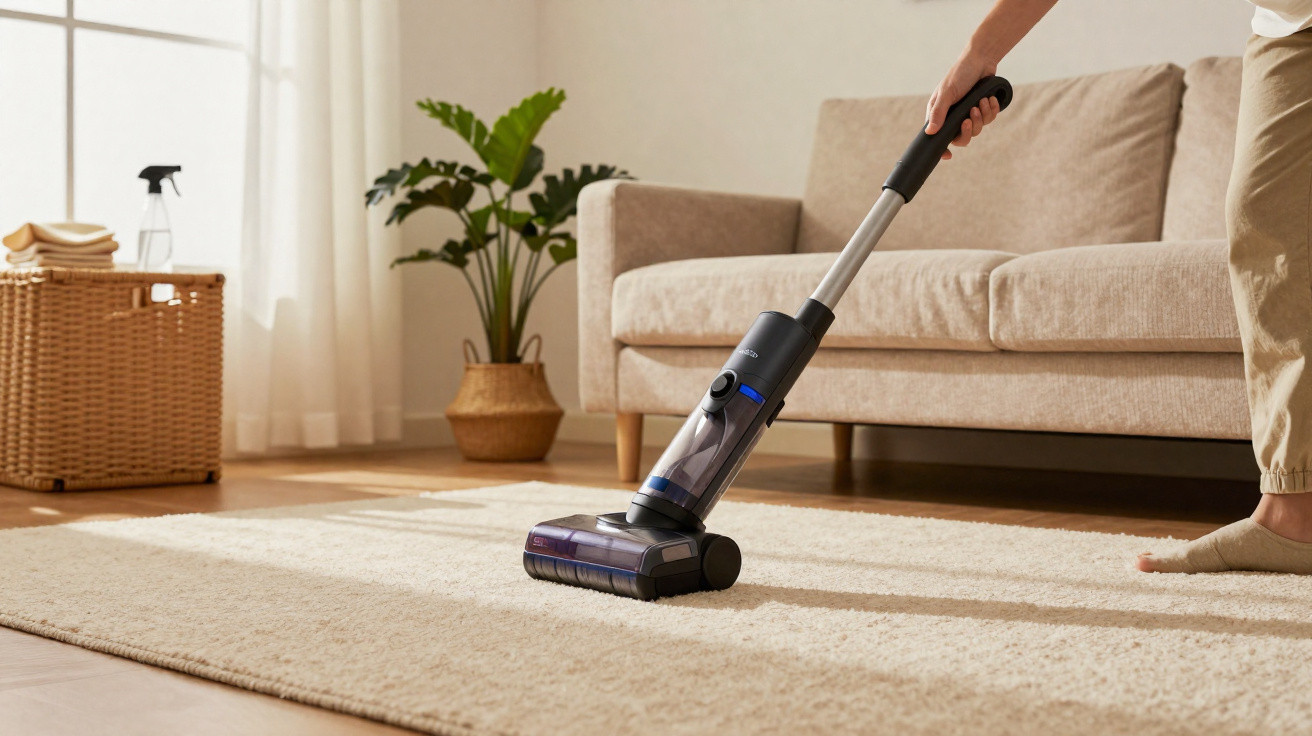
You pull out the vacuum, let out a sigh and look across the living room as though it were a small battleground. There are crumbs beside the sofa, dust lining the skirting boards and that strange grey patch beneath the coffee table. You promise yourself, “I’ll just do a quick pass,” while part of your mind is already judging how “clean” the room is likely to feel.
Then there is the small choice most people barely notice: where should you begin?
On some days, you start at the doorway and push the vacuum forwards like a snowplough. On others, you make for the furthest corner and work backwards towards the exit. It is the same room, the same dirt and the same appliance. Still, when you switch the machine off, the satisfaction you feel can be completely different.
The direction in which you begin has already shaped the ending.
The surprising effect of your first cleaning move
Pay attention to yourself the next time you vacuum or sweep. There is a brief pause before your body picks a direction. Perhaps you naturally begin by the door because it seems “logical”. Or perhaps you tackle the worst patch first because it is bothering you too much to ignore.
That opening move creates a pattern.
Your brain draws a small mental map of the space, while the route you take quietly answers a question you never say aloud: am I only skimming the surface, or am I cleaning this properly today? The overlap of the vacuum lines and the way dust collects in the dustpan are both affected by the place where you started.
Picture two weeknights after work.
On Monday, you hurry in, put down your bag and begin vacuuming in the middle of the room, weaving between toys and chair legs. After five minutes, you stop. The floor is not terrible, but it somehow feels… incomplete. You spot neglected corners, stray crumbs beneath the radiator and a section missed next to the sofa.
On Thursday, you begin in the far corner behind the armchair and work carefully, lane by lane, towards the door. You spend the same five minutes, use the same vacuum and face a similar amount of mess. This time, though, you leave the room with a calm, almost smug feeling. You have not cleaned for longer; you have simply taken a route that tells your brain, “We covered this.”
This is because the brain does not measure cleanliness purely by how little dust remains. It also responds to the story.
Starting in a corner and travelling steadily in one direction creates an understandable sequence: beginning, progress, ending. Your eyes register carpet tracks or organised areas of flooring, and your brain interprets them as a before-and-after image. Beginning at random or moving in circles communicates something far less orderly.
You may pick up exactly the same amount of dirt, but your internal scorecard can still suggest that something was overlooked. The route you take, rather than only the effort you put in, influences how thorough the job feels. That feeling determines whether you think, “This room is done,” or, “Ugh, I’ll have to redo this soon.”
A more satisfying way to vacuum and clean
One modest habit can make a substantial difference: start at the point furthest from the exit, then work back towards the door.
When sweeping, this means gradually bringing everything towards one collection point near you instead of pursuing crumbs in circles. When vacuuming, imagine the floor divided into rows or “lanes” and travel through them methodically.
It is not about rigid military precision. It is about providing your brain with visible proof of coverage. If you stand back and see straight or softly curved routes all leading out of the room, your mind sees a “completed route” rather than a “random sprint”.
The familiar pitfall is the “oh, I’ll just do that bit” method. You deal first with the obvious mess under the table, then notice hair near the bathroom, followed by crumbs beside the counter. Ten minutes later, you are tired, mildly irritated and left with a room that appears half-cleaned.
We have all had that moment of holding the vacuum while looking over the floor and wondering, “Did I already pass here?” That uncertainty ruins the satisfaction. You have put in the work, but you no longer trust it.
Honestly, nobody follows this approach every day without fail. That is precisely why a straightforward, repeatable direction is useful when you do clean. It prevents the nagging feeling of, “I worked hard, but it still doesn’t feel clean.”
You do not need an elaborate system, only a small rule of your own. One person interviewed for this article, a busy nurse with two children, described her method in a single sentence:
“Start in the corner that annoys you most, then don’t break the line until you reach the door.”
She says it transformed how cleaning feels, even when she has just ten minutes available.
To make this practical, consider the room in these terms:
- Choose a “start corner” and begin there every time.
- Work in parallel lines or distinct zones rather than circles.
- Sweep or vacuum towards one clear collection point.
- Only move back into sections you have already cleaned.
- End with a final pass by the door as a mental “full stop”.
These small decisions create a visible account of your effort, and that account is what can make you unexpectedly proud when you turn the vacuum off.
Cleaning as a small story worth feeling proud of
Once you see how direction affects your sense of “thoroughness”, you may notice the same pattern elsewhere: when wiping a kitchen worktop, folding laundry or clearing a desk. You either act randomly, following whatever catches your attention, or follow a quiet route with a beginning and an end.
One approach leaves you partly finished, checking your phone while thinking, “I should really finish that.” The other makes you feel more at ease because the task has a visible endpoint. Your brain likes endings; it settles when a story is complete.
Over the next week, try observing your own habits. When sweeping the hallway, do you begin close to the door or at the far wall? How do you feel once you are finished? When vacuuming the bedroom, do you make deliberate rows or merely target clumps of fluff?
You may discover that, on days when you start “in order”, you walk away more satisfied, even when the cleaning itself is brief. The dirt may be much the same and your energy may be limited, but the direction gives you a small feeling of control. Often, that is what we are truly looking for when we pick up a broom.
There is no single correct direction for everyone, only one that tells your brain, “I did this properly, for today.” Some people will always start by the window, others at the sofa and others at the very back of the room.
What matters is that your route feels like one continuous line, not a scribble. You are not merely removing dust; with your movements, you are creating a small, satisfying story. Once you notice the difference, starting to clean a room will no longer feel quite so random.
| Key point | Detail | Value for the reader |
|---|---|---|
| Begin at the furthest point | Start in the corner opposite the exit and work back | Creates a clear “start to finish” feeling |
| Use rows or zones | Vacuum or sweep in strips rather than random patches | Reduces missed areas and second-guessing |
| Finish at the door | Complete a final pass close to the exit | Provides a mental full stop and greater satisfaction |
FAQ:
- Does the direction really matter if the room looks clean? The dirt may be gone whichever method you use, but your brain responds to the path you followed. A clear, consistent direction makes you more certain that areas have not been missed.
- Should I always start in the same corner? A “default” starting corner helps turn the process into a habit. Eventually, your body almost works on autopilot, so you do not spend energy choosing where to begin.
- What if I don’t have time for full rows? Even with only five minutes, choose a distant corner and work roughly towards the door. The route does not need to be perfect, provided it has a start and an end.
- Does this work in tiny rooms or studios? Yes. In compact spaces, use zones instead of rows: the bed area, table area and entrance. Move through them in one direction instead of jumping back and forth.
- How do I stop getting distracted mid-clean? Set one simple rule: do not leave the row or zone you are working on until it is complete. That small boundary stops your attention from chasing every new patch it notices.


Comments
No comments yet. Be the first to comment!
Leave a Comment