
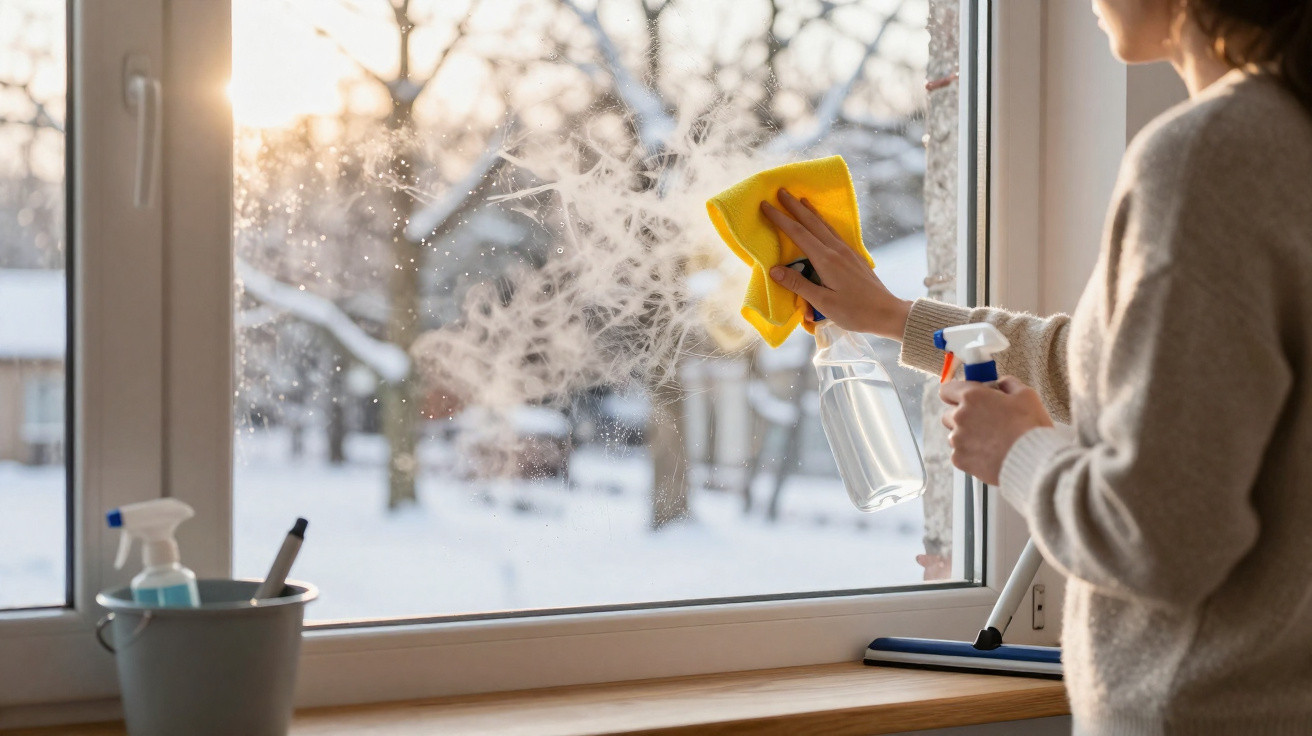
You spray the cleaner, wipe it away with a cloth, then stand back to inspect the result… only to find them. Long, pale streaks picked out by weak winter daylight, as though a damp paintbrush had been pulled across the pane. Indoors, it is warm: the heating gives off a gentle hum and the kettle whistles. Beyond the glass, the air is sharp and motionless, the sort of cold that catches your nose as soon as you crack open the window.
All you wanted was an unobstructed view of the grey sky and leafless branches.
Instead, the windows look even worse than they did before you cleaned them.
The odd part is that you did everything “properly”. You used the same product and followed the same method that works in spring. Winter, however, plays by different rules. During those quiet minutes when cleaning water remains on the glass without fully drying, streaks begin to form.
Why winter windows become streaky even after careful cleaning
Glass reacts differently on a cold day. Although the room may feel comfortable, the pane itself is cold beneath your fingertips, and each drop of cleaner cools as soon as it touches the surface. The water from your spray bottle does not evaporate quickly as it would in July. It stays on the glass as a thin, glossy layer.
As that layer lingers, dust, minute traces of grease and leftover soap settle into it. Rather than disappearing immediately, they are moved around by your cloth. This is what creates those long, muted lines that emerge when daylight catches the window from an awkward angle. Cold air does more than delay drying: it gives streaks time to arrange themselves.
Picture a January afternoon. Someone in a city flat decides to clean the balcony door “quickly” before visitors arrive. Because the glass is particularly dull, they apply plenty of spray, then move a paper towel in wide circles to spread the liquid around.
Ten minutes later, as low sunlight passes between two buildings, the evidence is unmistakable: narrow vertical stripes, a halo at eye height and a large hazy area near the handle. They reach for a dry cloth, scrub more forcefully and even breathe on the pane as though cleaning a phone screen. Yet every extra rub divides the marks into fresh lines. The doorbell rings while they are still battling that very same window.
A straightforward piece of physics sits behind this familiar irritation. The rate at which water evaporates is affected by temperature, air circulation and the amount of moisture the air can still take in. Winter air can be dry, but cold glass and limited movement of air around the pane still slow the process.
Your cleaning solution remains there and gradually separates into water, alcohol, surfactants and the dirt you have lifted away. Part of that mixture dries where it sits, leaving fine, nearly undetectable trails. These tracks become noticeable only when light falls across them at a shallow angle. This is why windows may appear spotless at night but look dreadful once the first weak winter sunshine arrives.
How to clean winter windows without leaving a single streak
The key winter technique is to move quickly while using as little liquid as possible. Rather than soaking the entire pane with spray, lightly mist a small area, or apply the product straight to your cloth or squeegee. The aim is to limit the water that can remain on, and cool against, the glass.
Begin at the top, working downwards in firm, straight strokes. Every stroke should remove the used liquid immediately rather than allowing it to pool. Clean the squeegee blade or cloth after each strip so that dirty water is not pulled back across the window. Once an area is complete, take a separate, completely dry microfibre cloth around the edges, where droplets commonly collect.
Paper towels are a trusted choice for many people, but they can cause problems on cold glass. They shed fibres, and these tiny fibres hold moisture for just long enough to leave marks. In chilly conditions, a close-woven microfibre cloth or a proper window squeegee is much more forgiving.
Using too much soap is another understated cause. A small dash of washing-up liquid in warm water will do; add too much and you are effectively coating the pane with an invisible layer that will dry as streaks. Realistically, no one carefully measures every drop each time. Still, if your windows shine for ten minutes before tracks slowly appear, leftover product is often the culprit.
On a January morning, professional window cleaner “Marc, 17 years on ladders and scaffolds,” summed it up in one sentence: “Glass doesn’t care how hard you rub, it cares how fast you get the dirty water off.” He refuses to overload the pane in winter. “Cold glass is unforgiving. Use less water, better tools, and be done with it before it cools down on you.”
- Use barely-warm water – Keep it only slightly above room temperature, rather than hot, to avoid condensation that causes fogging and streaks.
- Work in smaller sections – Work from top to bottom with one or two strokes, then dry the edges immediately.
- Choose the right time of day – Late morning or early afternoon is ideal, when the pane is not freezing cold and daylight makes marks easier to see.
- Swap paper towels for microfibre – It produces less lint, absorbs better and requires less cleaning product on the glass.
- Finish with a dry polishing cloth – A brief, gentle buff lifts the final thin layer that might otherwise turn into lines as it dries slowly.
Winter light, glass and persistent window streaks
Winter tends to highlight every imperfection on a window. The sun sits lower, daylight hours are shorter and the angle of light is more severe. Each fingerprint and half-removed smudge can suddenly resemble a neon sign on the pane. Noticing a streak can bring a small sense of defeat, particularly after you have already spent time and effort cleaning.
There is, however, something reassuring about understanding the slow-evaporation explanation. It changes the thought from “I’m bad at cleaning” to “cold air rewrites the rules of water.” That slight shift can make the next clean feel less pressured: more like a modest winter ritual, and less like a test you might fail.
We have all experienced that point when you wonder, “How can a simple pane of glass make me feel this incompetent?” You tilt your head, squint at the surface and try a new angle or another cloth. The window starts to reflect more than daylight; it mirrors your mood, exhaustion and impatience.
When you know that streaks often develop because cleaner dries too slowly in cold conditions, the situation becomes less fraught. You are not fighting an unexplained curse. You are simply staying ahead of evaporation by applying slightly less product, drying slightly faster and choosing a more suitable time of day.
You might also begin to spot other details: condensation gathering along the lower edges each morning, glass feeling a touch warmer on a sunny afternoon, or city pollution and woodsmoke clinging more noticeably in January. Such small observations can turn window cleaning from an automatic chore into a quiet conversation with your home.
The next time a faint streak appears in late-afternoon sun, you may see it not as a failure but as a clue: evidence that the glass, air and water were having their own subtle exchange. With a few straightforward adjustments, you can welcome in winter light without the drama on the glass.
| Key point | Detail | Value for the reader |
|---|---|---|
| Cold slows evaporation | Cleaning water stays on chilly glass for longer, allowing residues time to create streaks | Explains why winter windows can look worse despite using the same products |
| Less liquid, better tools | Apply light sprays, use microfibre cloths and a squeegee, and tackle small sections | Cuts down marks, makes cleaning quicker and prevents product being wasted |
| Timing and technique | Clean during milder daylight hours, dry the edges and avoid excessive soap | Provides a practical routine for everyday life and keeps windows clearer for longer |
FAQ:
- Why do streaks only appear when sunlight hits the window? Dried residues are almost impossible to see until light strikes them at a low angle, exposing thin films left by slowly drying cleaner or too much product.
- Should I use hot water to prevent winter streaks? No. Hot water may mist up the glass and cause condensation that dries unevenly. Barely-warm or room-temperature water is generally best.
- Is vinegar better than shop-bought window cleaner in winter? Diluted vinegar can work effectively when used sparingly, but leaving too much of it on cold glass can still result in streaks.
- Can I clean windows when it is freezing outside? You can, though it is more difficult. Focus on the inside, use minimal liquid, clean in small sections and avoid products that may freeze on contact.
- Why do my windows mist up after cleaning? Very warm water, or a large temperature difference between indoors and outdoors, can create temporary condensation. If it is not wiped away, it can dry into marks.





Comments
No comments yet. Be the first to comment!
Leave a Comment