
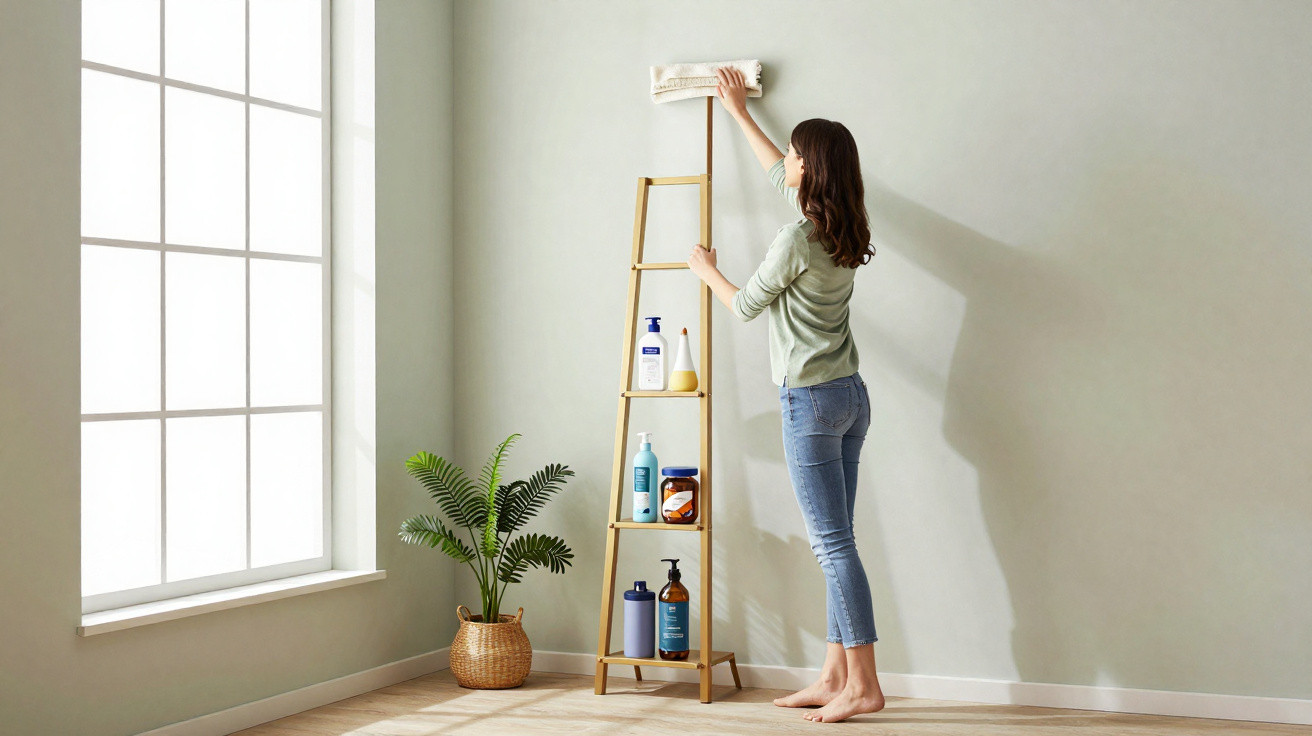
With one hand on the hoover and the other flicking through her phone, she sighed as another layer of dust settled on the floor she had only just cleaned. The thought was almost visible: “What’s the point?”
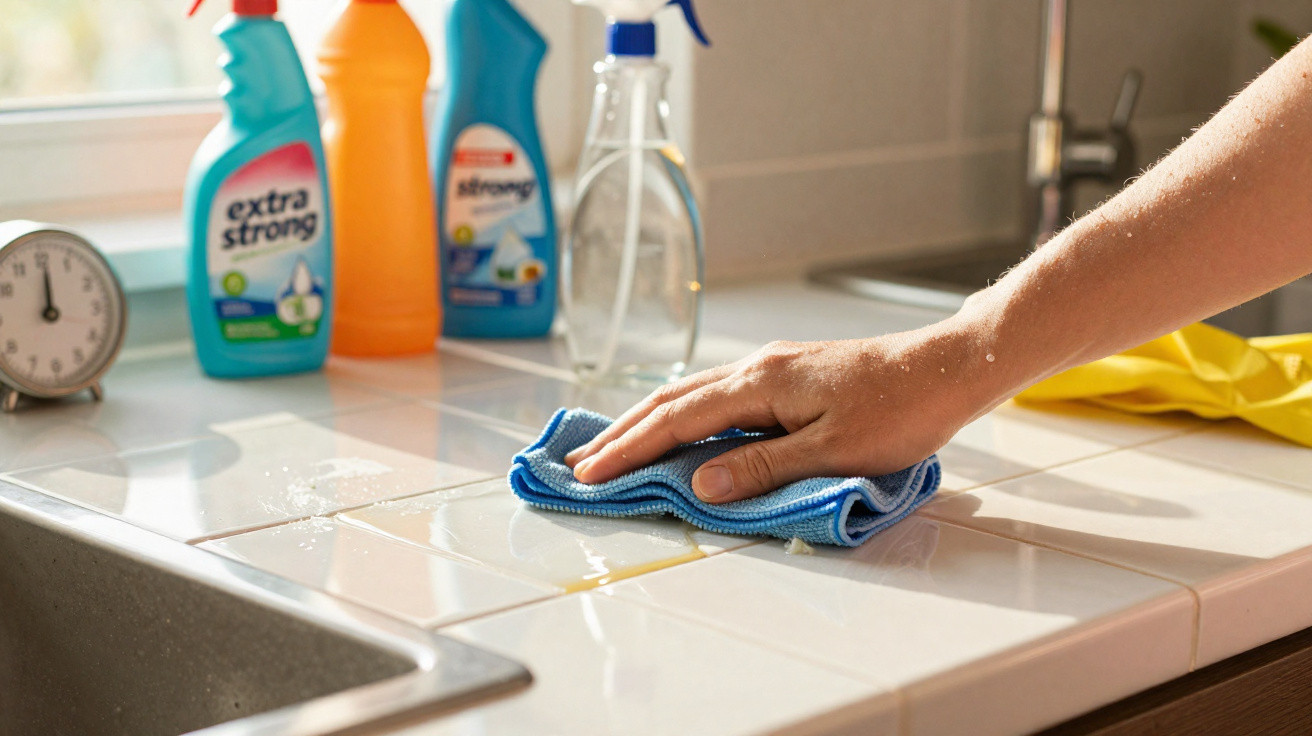
Sprays and cloths stood in a neat row on the kitchen worktop, like miniature soldiers on parade. The counter gleamed, yet the shelves above looked dull and grainy. Whenever she wiped them, fresh crumbs and dust fell from overhead, as though the room were quietly reversing everything she had done.
She was neither lazy nor untidy. She was simply cleaning in the wrong order: from the bottom upwards. That one small mistake was quietly taking more of her time.
Professional cleaners begin at the top and work their way down for a reason. It is not about being “obsessed with cleaning”; it is about physics, tiredness and keeping your sanity intact.
A tiny change of direction can alter how your entire home feels.
Why top-to-bottom cleaning changes everything
Watching somebody clean a room can reveal a surprising amount about them. Some immediately tackle what is most noticeable: the floors, the sink or that clear smear on the hob. Others start with lampshades, picture frames and the tops of wardrobes that hardly any visitor will spot.
The latter group tend to finish sooner, not because they put in more effort, but because gravity is working in their favour. Dust does not rise. Crumbs do not leap back onto shelves. If you begin at the highest point, anything you dislodge lands somewhere you are due to clean afterwards.
That is the entire principle behind top-to-bottom cleaning: each task is done once rather than twice. Nothing returns later to spoil the result.
A recent UK cleaning survey uncovered a telling pattern: most people devote the largest share of their “big clean” to the floors. That is understandable. Floors show every mark. Dogs walk across them, children drop snacks on them, and shoes leave quiet traces of mud and city dust.
However, many people say they dust only after vacuuming or mopping. Each pass of the cloth then releases more particles onto a floor they considered finished. Later, when grit is felt under bare feet, it can seem as if the clean has failed. So the job gets repeated. Then repeated again.
One quiet Sunday morning in a north London flatshare, I saw three housemates follow this exact pattern. One person scrubbed the bathroom floor while another dusted the shelves over the toilet. By that afternoon, the floor needed another going-over. They blamed one another, when the true problem was the sequence of their jobs.
Top-to-bottom cleaning may sound like a catchy phrase, but it is really a way to manage your energy. By dealing with the highest and least-used areas first, you approach them when your body and mind are at their freshest. You are more likely to spot cobwebs in corners, a grey coating on curtain poles or a sticky mark on top of the fridge.
This is not a pursuit of perfection; it is simple logic. Dust is lazy: it drops and settles. Disturb it at the beginning, and it has plenty of time to land on lower areas that you will later wipe, sweep or vacuum.
In terms of time, the calculation is straightforward. Clean the lower parts first and you may need to do the floors twice. Start high instead, and the mess created becomes part of the final stage. It is one pass rather than two. Over a year, those saved hours could be spent doing something more enjoyable than hunting down fluff.
How to use top-to-bottom cleaning without overthinking it
The simplest way to follow this approach is to picture the room as a series of invisible layers. Begin above head height, work down to eye level, then to waist height, and finally to the floor. There is no elaborate checklist and no military-style schedule required.
In real terms, start with ceiling corners, light fittings and cupboard tops. A long-handled duster, or a microfibre cloth wrapped around a broom handle, will do the job. Then move downwards through shelves, mirrors, picture frames and window ledges.
Only after these areas are finished should you turn to tables, chairs, worktops and, at last, the floor. Each part of the room has its turn in the right sequence. Instead of battling against the space, you are working with it.
Let’s be honest: nobody truly does this every day. Real homes are busy, untidy and full of jobs left half-finished. You may only carry out a strict top-to-bottom clean before visitors arrive, or when clutter seems to be murmuring from every corner.
The mistake is assuming that this method is “too much” for everyday life. It can actually be very simple. Even during a quick clean, swapping just two steps has an effect: dust high shelves and surfaces before you hoover, and wipe worktops before mopping.
We have all had the experience of mopping, admiring the result, then seeing the cat jump down from the windowsill and drop a small cloud of fur straight onto the wet floor. Top-to-bottom cleaning cannot stop the cat, but it can reduce how often your work seems to have been undone instantly.
One professional cleaner I spoke to summed it up neatly:
“I don’t clean a room twice. I let gravity help me do half the work.”
It is not about scrubbing with more force. It is about avoiding the need to undo your own work. There is something unexpectedly kind about that way of thinking.
To make the order easier to remember, keep a short visual checklist in your mind, or tape one inside a cupboard door:
- Begin with ceilings, corners and light fittings
- Continue with shelves, frames and other high surfaces
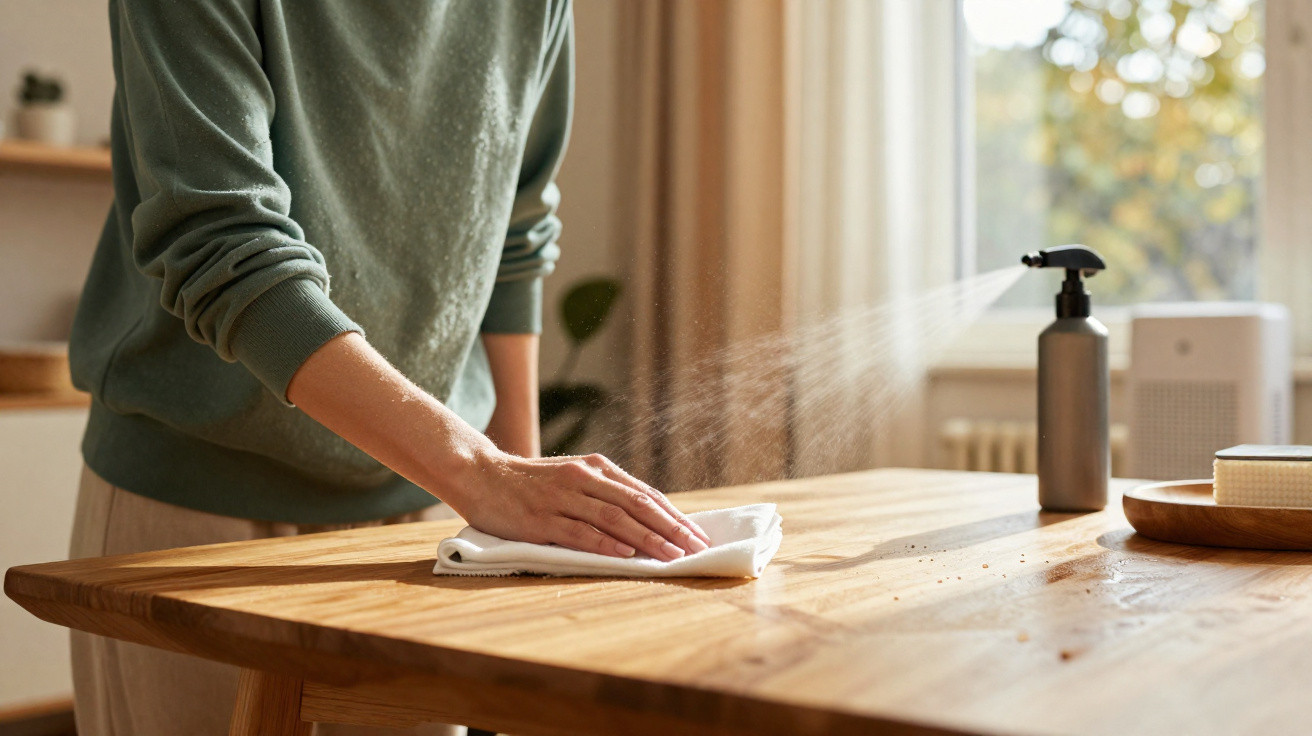
- Wipe tables, worktops and handles
- Finish by hoovering or mopping the floor
This modest order can turn a frantic clean into a calm routine that becomes almost automatic. When your future self enters the room, it simply feels as though it remains clean for longer. That is not magic; it is the result of doing less work twice.
The subtle benefits of top-to-bottom cleaning
There is another aspect to this that is not really about dust at all. It concerns how your own space makes you feel. A room cleaned from top to bottom does more than look better; over the following days, it also stays better behaved.
Once those high, often-forgotten surfaces have been dealt with, less fluff and grime drifts down during the week. Your quick midweek tidy can therefore remain genuinely quick: a fast wipe in one place, a hoover in another, and the job is done. There is no hidden build-up waiting to catch you out.
Top-to-bottom cleaning can also have an unusual calming effect. You travel through the room in one clear direction instead of jumping from floor to shelf, sink and back to floor. That steady, linear progress feels less like firefighting and more like regaining control one level at a time.
You do not need to become “that person who loves cleaning” to appreciate the difference. Even if the sight of a bucket and mop makes you groan, this method values your time. Its message is simple: do it once, do it in order, then get on with living.
Perhaps that is why this straightforward top-to-bottom rule has lasted so long among professional cleaners. It is not because it is fashionable or charming. It works because, when everything else in life feels scattered, it offers one small, dependable and repeatable success.
The next time you pick up a cloth or plug in the vacuum, you do not need a motivational speech or a Pinterest board. Look upwards, begin high and let everything else follow. Your floor will appreciate it. So will your next Sunday.
| Key point | Detail | Benefit for the reader |
|---|---|---|
| Clean from top to bottom | Start with high surfaces and work down gradually | Less duplicated work and a longer-lasting result |
| Work in “layers” | Picture the room as a set of levels to tackle one at a time | A clearer routine with less mental load |
| Let gravity help | Allow dust to fall onto areas that will be cleaned later | Saves time and creates a longer-lasting feeling of cleanliness |
FAQ
- Do I really need to clean ceilings and light fittings? Not every week, but tackling them first from time to time prevents continual dust fall, helping your “normal” cleaning last longer.
- What if I only have 20 minutes to clean? Apply the same rule on a smaller scale: wipe higher surfaces first, then finish with a quick hoover or mop.
- Does this method work in very small flats? Yes, perhaps even more effectively. Dust travels quickly in compact spaces, so top-to-bottom order avoids repeat work.
- Can I combine decluttering with top-to-bottom cleaning? Yes, though keep the tasks separate within each “layer”: clear and wipe shelves before progressing down to tables and floors.
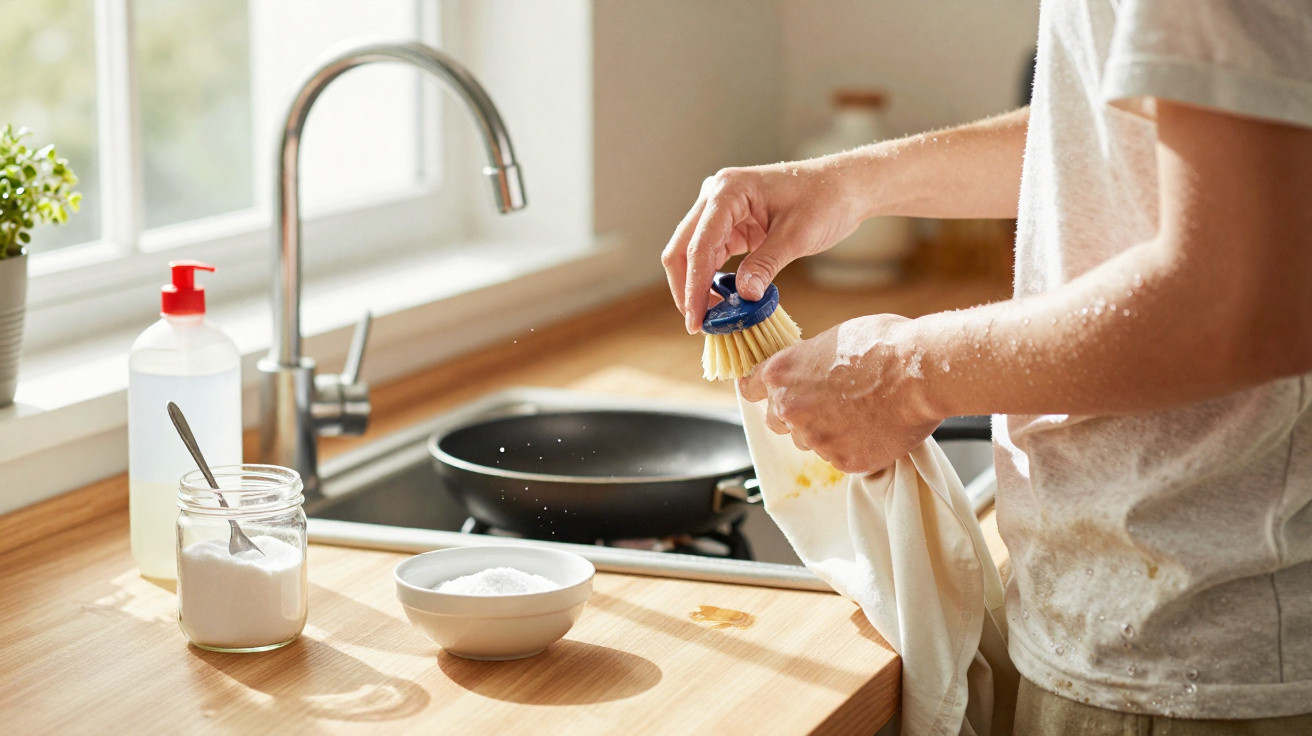
- Do I need any special products? No. A microfibre cloth, an ordinary spray and a good hoover are sufficient. The real difference is the order of cleaning, rather than the tools you use.
Comments
No comments yet. Be the first to comment!
Leave a Comment