
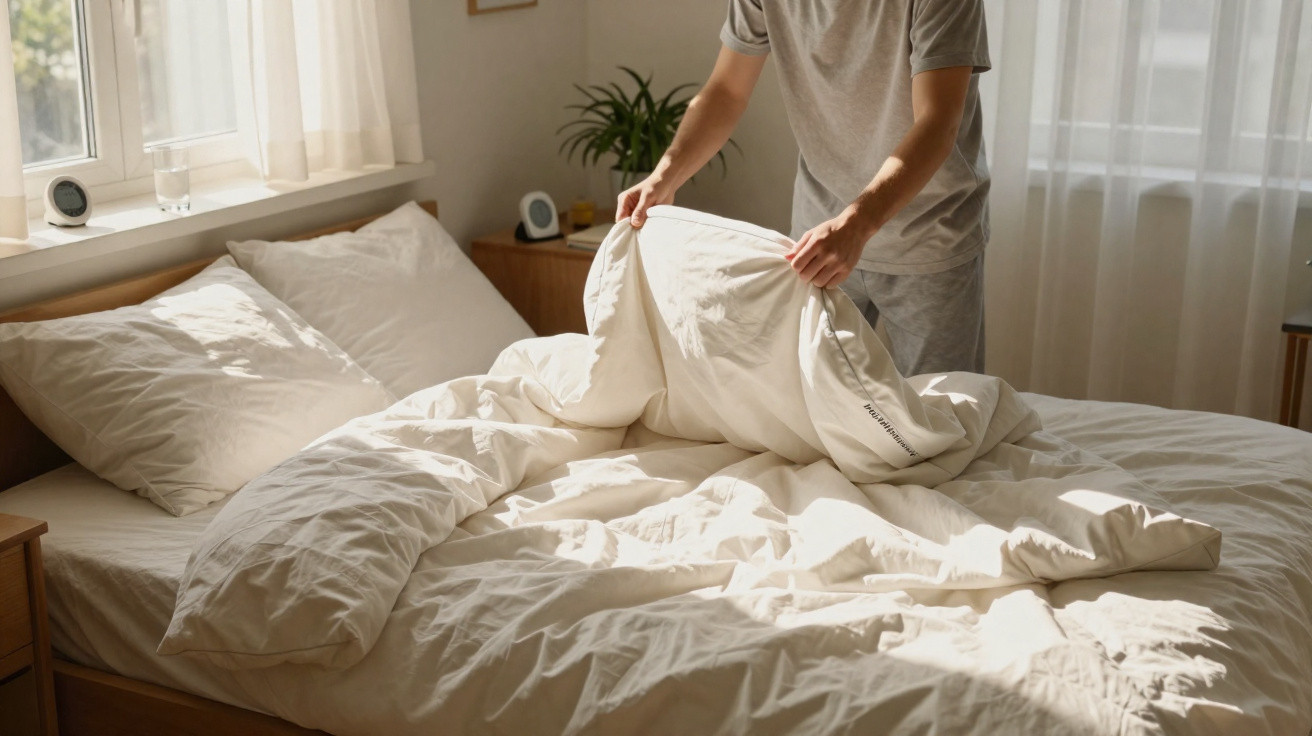
The fine grey line of dust along the mattress. The slightly stale scent that announces, very plainly, “You do not wash me as often as you claim.” You are left standing with the duvet gathered in your arms, picturing a whole microscopic metropolis coming alive while you sleep. It is hardly a pleasant image, particularly once you remember that you rest your face there. Every single night.
We promise ourselves we will wash the sheets more regularly. Every Sunday: clean bedding, a fresh start, the feeling of a reset. Then life intervenes, the washing basket sits sulking in the corner, and a fortnight later you are still sleeping beneath the same creased cotton. Dust mites love this situation. They flourish in our procrastination, our perspiration and the warm dampness we create without meaning to. Yet what if the most effective change was not washing your bedding more frequently at all?
The Bed-Making Habit No One Taught Us
When researchers at Kingston University in London proposed that one straightforward habit could cut dust mites by up to 84%, it attracted very little attention. It seemed too mundane and too low-tech. There were no expensive sprays, antimicrobial silver fibres or subscription bedding companies offering “hotel sleep” in your own home. There was simply one small adjustment to what happens to the duvet each morning.
The advice is this: do not make your bed immediately. Draw the duvet right back, leave the sheets completely uncovered, and allow the mattress and bedding to dry in the air for at least an hour before making everything look Instagram-ready. That is all. No specialist purchase, additional washing or elaborate regime required. Just a daily striptease for the mattress.
It feels almost underwhelming, does it not? We tend to want a miracle product rather than another unglamorous routine. Yet dust mites themselves are exceptionally unglamorous, and they have one firm preference: warm, lightly damp, enclosed environments. If you trap the night’s moisture beneath a perfectly arranged duvet at 7.02 a.m., you are effectively treating them to an all-inclusive spa break.
Why “Ugly Bed First, Pretty Bed Later” Works
Dust mites have no interest in the price of your bedding or whether its tag says “anti-allergy”. What matters to them is humidity and food. Their food is you - or, more precisely, the minute skin flakes you shed without ever noticing. Their perfect habitat is a warm, sheltered microclimate in which body moisture remains caught in the fabric. The neatly smoothed bed that fills you with domestic pride each morning? To them, it is a penthouse.
When you pull everything back and allow air to reach the sheets, that luxury hotel suddenly becomes far less hospitable. The moisture they need evaporates, humidity falls and their soft, protected surroundings begin to dry. As a result, they either die or no longer reproduce with quite such enthusiasm. The research finding of an 84% reduction was not magic; it was simply physics, plus time.
There is something unusually satisfying about that. In this case, the option that looks lazy - leaving the bed open and slightly untidy - is actually the more intelligent and hygienic one. You are not scrubbing, boiling or disinfecting anything. You are merely declining to provide microscopic squatters with the damp, dark conditions they enjoy.
When an Unmade Bed Is More Than “Messy”
Most of us have experienced the moment when an unexpected visitor needs to pass the bedroom door and we make a frantic sideways lunge to pull it nearly shut. An unmade bed has become shorthand for being disorganised, immature or not entirely in control. You can almost imagine your mother’s expression, with that faintly raised eyebrow: “You went to work and left it like that?” Rumpled bedding carries a surprising amount of moral judgement.
However, if allergies trouble you, if your nose starts running as soon as you wake, or if you have an odd morning cough that vanishes by late morning, the apparent disorder may actually be helping. A bed left open to air generally contains far fewer dust mites than one arranged to hotel standard, as seen in advertisements. The thing that makes you feel ashamed could quietly be benefiting your lungs.
For people with asthma or eczema, mornings are often described as the hardest part of the day. Their eyes may be puffy, their throats scratchy and their skin irritated after hours of contact with microscopic allergens. Doctors identify dust mite droppings as a significant trigger, which is both revolting and oddly juvenile-sounding, as though you are being picked on by something invisible. Exposing the bed to daylight and circulating air is not a cure, but it is one practical way to lessen a trigger without relying on medication or perpetual washing.
A Small Domestic Rebellion
There is a quiet satisfaction, too, in making this a daily rebellion against perfection culture. You get up, throw back the duvet and leave the room. No fussing, smoothing or arranging decorative cushions. Just a deliberate decision to value your breathing above another person’s idea of “togetherness”.
Let us be realistic: hardly anyone changes their bedding as often as glossy magazines suggest. Weekly changes sound admirably virtuous until you reach the third week and cannot quite recall when the pillowcase last saw daylight. This habit does not scold you for that. It simply acknowledges that life is full, then offers one small action that can make your bed statistically less welcoming to mites.
There is something quietly generous about a habit that fits around your life instead of fighting against it. The duvet-back routine asks for no time you do not possess. You do it while getting out of bed, then carry on with your day as air and physics get to work unnoticed.
What Letting Your Bed Breathe Actually Means
“Air your bed” can sound rather old-fashioned, like advice from a grandmother hanging sheets in a chilly back garden. In reality, it could not be simpler. Once you wake, take hold of the duvet and either fold it or toss it fully towards the foot of the bed. Reveal as much of the sheet and mattress as you can - as well as the pillows, if you have the inclination.
Open the window if conditions permit, even if it is only a small amount. The aim is not to make your bedroom feel like a wind tunnel; you simply want to encourage a little airflow. Where a window is not practical - because of city noise, cold weather or inquisitive neighbours - leave the door open instead, allowing the room’s air to move around. If you use blinds, angle them to bring in some daylight. Dust mites are not particularly fond of bright, dry conditions.
Then leave it alone. Make breakfast, have a shower, doomscroll or argue with a toddler about putting on shoes. Allow at least 30–60 minutes before returning to make the bed presentable. That is the important part: not whether you prefer precise hospital corners or a casually folded duvet, but whether the bedding has been allowed time to cool and dry before being enclosed again.
What If a Perfectly Made Bed Matters to You?
This is the point at which some people resist. They want to pass their bedroom and see an inviting, smooth duvet rather than an exposed mattress and skewed pillows. It gives them a sense of calm and competence, as though the day has properly started. That feeling is important. A home is not a laboratory; it is where your nervous system attempts to recover from everything else.
Fortunately, you need not abandon that pleasure. Consider it a two-step routine: practical needs first, visual appeal afterwards. For the first part of the morning, the bed looks a little deserted; once the sheets have cooled and dried, it can have its glow-up. By lunchtime, the room can look magazine-ready without having transformed the mattress into a damp cave.
Some people find a middle ground by folding the duvet tidily at the foot of the bed rather than leaving it in a pile. It still appears intentional, perhaps even stylish, while giving the mattress room to breathe. The aim is not disorder; it is simply to interrupt the long, humid period in which mites are most comfortable.
Why the Traditional Routine Persists
It is curious that a practice with such a clear advantage has not become more widespread. One reason is that dust mites do not cause immediate pain: they neither bite nor sting. Their effects are subtle and cumulative, hidden in terms such as “inflammation” and “chronic symptoms”. You cannot look at a pillowcase and see an 84% reduction, so it does not provide the gratifying before-and-after result we expect from cleaning tips.
There is also a cultural narrative that links a made bed with a well-ordered life. Productivity experts encourage us to begin with an achievement: make the bed, tick off a task, feel productive. It is an appealing idea, unless that supposed achievement is gradually worsening your sinuses. That detail rarely appears in motivational slogans.
Think back to being a child. Many of us were reprimanded for leaving the bed untidy, rather than for failing to air it. The rule concerned appearance, not function. That lesson lingers. Revising it can feel strangely defiant, almost like admitting that the home is primarily somewhere bodies sleep, sweat and shed skin, and only afterwards somewhere designed to impress visitors.
The Invisible Housemates Around Us
Once you accept that dust mites will always be present in your bed, the anxiety tends to ease. Removing every last one is almost impossible and likely unnecessary. The purpose is not to create a sterile space; it is to reduce a population that becomes excessive when it is given heat, moisture and darkness.
There is a peculiar relief in recognising that sheets will never be completely “pure”, regardless of detergent advertising. The objective becomes more realistic: fewer mites, fewer droppings and fewer allergy triggers. This is why one simple action can start to feel so effective. It slips into an ordinary morning with virtually no effort, while shifting the balance of that unseen ecosystem in your favour.
You will still wash the sheets, naturally. You may vacuum, use mattress protectors or avoid feather pillows if you are sensitive. But rather than fixating on immaculate routines that are impossible to sustain, you can depend on one reliable, almost lazy movement: duvet back, air in, walk away.
When the Bedroom Begins to Feel Different
People who begin airing their beds often spot modest changes before major ones. When they return at lunchtime, the room may smell slightly fresher - less like “sleep” and more like nothing at all. At night, the pillow can feel cooler against the cheek. The mild stickiness of summer mornings may disappear more quickly. None of these observations proves anything alone, but together they can create a quiet impression that the bedroom is no longer such a sealed container.
For others, the difference is clearer: fewer sneezes upon waking, a chest that feels less constricted or an eczema patch that seems a little calmer. It is seldom dramatic, which makes it easy to dismiss. We are conditioned to expect big transformations, not gradual patterns. Even so, after four mornings without reaching for tissues, you may begin to join the dots: perhaps this is helping.
There is also a point when the routine ceases to feel untidy and begins to feel purposeful. The unmade bed in the morning half-light is not evidence of failure; it is a task in progress. You pull back the duvet with that satisfying rush of fabric and think of the 84% figure, not as a study statistic but as a clearer nose, a more settled chest and fewer restless nights driven by allergies.
That is the deeper change: the bed becomes more than a backdrop for photographs of “self-care Sundays” and returns to its essential purpose as the place where the body recovers. It is a small, unseen act of care carried out while the kettle boils, the radio murmurs from the kitchen and the day gradually starts beyond the bedroom door.

Comments
No comments yet. Be the first to comment!
Leave a Comment