
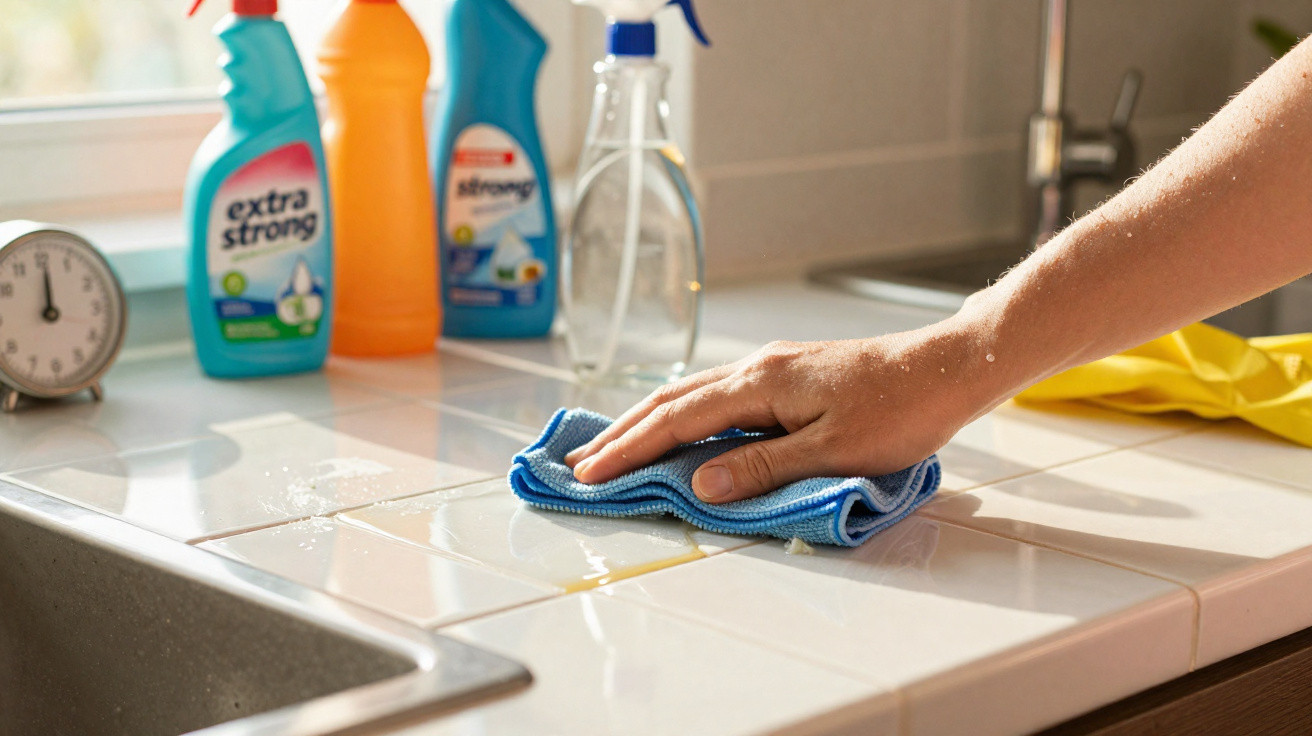
The bottle claims a “99.9%” clean. Its label gleams, and the liquid has the scent of a hotel reception. You spray, wipe and step back. Still, a faint trace of limescale remains in the shower, the greasy layer on the hob returns a few hours later, and that odd bathroom smell never quite goes away.
Most of us turn the blame on ourselves. “I must be doing it wrong, I’m not a cleaning pro.” Then we buy a more powerful product - perhaps two or three. The brands change, but the outcome does not.
One quiet Tuesday evening, I watched a friend clean her kitchen as though she were in an advert. Precise sprays, quick wipes, pristine white paper towels. When the light changed ten minutes later, every streak became visible. She looked at the worktop with the bottle still in her hand and said: “So… what are these things actually doing?”
The reality is rather different from what the labels imply.
Why your “power” cleaner isn’t as powerful as you think
Begin with the detail that nearly everyone overlooks: the small print on the reverse of the bottle. It is in these tiny directions - covering “contact time”, dilution and suitable surface types - that the less obvious truth appears. Many cleaning products achieve their stated results only when the surface remains visibly wet for several minutes, occasionally as long as 10. Most people wipe it away after 20 seconds.
The liquid may smell sharp and fresh, while the foam looks convincing. Yet the chemistry has not had enough time to do its job. It feels as if the cleaner has failed, but you have simply used it as people generally do in everyday life: quickly, while distracted, between emails or after supper.
Supermarket shelves are packed with bottles promising hospital-level disinfection. In ordinary kitchens and bathrooms, however, cleaners rarely receive the conditions required for those claims. A 2022 UK survey found that fewer than 15% of users left disinfectant on surfaces for the advised length of time. Most allowed less than a minute. That leaves a considerable distance between laboratory conditions and your sitting room.
Take limescale removers as an example. Television adverts show them “dissolving” stubborn deposits within seconds. At home, you spray the shower, wait briefly, scrub and sigh. Genuine limescale may have formed over years, accumulating layer upon layer. Expecting one rapid spray to remove it is rather like throwing water over a concrete wall and waiting for it to melt.
There is a psychological trap too: the satisfaction of an immediate visual effect. Products are made to foam, shine or release fragrance straight away. When you see “kills 99.9% of bacteria”, your mind connects that claim to what you instantly see and smell. In laboratory testing, though, the statement normally depends on particular circumstances: surfaces cleaned first, no substantial dirt, an exact temperature and a lengthy contact time. A kitchen table after children’s homework and dinner is not a sterile laboratory plate.
Under ideal conditions, then, the product does “work”. In a typical home, where it is used rapidly and often over older grime, it works less effectively than anticipated. Disappointment grows in precisely that gap between advertising promises and daily use.
Small tweaks that suddenly make your cleaning products actually work
One straightforward habit can make a substantial difference: leave products in place. Rather than treating cleaners as instant erasers, see them as tools that “soak and lift”. Spray the bathroom before brushing your teeth. Wet the greasy hob, then unload the dishwasher. Allow the molecules time to break down what you want to remove instead of demanding an immediate miracle.
For limescale, apply the product generously to a dry surface and leave it for 10–15 minutes. On greasy areas, use hot water on the cloth or sponge so the cleaner spreads more easily and the fat begins to soften. With disinfectants, check the contact time once and use it as an approximate target. It is not about perfection, only waiting “longer than I usually wait”.
You do not need to scrub harder. You need to wait longer.
Most people are not “bad at cleaning”. Their routine is simply a little misguided. We are taught to equate cleaning with visible exertion: vigorous scrubbing, rapid rubbing and using more product than necessary. In truth, it is more like cooking: combine the ingredients, then let them simmer. If you take the pan off the heat after 30 seconds, you would not blame the recipe.
Let’s be honest: nobody genuinely does this every day. No one stands in the bathroom holding a timer while they count seven minutes of disinfectant contact time. We are tired, we take shortcuts and we want the task finished. We have all had that moment of giving a surface one final hurried wipe just before a guest arrives.
The answer is not to become a cleaning robot. Instead, build contact time into periods when you are already occupied. Spray first and wipe later. Let the chemistry get on with its work in the background of daily life.
“Most cleaning products don’t underperform. They’re just being asked to run a marathon in the time it takes to tie their shoes.”
This minor change can also mean using less product while getting improved results. Rather than applying three separate cleaners to the same mark, choose one, use it properly and allow it to work. Your budget - and your lungs - will benefit.
- Apply or spray the product, then leave it for a few minutes.
- Use hot water on greasy surfaces and cold water on protein stains.
- Begin with the dirtiest spot, giving it longer to soak.
- Wipe using a clean cloth rather than one already loaded with old grime.
- Rinse surfaces or ventilate the room when labels refer to strong chemicals or fragrances.
The quiet reasons some messes never truly disappear
The feeling that something is “still a bit dirty” is often caused by things you cannot see. Old grime can become lodged in minute scratches in plastic or inexpensive worktops. Soap scum combines with body oils to create a stubborn film. Product residue can build up in layers, leaving surfaces looking dull even immediately after cleaning.
Other problems are structural rather than merely surface-level. Poor bathroom ventilation allows humidity to linger, encouraging mould and odours to return. A kitchen extractor that performs poorly distributes fine grease over cupboards, where it gradually settles and oxidises. No spray alone can resolve inadequate airflow or years of microscopic build-up.
There can also be a mismatch between the cleaner and the task. Acid-based products are excellent for limescale but may do nothing for baked-on fat. Alkaline degreasers deal with kitchen grease but cannot shift mineral deposits. Fragranced sprays may make the air seem fresher without removing the bacteria or mould responsible for the smell.
Many people rely on one favourite multi-purpose cleaner for every task. It certainly makes life easier, but it also leaves some jobs without the treatment they actually require. The cleaner appears ineffective, when the real issue is that it is the wrong tool for the job.
You do not need a cupboard containing 20 specialist bottles. A modest, sensible selection is far more useful: one effective degreaser, one limescale remover, one mild all-purpose cleaner and one straightforward disinfectant for when it is needed. When you pair the product with the problem, the promise on the label begins to resemble real life.
Sometimes, too, the most difficult fact is that what looks like “dirt” is really damage. It may be yellowed plastic, scratched enamel or dark grout that was never properly sealed. A cleaner cannot reverse time. It can only uncover the genuine condition of the material beneath the build-up. That can feel like a failure - when it is actually clarity.
The next time you face a shelf of brightly coloured bottles, you may view them in a new way. They are not magical fixes, but tools that require the right conditions: time, an appropriate target and a suitable surface. Less brute force, more strategy. More honesty about what can be restored and what has already gone.
There is an unexpected sense of relief in that. Once you no longer demand miracles from a spray, small improvements seem more meaningful. You stop furiously scrubbing stains that are actually scars. You spend less, breathe more easily and may even feel slightly less guilty that your home does not look like a catalogue.
Perhaps that is the real change: not pursuing “perfectly clean”, but understanding how clean actually works. The bottles will remain the same, and the labels will continue to shout. Yet during your next quiet Tuesday-night cleaning session, you will know what is really happening between the spray and the wipe.
| Key point | Detail | Benefit for the reader |
|---|---|---|
| Contact time | Products need to remain on the surface for several minutes to work fully. | Adjust your routine without extra effort for visible results. |
| Product versus problem | Acids are for limescale, alkaline products for grease, and multi-purpose cleaners for light maintenance. | Avoid unnecessary purchases and repeated disappointment. |
| Real limitations | Some “mess” is actually damage, or the result of ventilation and material issues. | Less guilt, more realistic expectations and calmer choices. |
FAQ:
- Do cleaning sprays really kill 99.9% of bacteria at home? Only when you use them under the same conditions as laboratory tests: a pre-cleaned surface, sufficient contact time and the correct dose. In quick everyday use, that figure is more theoretical than real.
- Why does limescale stay even after strong products? Older limescale is often present in thick layers and mixed with soap and dirt. It needs time to work, sometimes several applications and, on occasion, gentle mechanical scraping with a suitable tool.
- Is mixing different cleaning products more effective? No, and it can be dangerous. Mixing certain products - bleach and acid, for example - can release toxic gases. It is better to use one product suited to the problem and leave it to work.
- Why does my home still smell “off” after cleaning? Synthetic fragrances can mask odours without always addressing their source: moisture, mould, saturated fabrics or dirty traps. You may need to tackle the cause through ventilation, washing fabrics or cleaning drains.
- How many cleaning products do I really need? Fewer than you might think. A good degreaser, a limescale remover, a gentle multi-surface cleaner and, where needed, a simple disinfectant will cover most everyday situations.
Comments
No comments yet. Be the first to comment!
Leave a Comment