
The odour reached her before the door was even open: a dense, stale blend of fried onions, wet dog and the previous week’s rubbish, somehow embedded in the curtains like an unwelcome memory. Emma stopped in the hall, holding Febreze in one hand and supermarket deodorising spray in the other, feeling slightly sick and deeply embarrassed. Her friends would arrive in an hour. There was no time for a full clean, no budget for costly diffusers, and no chance she would allow anyone to smell… this.
She had already sprayed the room twice. All it achieved was air that felt more oppressive: perfumed, yet still dirty.
Then she remembered her grandmother’s old-fashioned advice, involving the least exciting item in her kitchen cupboard.
Out of pure desperation, she gave it a go.
Within five minutes, everything had changed.
The unglamorous hero hiding in your cupboard
Put simply, the inexpensive household staple that puts chemical odour removers to shame is ordinary baking soda. Not a fragranced alternative, nor an “odor control” product costing three times as much. Just the little dusty box usually forgotten at the back of the cupboard.
There is something faintly ridiculous about seeing this powdery substance succeed where shiny, brightly coloured sprays fail. Scatter it, leave it alone and, gradually, the room no longer smells of damp socks and yesterday’s garlic pasta. It will not turn your home into a vanilla-scented spa. Instead, it smells… of nothing. Fresh, quiet nothingness.
Consider Marta, 32, living in a cramped studio with a cat that acts like a teenager and a fridge older than her relationship. For months, she spent a sizeable part of her food budget on branded odour absorbers and aerosol sprays. Yet her rubbish announced itself from the hallway, while the fridge retained an old-cheese smell despite weekly clear-outs.
Eventually, fed up, she tested her aunt’s “peasant trick”: one bowl of baking soda in the fridge, another beside the litter tray, plus a generous dusting across the carpet before vacuuming. Two days later, her boyfriend came in and asked whether she had replaced the fridge. It was the same fridge. The same cat. But the air was different.
Baking soda does not conceal odours. It interacts with the acids and bases responsible for unpleasant smells, neutralising them. While chemical spray layers perfume over the issue, baking soda quietly breaks it down molecule by molecule.
Most aerosols resemble spraying deodorant onto a sweaty T-shirt: nobody is fooled for long. Baking soda simply sits there, affordable and patient, taking in odours without fuss or an overpowering artificial fragrance. That’s why one 50p box often does more real work than an entire cupboard of perfumed promises.
How to use baking soda like a quiet cleaning pro
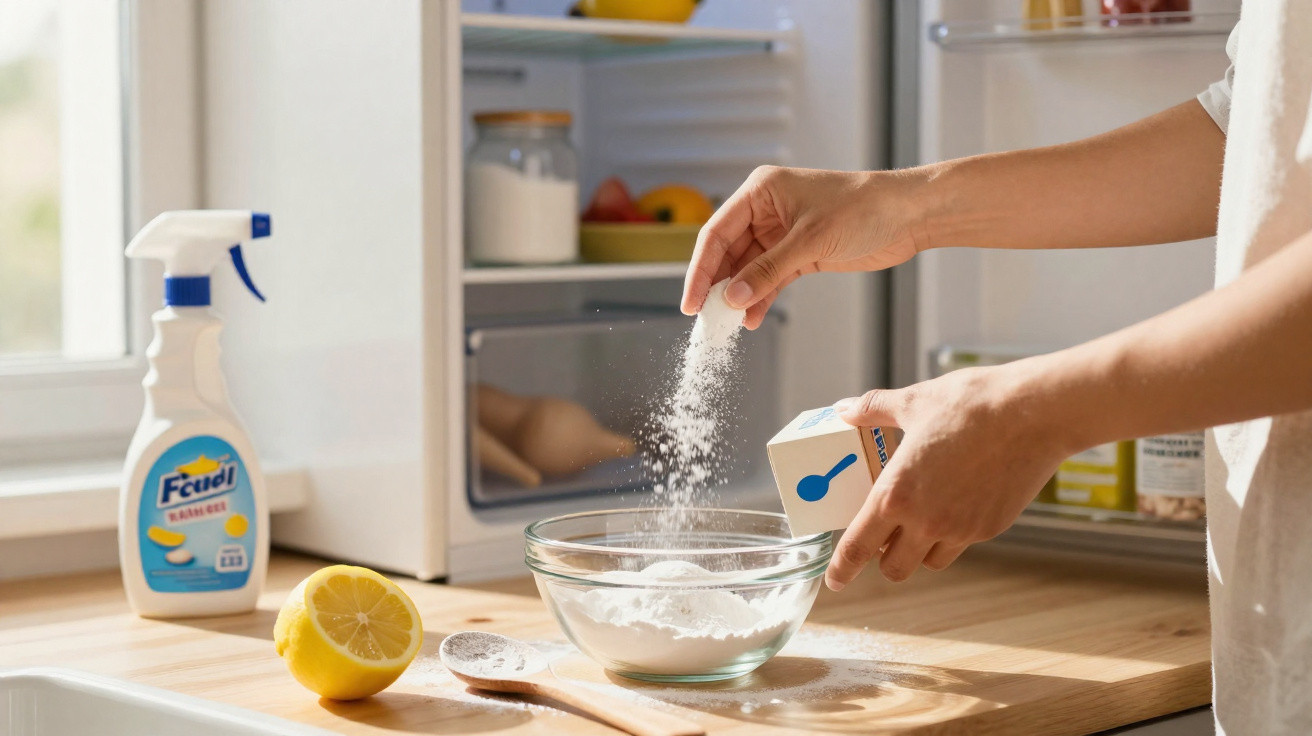
The most straightforward method is almost too easy: open a box of baking soda and put it wherever the odour originates. In the fridge, place it uncovered on a shelf; there is no need for a lid or special container. For household waste, scatter a layer into the bottom of the bin, then add a pinch over especially pungent leftovers.
For soft furnishings, it becomes even more useful. Sprinkle a light layer of baking soda over carpets, sofas, mattresses and even inside shoes. Leave it in place for at least 30 minutes, or longer for stubborn smells, then vacuum carefully. You will not be left with a “fresh meadow” fragrance. What you get is no lingering funk, which is far better.
People commonly make two mistakes: using far too little or expecting an instant result within five seconds. Odours need time to settle into materials, and neutralising them also takes time. Think in terms of hours rather than minutes, particularly for smoke or old cooking odours absorbed into fabrics.
Another frequent mistake is combining every granny remedy at once. Vinegar, essential oils, baking soda and boiled orange peel can easily create a chaotic mix of clashing scents and incomplete chemistry. Honestly, nobody keeps that up every day. The aim is a simple approach you can repeat, rather than a routine that feels like preparing for a science fair.
“Once I stopped spraying and started absorbing, my house didn’t smell like ‘lavender lemon forest’. It just stopped smelling like yesterday’s life,” laughs Julien, a smoker who used to douse his living room in air freshener before dates.
- Leave an open box in the fridge
Keep it there for 1–3 months before replacing it. No scrubbing or perfume is required, just neutral air. - Dust fabrics with it
Use it on carpets, rugs, sofas and dog beds. Allow it to sit, then vacuum slowly for a more thorough clean. - Treat shoes and sports bags
Put a spoonful into each shoe overnight and a handful into a gym bag. Shake it out or vacuum it away in the morning. - Freshen the bin and recycling area
Sprinkle it across the bin base and inside the lid. Add another pinch each time you change the bag. - Revive the wardrobe
A small open jar on a shelf prevents that “closed for months” smell from taking over your clothes.
Why this boring white powder feels quietly radical
There is something almost rebellious about dealing with a modern household problem using a product cheaper than a coffee, one that does not shout from a colourful advert. We are surrounded by scented candles, plug-ins, sprays, gels, sticks and beads: shelves full of promises that your house will smell like a pine forest or a Balinese spa, provided you continue buying them.
Baking soda offers no fantasy. It simply removes the traces of everyday life for long enough to let you breathe.
We all know the feeling: opening the front door and discreetly checking the air, hoping your home does not reveal precisely what you cooked, spilled or forgot about three days earlier. Smell is personal. It exposes routines, pets, laziness and stress. Nobody wants to feel judged by the scent of their hallway.
That is why this small box feels surprisingly reassuring. It does not mind whether the washing-up was delayed, your dog rolled in dubious mud or the fridge became home to a forgotten Tupperware offence. It quietly clears the slate, allowing you to begin the following day without yesterday’s odours lingering around.
Using baking soda can also encourage a subtle change in perspective. Rather than disguising problems, you start neutralising them. Instead of pursuing ever more powerful perfumes, you accept a straightforward truth: clean does not smell of strawberry or pine; usually, clean smells of nothing.
This simple realisation often lands when you return home after being out all day and notice that nothing hits your nose. No artificial ocean breeze. No “chemical flowers”. Just light, neutral air that does not compete with your cooking, coffee or perfume. Without fanfare, the cheapest item on your shelf has outperformed a whole industry of glittering bottles.
| Key point | Detail | Value for the reader |
|---|---|---|
| Neutralises, rather than masks | Baking soda reacts with acids and bases that cause odours, rather than covering them with perfume | A cleaner, more naturally smelling home without heavy fragrances |
| Ultra-low cost, multi-use | A single box can deodorise the fridge, carpets, shoes, bin and wardrobes | Saves money compared with buying multiple branded odour products |
| Simple, low-effort routine | Sprinkle, leave it in place, vacuum, or replace it every few months | An easy habit to maintain, even when life is busy |
FAQ:
- Question 1: How often should I replace the box of baking soda in my fridge?
- Question 2: Can I use the same baking soda for cleaning and cooking?
- Question 3: Does baking soda work on cigarette or vape smells?
- Question 4: Is it safe around pets and kids?
- Question 5: What if the smell is still there after one use?



Comments
No comments yet. Be the first to comment!
Leave a Comment